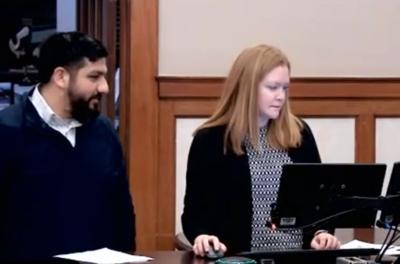
Sergio Garcia, development director, and Karen Long, executive director, both of Mid-Columbia Housing Authority (MCHA) and Columbia Gorge Housing Authority (CGHA), present at the Jan. 26 Hood River City Council meeting.
Sergio Garcia, development director, and Karen Long, executive director, both of Mid-Columbia Housing Authority (MCHA) and Columbia Gorge Housing Authority (CGHA), present at the Jan. 26 Hood River City Council meeting.
HOOD RIVER — Karen Long, executive director, and Sergio Garcia, development director, both of Mid-Columbia Housing Authority (MCHA) and Columbia Gorge Housing Authority (CGHA), provided an update on how the agencies work together to promote affordable housing in the Gorge at Hood River City Council’s Jan. 26 meeting.
MCHA and CGHA work together to address housing needs of low-income households in Hood River, Wasco, Sherman, Klickitat and Skamania counties, Long said. Its main program is the Housing Choice Voucher Program, which provides approximately $750,000 in rental assistance payments each month to private landlords on behalf of around 900 households in the five-county area. A third of those households are elderly, another third disabled, and the remaining third families with children, she said.
Households pay 30% of their income for rent and utilities, and the housing authority makes payments directly to the landlord. For Hood River landlords, that’s about $85,000.
“In Hood River, we serve about 95 households out of 900, which is not proportionate, given the five-county region,” she said. “I don’t need to tell you all that the rent prices here are really high and our voucher holders have a really hard time being able to use their vouchers here, so we see a lot of people who are from Hood River who have to move elsewhere to find an affordable place to live with their voucher.”
Council President Gladys Rivera asked why there are so few households receiving rental assistance in Hood River. “Is it that our rents are too high here in Hood River? I’d like to better understand the 95.”
“I think that it’s a variety of reasons,” Long said. “First is that the rents are too high and there just aren’t enough affordable units. I think also Hood River is one of the most desirable places to live in the Gorge, and that means that when a unit does become available, it’s really competitive. A lot of times, people can show up, and a landlord wants first and last deposit, and if you can show up with a $5-6,000 check and say, ‘I can move in today,’ a landlord is more likely to pick that person over someone who says, ‘I have a voucher and I have to have an inspection and I can get you the deposit next week.’”
The feasibility phase can take anywhere from 6 months to several years, he said. This is when a site is identified and evaluated, and funding sources secured. Next comes pre-development — which can take another 1-2 years — when the design is finished, permits are obtained, and funding closed. Construction can take another 1-2 years before the units are leased — 6 months to a year.
“There’s often a critique that affordable housing is not affordable to build, and that isn’t intentional on our end,” Garcia said. “We try to bring the cost down as much as we can while also operating as an organization and ensuring that the project succeeds financially.”
One factor contributing to the cost includes construction and material costs rising while feasibility and pre-development phases are completed.
“Multifamily has significantly a lot more due diligence requirements than single family housing, including the fact that our buildings are often a lot larger and have larger site footprints that trigger more extensive environmental review,” he added.
The sites also tend to be more challenging, given land availability, zoning, slope, wetlands, and infrastructure limitations resulting in higher preparation costs and additional engineering before construction can begin. The buildings themselves are held to standards that exceed base building code, which also increases costs.
“Local participation plays a critical role in ensuring that these projects are competitive and financially feasible,” Garcia said.



Commented