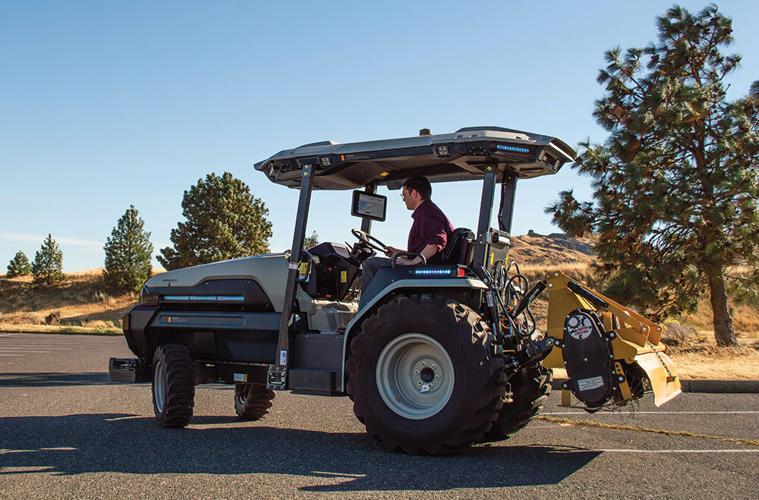
Rural Energy Coordinator Joshua Dishman, Lake County Resources Initiative, drives the Monarch MK-V electric tractor as the second day of Sustainable Northwest’s annual Fall Energy Symposium ends on Sept. 19. The American-made tractor, one of three electric farming vehicles available to test out, has 70 horsepower, autonomous abilities and costs $88,998.
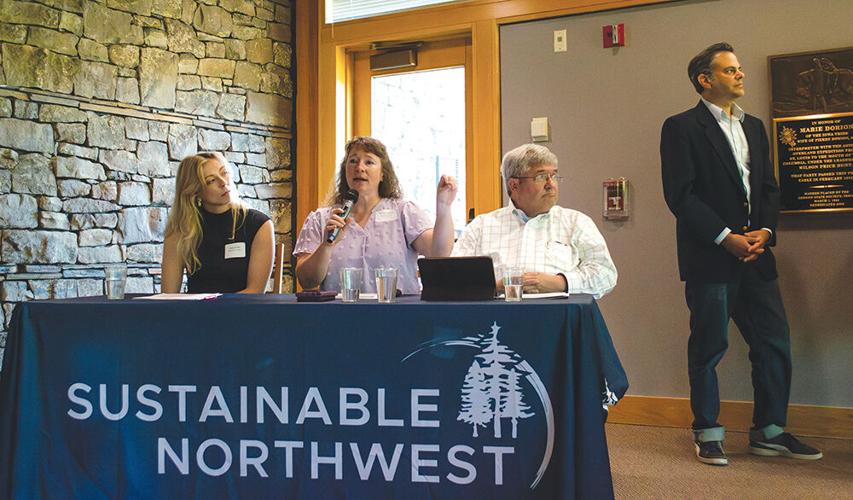
From left to right, Emily Griffith, Michelle Manary and David Brown unpack the barriers to approving renewable energy projects and enhancing Oregon’s transmission capacity during the second panel of Sustainable Northwest’s symposium, moderated by Joshua Basofin.
Rural Energy Coordinator Joshua Dishman, Lake County Resources Initiative, drives the Monarch MK-V electric tractor as the second day of Sustainable Northwest’s annual Fall Energy Symposium ends on Sept. 19. The American-made tractor, one of three electric farming vehicles available to test out, has 70 horsepower, autonomous abilities and costs $88,998.
THE DALLES — Dozens of clean energy leaders gathered at the Columbia Gorge Discovery Center two weeks ago for Sustainable Northwest’s ninth annual Fall Energy Symposium, a three-day event designed to facilitate a renewable transition across rural Oregon.
After touring The Dalles Dam and green improvements in Wasco County’s Dufur School District the previous day, participants listened to four different panels on Sept. 19: the legacy of Columbia Gorge hydropower, managing regional transmission capacity, the importance of community energy resilience and nearby electrification projects. The panels and conversations that followed came at a critical juncture in Oregon’s clean energy future.
As previously reported by Columbia Gorge News, electricity demand in the Northwest, Idaho, Montana, Oregon and Washington will top 33,000 megawatts (MW) in 2033 — a 30% increase from current usage (23,700 MW) that’s far higher than previous estimates. Data center development, high-tech manufacturing growth and rapid electrification are driving this increase.
But the main issue isn’t with demand, it’s too much supply and too little infrastructure. The Bonneville Power Administration (BPA), which manages 75% of the Northwest’s transmission lines, is buried under a mountain of renewable project applications and is struggling to expand the transmission capacity that developers are calling for.
“We have developers promoting projects that are a multiple of the number of projects that we actually will need and that will ever actually get built,” said David Brown, the founder of Obsidian Renewables. “We have this enormous process underway that’s very expensive — that will cause everything to slow way down — and most of the work will turn out to be irrelevant.”
By federal law, the BPA must study and review each renewable project application it receives. According to Michelle Manary, BPA’s vice president of transmission marketing and sales, renewable projects vying to connect with the agency’s electric grid, held in what’s called the generation queue, represent 209 gigawatts of potential energy. That’s 20 times more energy than what’s needed to satisfy the Northwest’s projected electricity demand.
From left to right, Emily Griffith, Michelle Manary and David Brown unpack the barriers to approving renewable energy projects and enhancing Oregon’s transmission capacity during the second panel of Sustainable Northwest’s symposium, moderated by Joshua Basofin.
The BPA is currently reforming how they process the generation queue, Manary said, grouping applications in clusters rather than reviewing each individually, to speed it up. Absent reform, she said it would’ve taken the BPA until 2035 just to see every request.
More clean energy is inevitably coming; however, that requires more transmission capacity, which is another barrier.
“We have been blessed that we had a very robust transmission system, a very robust generation system, and that has carried us through for a number of years. It’s now stressed,” said Manary. “It won’t do anymore.”
Siting and permitting new transmission lines is time-consuming, expensive and potentially litigious. Take for example the project from Hemingway, Idaho, to Boardman, Oregon, a 290-mile, 500-kilovolt transmission line that’s been stuck in approval processes and the court system for 17 years. Panelist Emily Griffith, Oregon’s policy manager for Renewable Northwest, highlighted possible solutions.
According to Griffith, around 40% of the Northwest’s electric grid is suited for reconductoring, essentially replacing existing lines with ones that have higher capacity, which she said is half the cost and time it takes to build entirely new transmission lines. She also proposed establishing a statewide transmission authority focused on funding new transmission projects, emphasizing that running lines along existing structures, like highways, is efficient.
“We know that using your existing structures, your existing right-of-ways, is the low-hanging fruit,” said Manary. “Try not to touch dirt” is the BPA’s transmission mantra.
Having addressed regional problems, the third panel focused on building small-scale energy resilience by highlighting different microgrid projects , local, self-contained energy systems designed to operate independent of the broader electric grid, or in coordination with it. Renewable microgrids can help rural communities recover from wildfires or earthquakes faster, reduce the strain on an already-taxed electric grids and save them money since fossil fuels are usually more expensive.
Lindsay McClure, energy and projects manager, talked about three microgrid projects that the Mid-Columbia Economic Development District has in the works as part of Hood River County’s Energy Plan. They include installing solar panels at Mount Hood Town Hall, Cascade Locks’ Town Hall and Wy’east Middle School, along with providing electric school buses.
“The energy plan envisions a future with good local jobs; clean energy; safe, comfortable and healthy buildings, and a community that’s prepared for long-term power outages that may result from natural or human-caused disasters,” said McClure.
The symposium’s second day finished with a short speech from Robert Wallace, the executive director of Wy’East Resource Conservation and Development, their E-Farms program. Wallace talked about three different electric farming vehicles, including the Monarch MK-V tractor, and earlier noted the divide between urban and rural areas when it comes to accessing new technology.
“E-Farms is our effort to evaluate and accelerate the adoption of clean technology on the farm, especially around electric heavy equipment,” said Wallace. “A lot of times [farmers] are the last people to see this technology.”
While Wallace acknowledged that many farmers are skeptical, he noted that the Monarch tractor provides a 90% reduction in both emissions and fuel costs, and is readily suited for work in vineyards or orchards.




Commented