
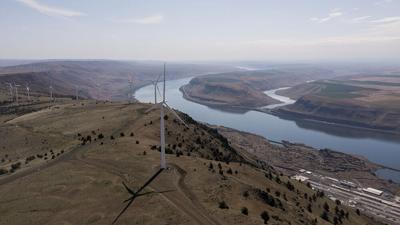

THE GORGE — The Federal Energy Regulatory Commission (FERC) licensed Goldendale’s Energy Storage Project on Jan. 22 over the objections of 17 tribal governments led by the Yakama Nation — which was excluded from signing the agreement that allows development to proceed on an site with both religious and cultural importance, otherwise known as Pushpum.
“If construction begins, there’s no way to save this sacred site,” said Simone Anter, senior staff attorney at Columbia Riverkeeper. “We’re talking about two massive reservoirs and then blasting through the mountain, through this sacred mountain with a conveyance tunnel.”
FERC’s final analysis of the project’s environmental impacts is incomplete, according to Columbia Riverkeeper. As required by the National Historic Preservation Act, FERC also had to identify adequate mitigation through a Programmatic Agreement with key stakeholders, a process that the nonprofit argues was manipulated to exclude or minimize tribal concerns.
And now, without its signature on the document, the Yakama Nation doesn’t have standing to enforce whatever mitigation occurs, among other issues in the years-long approval process previously documented by Columbia Gorge News.
“All of the burdens are placed on the Yakama Nation for this project,” Anter said. “And so, when that’s the case, projects like these are often seen as a win for everyone else.”
There’s a 30-day period to file an appeal with FERC for a rehearing, after which Columbia Riverkeeper can take legal action. The Army Corps of Engineers will handle its own consultation process with Yakama Nation and three other impacted tribes from the area to satisfy permitting requirements under the Clean Water Act.
“We understand the value and importance of consultation with tribal nations,” said Erik Steimle, who’s leading the project for Rye Development. “It’s certainly important for tribal nations to be heard in this process ... Before we even submitted the application to the commission, we communicated with tribal nations to try and understand and address their concerns.
“The FERC licensing process is one of the most rigorous and lengthy permitting processes for any type of energy project, and the Goldendale project met these requirements,” he continued. “Now that the license is issued, we do look forward to working with tribal governments to finalize the historic properties management plan to ensure protection of the cultural resources of importance to them.”
The largest and most expensive pumped storage project in Washington state would be located at the John Day Dam, with two reservoirs — one atop the ridge at Pushpum — a tunnel blasted out between them, and underground substation infrastructure. It would generate energy by allowing water 2.3 billion gallons of water to drop 2,000 feet to rush on command, producing enough electricity to power an estimated 500,000 homes for 12 hours.
All the major state permits and environmental clearances were done in 2023, including two environmental impact statements that said the project would destroy archaeological sites and traditional cultural properties.
FERC gave Rye, backed by Copenhagen Infrastructure partners, two years to begin construction, a process that the company expects to generate 3,000 jobs. It would be the first major pumped storage project in Washington, and the first new one nationally in about 30 years, Steimle said.
The owner of the private brownfield site — a former aluminum plant — where much construction would take place, is also seeking to redevelop the rest of this site. So the Goldendale proposal may not be the last big construction on this industrial-zoned property.
“There’s a lot of potential development on this land, not just at the aluminum smelter site, but of course, in the location of the upper reservoir,” Steimle said.
In a press release, the Yakama Nation and Tribal Council Chairman Gerald Lewis blasted FERC’s decision.
“Project developers have benefited from Trump-era rollbacks of federal clean water act protections and pulling-out of discussions with the state Department of Archaeology and Historic Preservation on destructive impacts to traditional cultural properties,” Yakama Nation’s press release read. “Corporate investors have contracted with local municipalities and unions to pay for some developmental impacts, but continue to ignore and downplay the harm identified by Yakama Nation,” said the press release.
“They know it’s wrong, if a small Christian shrine sat on this site the decision-makers would understand what ‘sacred’ means,” said Lewis. “During his last days in office, Governor Inslee encouraged FERC to consider damage costs of $25 million but developers rejected all specific commitments and hope to keep building the energy grid on still more sacrifices to the Yakama way of life.”
Anter emphasized that tribal nations are simultaneously fighting against fossil fuel development, advocating for climate legislation at the state level, proposing their own green energy solutions and pushing back development on their ancestral territory, all at the same time. They’re leading green energy — but opposing the destruction of this particular site.
“It really isn’t green energy if it’s destroying tribal cultural resources,” she said.
The Goldendale project was granted a faster licensing process by the state legislature in 2018-19, and expedited review at the federal level through FERC.
The permitting process made clear to Anter that “You cannot mitigate for the destruction of a sacred site. You you can’t go buy different lands and say, ‘Here, this replaces the sacred site that is going to be destroyed by this development.’
“And I think there’s a deep misunderstanding of what sacred sites are and what cultural religious resources are.” Sacred sites are irreplaceable: “It’s not something you can rebuild.”


Commented
Sorry, there are no recent results for popular commented articles.