
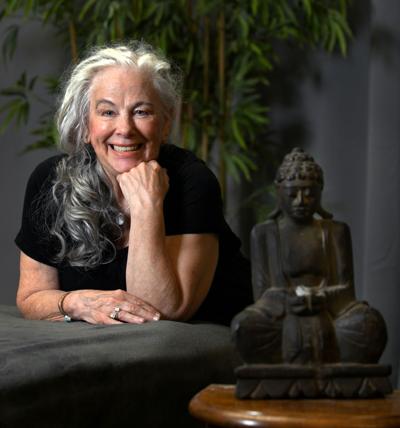
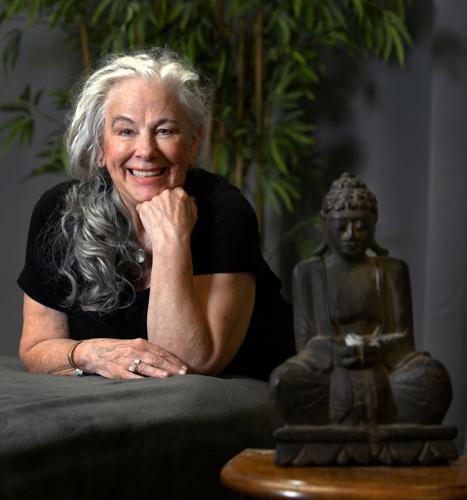
Linda is 79 years old, although she prefers to tell people she is “going on 80.” She is not retired.
She is not tired. And she is certainly not old.
“I’ll work until I get old,” she says. “When I was young, I had an old soul. Now that I’m old, I have a young soul.”
Her young soul has carried her through more than five decades of massage therapy, reflexology, teaching, motherhood, travel, and more than one room filled with people who were not quite sure what to make of her.
Today, massage studios, yoga classes, and wellness centers can be found throughout the Gorge. But when Linda arrived in Hood River in the 1970s, the idea of using touch to help the body heal was unfamiliar enough to frighten people.
When Linda was a young woman in Fair Oaks, California, she and her girlfriends began gathering at a place called the Village Sauna. They went to relax, gossip, and, in Linda’s words, “change the world.”
The center had been created by a woman, Linda, now describes as a visionary. This was decades before holistic wellness became part of our cultural vocabulary, but this center welcomed yoga, meditation, strength training, skincare, and different forms of bodywork. People could even bring their animals to the yoga class.
“She was probably 50 or 60 years ahead of her time,” Linda says.
One day, while Linda and her friends were talking in the sauna, Linda mentioned that she had been experiencing an intestinal problem. An older woman overheard her and approached her; she believed she could help by working on the reflexes in Linda’s feet. “I thought she was just a little bit of a nutcase,” she admits. “I didn’t see the connection because I knew nothing.”
“This works despite yourself,” she told her. “You don’t have to believe in it.”
Linda decided she had nothing to lose. Within 20 minutes, the problem was gone. “That changed it for me in a heartbeat.”
Linda immediately approached the center’s owner and asked if she could learn. There were few formal massage schools in the country at the time, so training often happened through mentorship and hands-on practice. At first, her mentor told her there was no room. Then, about a month later, the telephone rang.
“Are you sincere about learning?” the woman asked. “Get down here right now.”
Not long after, Linda came to Hood River for a Thanksgiving dinner. “I didn’t even know where Oregon was,” she laughs. “It was north somewhere. Everything was north of California.”
When Linda arrived, snow had recently fallen, dusting the ground and making the little farming town feel like something from a storybook. She stepped into the snow, looked around, and knew she was moving to Hood River.
“I just fell in love,” she says. “I thought, ‘I’ll do whatever it takes.’”
She opened her practice in Hood River around 1976. She never advertised; people just began talking, and she became busy. But not everyone welcomed her or her new business.
Massage therapy was so unfamiliar that some people were suspicious of what Linda was doing. One established member of the community reportedly questioned whether she was operating legally. While Linda was away one day, authorities entered her new studio, damaged the door, and confiscated her belongings.
“In any field you get into, you can either compete or you can be a team player. You can support each other. And I came from support. I came from a place where everyone is valued. I had this instilled. I came up here, and this person was trying to burn me up and get me out of town. Like, 'She's not legal. Who knows what she is?'"
Linda was summoned to meet with the district attorney. She had never been in trouble before. Now she was sitting across from a man with a folder containing information about her, being asked to explain exactly who she was and what she was doing in Hood River.
“If you have a body, I can help you,” she remembers telling him. “You need me.” The district attorney listened. Her belongings were returned, and Linda was permitted to continue her work.
News of the controversy traveled through town. A local radio host invited Linda onto a live morning show, telling her that if she wanted people to understand massage therapy, she would have to educate them. The interview did exactly what it needed to do. People became curious. Local leaders and politicians began visiting Linda for treatments. Linda met each one with the same invitation: show up, and let’s see what we can do.
“I didn’t know if I could help them,” she says. “But they would say, ‘Well, let’s find out.’ That became my bedrock.”
Years later, Linda moved to The Dalles with her husband and their two young children. Her husband’s work with grapes eventually became the founder of The Pines vineyard and tasting room, but Linda remained, as someone once described her, ’very much her own woman.’
Once again, however, people became uneasy about what they did not understand. Although she saw only a few clients each day, a petition was circulated alleging that her practice was creating traffic and making the neighborhood unsafe. Linda was summoned before The Dalles City Council.
Two hours before the meeting, her telephone rang. The caller refused to give a name. “Do not come alone,” the voice warned. “You are not safe. It is a witch burning.”
Then the caller hung up.
"I called three women who were clients of mine, and they were pillars in this community. I said, 'Can you show up at City Hall in two hours?' And they said, 'We're dropping everything, and we will meet you there.'"
Together, the four women walked into a meeting so crowded it was standing room only. Linda could feel the tension as she took her place near the front. Many of those filling the room had signed the petition against her.
Her three friends spoke first, telling the council what Linda had done for them. They described the relief they had experienced and the ways her work had improved their lives. “I drew from their strength and their belief,” Linda remembers.
When her turn came, Linda spoke about being a mother, a practitioner, and a member of the community. She explained that she was not harming the neighborhood; she was contributing to it.
The head of the council looked out over the crowded room, swept his finger, pointing at the crowd, “You should be ashamed of yourself for signing a petition to have this woman shut down.” Instead of closing her practice, the city found a way to accommodate it through its zoning rules.
Years afterward, she was assisting a woman in a competition where participants had to keep a hand on a car for as long as possible. The last person touching it would win. Linda was there to help the woman manage swelling, circulation, hydration, and exhaustion.
Throughout the contest, Linda noticed a tall cowboy watching her. Eventually, he asked to speak with her alone. “I thought, ‘Oh my God, he’s going to take me out in the field and kill me,’” she says.
He told Linda that he had been in the City Hall meeting years earlier. He had signed the petition without truly understanding what he was signing or what she did. After watching her care for the woman in the contest, he finally understood. With tears in his eyes, he asked Linda to forgive him.
Her advice to her teenage granddaughter is much the same as the advice she would give anyone standing at the beginning of an unfamiliar path. “Stay curious,” Linda says. “Trust your intuition; it is a form of intelligence.”
Most of all, she believes in doing what you love and loving what you do, because love will become visible in the work. “That is what is going to shine through,” she says. “That is what comes through our hands.”
Linda says women today are harvesting seeds planted by generations before them. She remembers a time when women were expected to remain in the back seat, or perhaps, if they were fortunate, the sidecar. She was never especially interested in either location.
She chose the driver’s seat, or even the unknown, every, single, time. “I think you have to practice believing in yourself,” she says, “even if you don’t have much to go on. You have that glimmer. You have that little spark that everybody has.”
Looking around the Gorge today, with wellness centers, yoga studios, massage therapists, and women leading in every corner of the community, she smiles. "The women are rising up," she says. "They're not taking the back seat or the sidecar anymore."
Although Linda is still working, she is currently not accepting new clients.


Commented