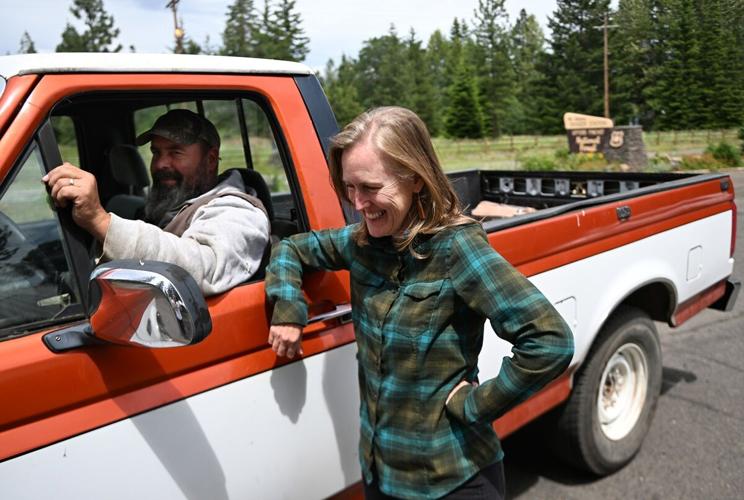
TROUT LAKE, WA: Erin Black, U.S. Forest Service Mt. Adams District Ranger, right, chats with a fellow employee in the parking lot of her ranger station on May 29, 2026, in Trout Lake, Washington. (Photo by Helen H. Richardson)
TROUT LAKE, WA: Erin Black, U.S. Forest Service Mt. Adams District Ranger, right, chats with a fellow employee in the parking lot of her ranger station on May 29, 2026, in Trout Lake, Washington. (Photo by Helen H. Richardson)
There is something wonderfully refreshing about spending time with Erin Black. Ask her about her career, and she'll tell you about the scientists she loves working alongside. Ask about leadership, and she'll start talking about the next generation of employees who have brought fresh ideas and renewed energy into the Forest Service. Mention the forests she helps oversee, and before long, she's telling stories about the families who have spent generations making memories there.
As the Mount Adams District Ranger, Erin oversees nearly 300,000 acres of public land, including campgrounds, trails, wilderness areas, wildlife habitat, timber resources, grazing lands, and fire management operations. She leads teams of foresters, wildlife biologists, recreation specialists, firefighters, fisheries experts, archaeologists, and countless other professionals who work together to care for one of the Pacific Northwest's most treasured landscapes.
But if you ask Erin what the job is really about, her answer has little to do with trees.
It's her ideology of bringing together scientists, community members, county leaders, recreationists, conservation groups, and the timber industry that has made Erin one of the Gorge's most respected leaders. "There's a small part of the job that is actual science and natural resources," she says. "A large part of most of our jobs is working with other people."
While many people picture a district ranger spending every day hiking through the woods wearing the iconic ranger hat, Erin laughs at the image. "The joke is that when you hear 'Ranger,' I must have a hat, right?"
She doesn't. One of her closest friends found out her job didn’t come with the famous ranger hat and had her father surprise Erin with a watercolor painting of one. It now hangs in her office.
Erin earned a bachelor's degree in International Affairs before completing a master's degree in Public Administration. It was here that she realized she wanted to work for the federal government, specifically in natural resource management. As her career goals became clearer, so did her academic focus. She centered many of her research projects on the Endangered Species Act and the National Environmental Policy Act.
Her career path seems almost inevitable because even when Erin was young, she was already drawn to caring for the environment. In high school, she and a group of her friends started an environmental club called EnviroPeace. They would organize litter cleanups and encourage others to take pride in the places they shared.
Erin grew up in north-central Washington during the heated debates surrounding the Northern Spotted Owl. "No one was talking or listening to anyone else. It was very divided."
She witnessed communities becoming divided by disagreements over forests, wildlife, and livelihoods. Because of this, she became fascinated with helping people understand one another. It's one of the many reasons Erin has earned the respect of colleagues and communities alike.
"I think my draw is more around helping manage the conflict around natural resources than the science lens," she explains. "I realized that's where I would add more value."
She doesn't pretend to have all the answers or be the foremost expert in every field. Instead, she chooses to surround herself with talented professionals and specialists, creating an environment where knowledge can thrive and listening is part of the agenda.
"Now I have this whole group of folks that are like, 'I'll take that phone call. I'll see if I can't figure out how to mitigate the effects,” so it's fun right now."
She learned early in her career that most conflict begins to soften when people feel heard. That's why, when someone calls upset, Erin listens for what's beneath the frustration. And because she listens, she hears concerns more clearly. Like someone worried about losing a place that has become part of their family's story. She remembers a specific call from people upset that a forest road had been closed. That road was where a grandfather once took his children, and years later, those children returned with families of their own. Just a generation hoping to pass down the beauty of the land with their loved ones. She feels gratitude for the moments when she has paused to listen and feels they have truly shaped the way she leads.
"If I sit in a room with people," Erin said, "I might start to understand where they're coming from."
Her quiet compassion seems to guide nearly everything she does. You won't hear Erin describe herself as an expert. She is much more likely to brag about the people around her. During our conversation, she spoke with genuine admiration about the scientists she works beside, the firefighters protecting our forests, the young employees bringing new energy into the Forest Service, and the community partners helping accomplish work that no single agency could do alone.
She celebrates other people so naturally that you almost forget how extraordinary her own career has been. As District Ranger for the Mount Adams Ranger District, Erin helps oversee one of the most breathtaking landscapes in the Pacific Northwest. She loves every bit of it because she believes these forests belong to all of us. The child seeing Mount Adams for the first time, the family returning to the same campground every summer, the hiker searching for quiet after a difficult week, and to future generations who deserve to inherit healthy forests long after we're gone.
Erin credits her mother with building her confidence to pursue opportunities. “My mom is a physician, and so she was always pushing me, right? Like, 'Well, when are you gonna go to the leadership position?'"
When 15-year-old Erin discovered she was technically too young to apply for a summer job she desperately wanted, her mother challenged her. "She looked at me, and she said, 'You fill out that application. You make them tell you that you're not qualified.'"
So Erin filled out the application and got the job.
As Erin's career has evolved, she feels her greatest contribution comes from helping people understand. "I love to hang out with scientists," Erin says. "I'm really drawn to scientists in general. I think they're smart, and they usually have this guiding principle. They really want to serve. I've always enjoyed surrounding myself in that world."
"It also has this public aspect," she says. “I could go out to the public, helping them understand where the scientists are coming from and their recommendations."
Outside of work, curiosity follows her. "During the COVID years, I started woodturning. I took a class at the Gorge Makerspace, and I just loved it and kept going back. It's not like I'm artistic in any way, but it gets your mind out of whatever you're stressed about, and it provides a community. We all show up on Sundays. It's just lovely."
Erin and her husband have raised two children with an appreciation for the outdoors. The landscapes she works so hard to protect have also become the backdrop for some of her family's favorite memories.
The forests of the Columbia Gorge will continue to well beyond today's decisions have passed into history. Thanks to leaders like Erin, so will the relationships and communities connected to them. As lovers of the Gorge, if we can remember to choose curiosity over judgment, conversation over conflict, and collaboration over division, together we will help our beautiful land continue to thrive for generations to come.



Commented