
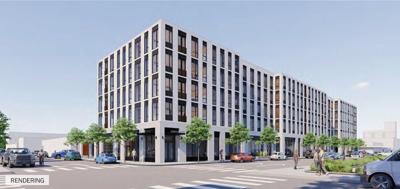
THE DALLES — Wasco County commissioners agreed to buy a downtown parcel for $3.08 million and immediately lease it back to the private developer building the Basalt Commons housing and commercial project on April 1.
County commissioners framed this move as necessary to jump-start a stalled, $31.2 million development they say will add much-needed housing and tax revenue to the city.
The county’s order, adopted unanimously, authorizes acquisition of roughly 0.69 acres at 523 E. Third St. from the developer, TD3RD LLC, and a ground lease that gives the developer a five-year option to repurchase the land for $3.18 million.
If the option is not exercised, the ground lease will continue under terms that include a 35-year lease, an annual net rent of $154,000 (roughly $12,833 a month) with a 3% annual increase.
The development agreement also requires personal guarantees from the developer and gives the county automatic ownership of the project’s improvements if the lease terminates early.
County Administrator Tyler Stone voiced support for the project, saying the investment is intended to stimulate growth downtown and that the lease will “put the county’s money to work.”
“Probably the biggest impact is that it adds additional housing units to the inventory in Wasco County, which, if you look over 20 years, has seen pretty decent growth, but you haven’t seen housing grow at that same kind of rate,” Stone said.
Eight years in the making
In a packet provided to the board, the developer cited a decades-long shortfall in apartment construction in The Dalles, a rental vacancy rate of 1.4% and population growth of 34.7% between 2000-2023.
“We’ve been trying to get this project going for eight years,” said Mary Hanlon, the developer who has led the effort. “This lot has been vacant for 10 years. Building housing downtown brings people, eyes on the street and economic activity for small businesses.”
Hanlon described Basalt Commons as a downtown revitalization project that would diversify housing stock, add commercial space and expand the county’s property tax base.
“This project will immediately bring a huge increase to the tax base,” she told commissioners. “We will be paying back with interest and then some.”
But several downtown business owners and residents urged caution, raising concerns about parking, historic character, and the visual impact of a taller building.
“The design is totally out of place and character,” said Bob McGuire, a longtime furniture store owner on First Street.
“There are other buildings of this height in the downtown core already,” said The Dalles City Manager Matthew Klebes, referencing previous processes and public hearings this project has been through to approve the current height in the design.
“What you guys are thinking about contributing to this program, it’s almost $5 million. That’s a lot of money for a private entity, and I just don’t think that that kind of public money should be spent on one project,” said resident Randy Seufert.
“Our role is really more of investment of our funds in more of a temporary way,” replied Commission Chair Scott Hege, drawing a line between Urban Renewal’s investments in the project and the county’s interest-earning purchase. “Just so it’s clear: we’re not giving any money to anybody.”
Seufert also voiced concerns about parking. “Everybody’s got to have a car to drive, and with 116 units plus businesses on the ground floor, where are they all going to park?” he asked.
Klebes discussed strategies the city is currently considering to address parking needs, citing the new downtown parking plan.
“I’d much rather deal with a parking problem than a ghost town downtown problem or a housing crisis,” he said.
How the deal operates
The county’s chosen structure is a precedented public-private tool authorized in ORS 271.310 and related provisions: the local government purchases the land, leases it to a private developer who builds the improvements, and either sells the site back to the developer later or retains ownership while collecting rent.
Under the terms approved, the county’s protections include an “unsubordinated fee simple ownership” of the land, meaning the county’s ownership sits ahead of any leasehold mortgage the developer might take and an automatic vesting of improvements to the county if the lease ends early.
The county’s order also frames the $154,000 annual rent and a repurchase mechanism as financial safeguards, noting the rent stream and an eventual repurchase option are expected to recover the county’s $3.08 million investment plus accrued rent.
“Using these dollars actually has a better return than what we would be getting in the LGIP rate if we had that money sitting there,” he said, referring to the Local Government Investment Pool.
Growth and changes
Commissioners framed their vote as a deliberative choice between enabling a long-planned development or risking continued vacancy and the loss of potential housing and economic activity.
“If we don’t do it, it’s probably not going to happen. If we do do it, it might happen,” Hege said.
Yet the measure drew critiques from residents who said the county was assuming development risk and potentially ceding oversight to a private partner.
Questions at the hearing about contingencies, whether demolition must occur before purchase, what would happen if construction stalls, and how parking and historic preservation concerns would be addressed, highlighted some anxieties surrounding downtown development.
Urban Renewal board member and former city councilor Darcy Long commented that many of these concerns have already been discussed in Urban Renewal meetings.
“I think people are trying to encourage you to say no to this because they don’t like the overall project,” Long said. “The people who have been working on this, literally for years, we care so much about The Dalles and Wasco County that we are trying to do what’s best and take everyone’s concerns into account. There is no coercion going on here.”
Long ended by sharing about her decision to move back to The Dalles to raise her family after growing up in the town and moving away.
“We used to be a small town when I was growing up,” she said, “but now we’re a big town, and hopefully, I think we’re becoming a small city, and that means changes.”


Commented