
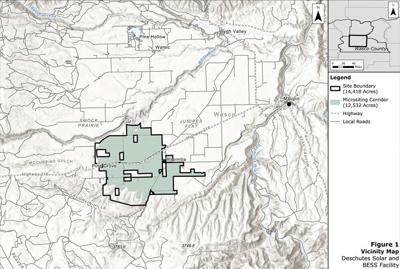
MAUPIN — Wasco County commissioners reviewed an application on March 4 for a proposed 1,000-megawatt solar and battery storage project near Maupin, as residents warned the development could reshape the agricultural landscape, strain local resources and threaten safety in wildfire-prone terrain.
The hearing centered on the Deschutes Solar and Battery Energy Storage System (BESS) facility, a roughly 14,000-acre proposal located about 7.5 miles southwest of Maupin, largely on land zoned for exclusive farm use.
County planners emphasized that the proceeding was not a final decision, but part of a state-led siting process in which Wasco County serves in an advisory role to the Oregon Department of Energy.
“This is not the final time that the public or other agencies will get an opportunity to actually provide comment,” Planning Director Daniel Dougherty said, describing the current phase as a general evaluation of the developer’s application.
Large-scale proposal in agricultural zone
The project would generate up to 1,000 megawatts of electricity, paired with a battery storage system capable of four hours of output, and include transmission infrastructure connecting to the regional grid.
Roughly 99% of the site lies within the county’s Exclusive Farm Use zone, where the stated purpose is “to preserve and maintain agricultural lands for farm use.”
That mismatch formed a central tension in the hearing.
“Conditional use permits are generally required when the proposed use doesn’t conform with the purpose of the zone,” Dougherty explained, noting that such reviews are “highly discretionary” and rely on expert input to limit impacts.
Dougherty and Senior Planner Sean Bailey raised multiple concerns their department has with the application, including insufficient setback distances from neighboring farmland, incomplete mapping of waterways and irrigation systems, and unclear plans for development within a portion of the site zoned rural residential.
Water, roads and long-term impacts
One of the most contested issues was water use. The planning department reported they had identified data inconsistencies in the applicant’s projections, which ranged from 20 million to 54 million gallons over the project’s 30-year lifespan.
They also disputed the developer’s assertion that the county had committed water from the Columbia River.
“The email is unequivocally not a service commitment letter,” Dougherty said.
Staff warned the application does not adequately address drought, which ranks among the county’s top natural hazards, or explain how water would be secured for construction and operations such as dust control and solar panel washing.
Concerns extended to infrastructure. The Wasco County Sheriff’s Office reported that similar energy projects have led to “increased traffic violations and accidents” and strained law enforcement resources, while public works officials are seeking a road use agreement and maintenance bond to address heavy construction impacts.
Residents warn of safety and livability risks
Public testimony reflected deep unease among nearby landowners, particularly those whose properties would be surrounded by the development.
Connie Lee, a Pine Grove-area resident, said the project would leave some neighbors effectively enclosed. The plan shows several individually-owned properties within the plant’s footprint, described as a “donut hole” surrounded on all sides by the facility except for a road leading out.
Lee described the prospect as “living in a prison yard,” citing 8-foot chain-link fencing and warning of declining property values for retirees. She also questioned evacuation safety during wildfires.
“How would I exit my property if surrounded by solar arrays?” she asked, urging commissioners to “slow down” and ensure protections for the 49 non-participating properties.
Rancher Ailee Aschoff echoed those concerns, saying the design would make it “nearly impossible” for residents to fight fires or protect livestock, forcing a choice “between saving their lives or saving the businesses they have worked for.”
Other speakers criticized the application’s technical adequacy. Resident Les Poole described project maps as “virtually worthless” and “vague,” while questioning the feasibility of firefighting around a large battery storage installation.
County’s recommendations go to ODE
Local fire officials reported ongoing coordination with the developer and did not identify major concerns with facility design, though county staff recommended that all fire district requirements be formalized as conditions of approval.
Still, broader risks remain unresolved, including long-term land quality impacts from removing more than 5,400 acres of agricultural production and potential herbicide use over decades.
“There’s really no data … analyzing this potential impact over 30 years,” Dougherty noted in the review.
Commissioners voted unanimously to adopt the county’s recommendations and submit them to the Oregon Department of Energy, preserving the county’s role in future proceedings.
The project will continue through the state’s siting process, including further opportunities for public testimony and a draft proposed order before any final decision.
For more information and to submit comments, visit the Oregon Department of Energy website at www.oregon.gov/energy/facilities-safety/facilities/Pages/DSB.aspx caption.
•••
Our journalism needs your support. Become a subscriber today at columbiagorgenews.com; click subscribe.


Commented