
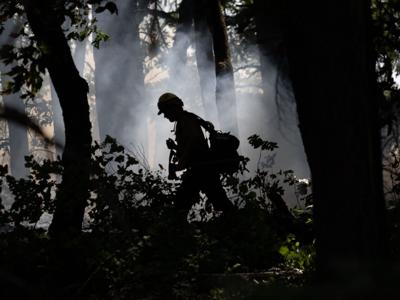

THE GORGE — Looking down the barrel of longer, all but guaranteed severe wildfire season, boots are being broken in, Pulaskis sharpened and trainings repeated until they become habit across the region, including at the Washington Department of Natural Resources’ (DNR) Dallesport Work Center.
Up until October or so, that’s home base for the Klickitat Handcrew, a 23-member team specialized in the physical, grueling work of digging 18-inch-wide trenches down to mineral soil for the purpose of containing wildland fires. Most are no stranger to carrying a 40-plus-pound pack up steep terrain and working 12 hours a day for 14 straight, apart from the few new faces, though all are relatively young.
“For three open spots, we interviewed upwards of 30 people,” said Superintendent Patrick Richardson. “It’s somewhat cutthroat.”
Alongside his foreman, fire management officer and squad bosses, Richardson has been leading the Klickitat Handrew through what’s called the “Critical 80,” a series of progressive trainings designed to teach field-based skills — everything from taking weather to felling hazard trees, safely working around bulldozers — and ensure peak physical readiness over two weeks before the season begins in earnest. It's a trial by fire, so to speak.
Every morning starts with a similar pattern. One person from each squad helps clean the showers, bunk room and kitchens while the rest perform morning checks, seeing that trucks are fueled up, chainsaws warm, water jugs filled and all other necessary equipment is accounted for at 8 a.m.
Next comes an overview of goals for the day during crew briefing, which also includes a short safety presentation. On May 8, the topic was chipping debris during post-fire cleanup, and then everyone gathered behind the center, formerly Dallesport Elementary, for an hour-long physical training session under the sun, winds shooting down the Gorge.
Beyond the mental fortitude needed to remain rational in life-threatening situations, Richardson stressed that wildland firefighting demands strength, endurance and flexibility — “occupational athletes" — so the Critical 80 places a heavy emphasis on conditioning. The group did weighted sandbag rows, pull-ups, battle ropes and other exercises, rotating stations every three with almost no rest inbetween. Capped by a group core session, everyone then changed into their “greens” and “yellows” (standard flame-resistant clothing) for an afternoon of simulated training sessions.
“I want you verbalizing as you’re doing it. Say it out loud,” Richardson told the group. “We’re learning the play and running half speed. You’re learning it to the point where you don’t have to think about what you’re doing, because we train to develop that muscle memory.
“If you’re distracted with the stuff you possess every day because we don’t train with it, you can’t focus on the fire itself,” he continued. “That’s why we walk through. That’s why we do it until we can’t get it wrong.”
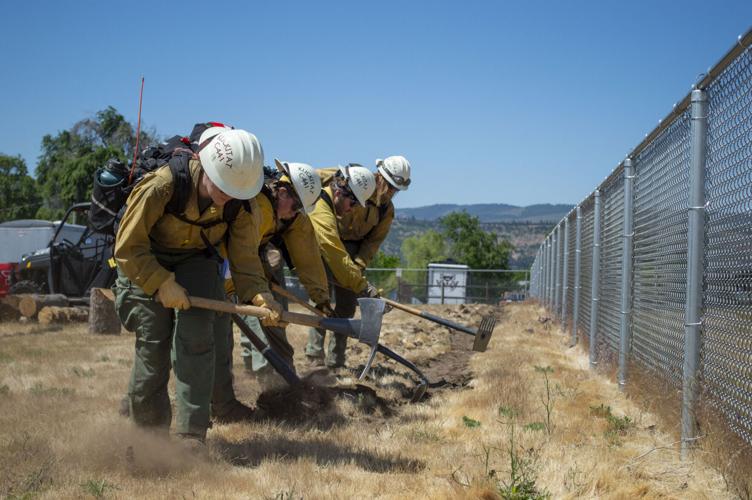
Led by Squad Boss Natalie Schroder, the Klickitat Handcrew works on their bread and butter — digging fireline — during the afternoon training session on May 8. They had to rotate through five stations designed to simulate critical skills and scenarios on the job. Completing 99 feet in 20 minutes was the goal at this one, and each tool serves a slightly different purpose, like cutting through roots, scraping and grubbing. Visible are Scout Dale, Alex Barzee and Sean Albro, in that order.
- Nathan Wilson photo
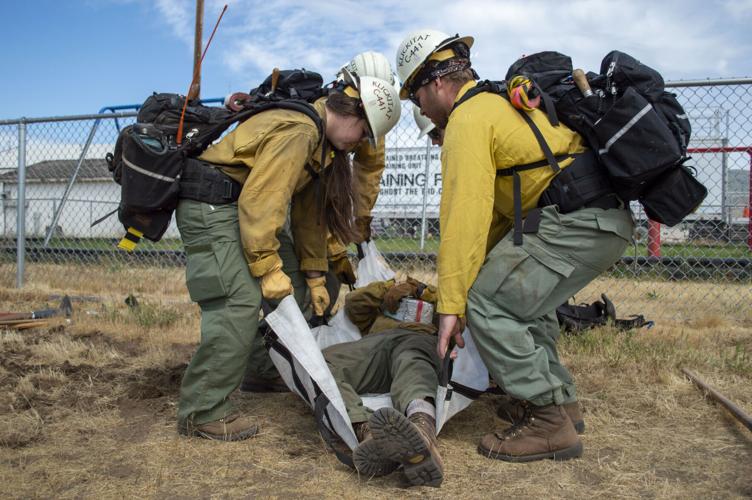
At another station, Sean Albro pretends to have injured his foot, and the squad worked through how to manage an incident where someone needs medical attention. Carrying Albro are Natalie Schroder and Ryan Towell on the left, assisted by Alex Barzee and Scout Dale on the right.
- Nathan Wilson photo
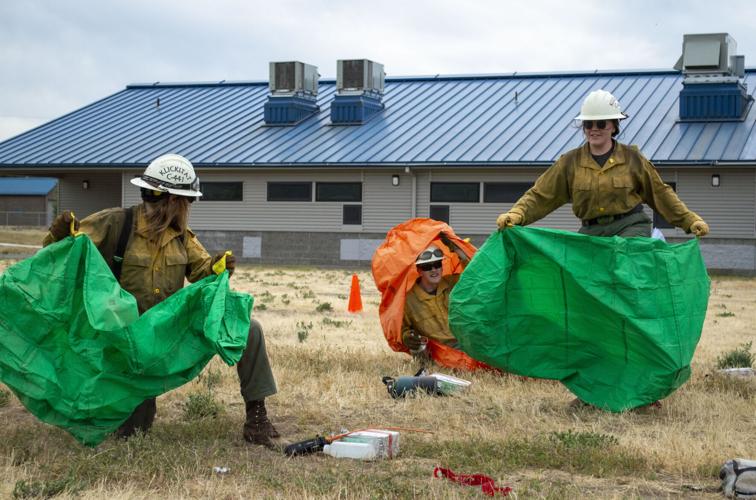
Should they ever be trapped by wildfire, Sean Albro, Ryan Towell and Natalie Schroder practice how to deploy an emergency shelter, shedding everything apart from their water and radios. To prevent oxygen from escaping and noxious gas from entering, it’s critical that firefighters have a tight seal between their shelter and the ground.
- Nathan Wilson photo
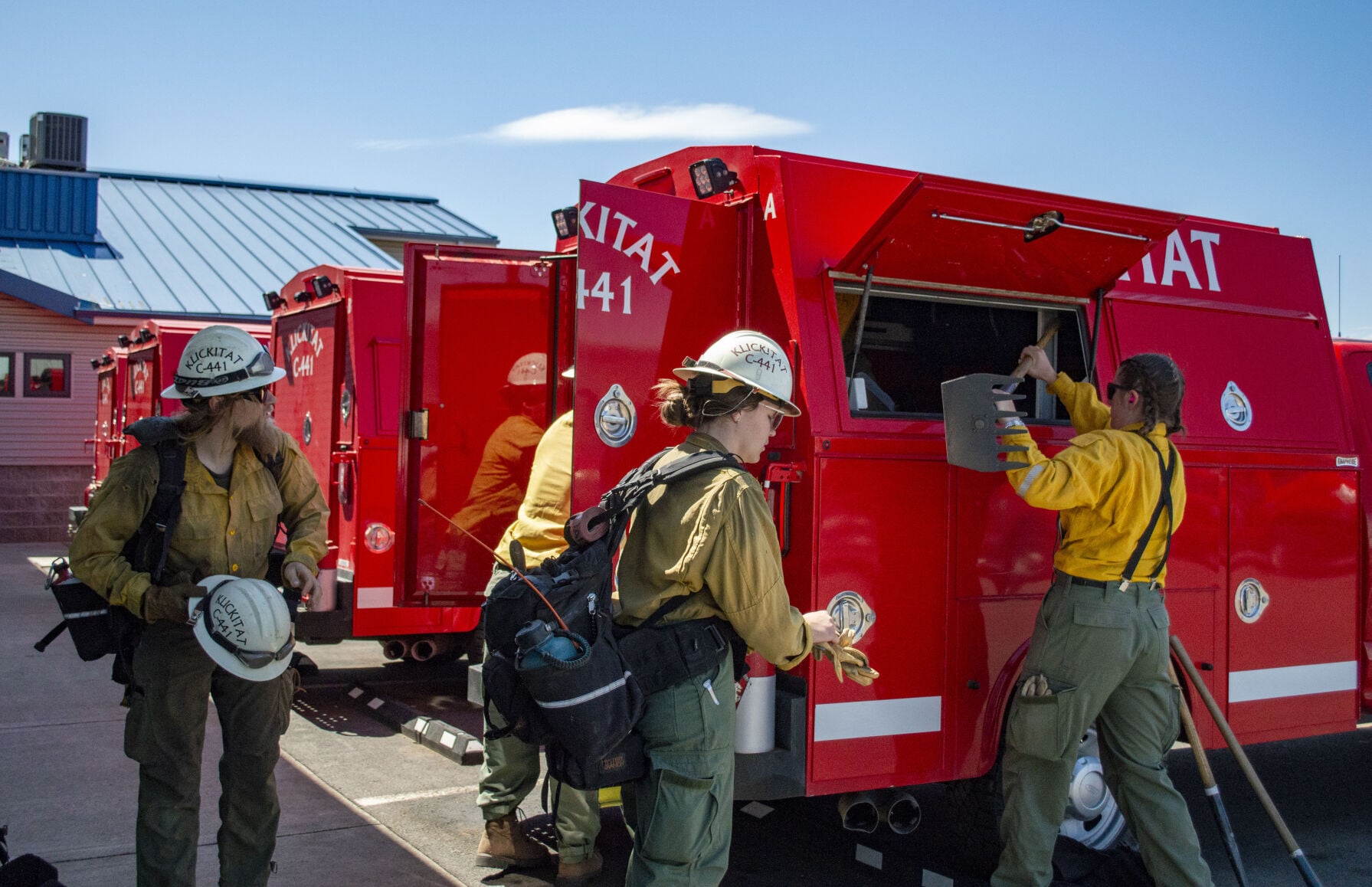
The squad deploys from their crew truck before digging fireline. Scout Dale grabs the tools while Ryan Towell and Alex Barzee shuttle packs out to Sean Albro and Natalie Schroder. At other stations, the squad went over positions for mobile attack with a brush truck and, when working in a heavily wooded landscape that restricts movement, progressive hose lays.
- Nathan Wilson photo
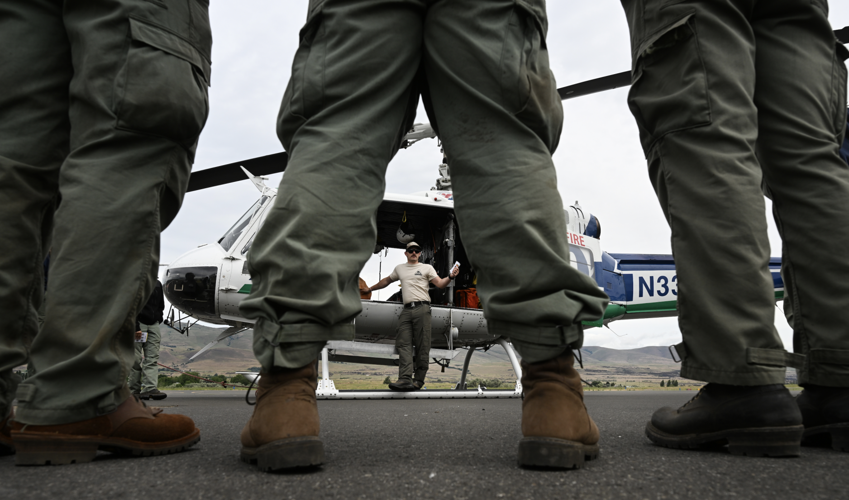
Austin Russell, helicopter manager with Washington Department of Natural Resources Helitack, talks with the Klickitat Handcrew and engine personnel for aviation training at the Columbia Gorge Regional Airport in Dallesport on May 14.
- Helen H. Richardson photo / special to Columbia Gorge News
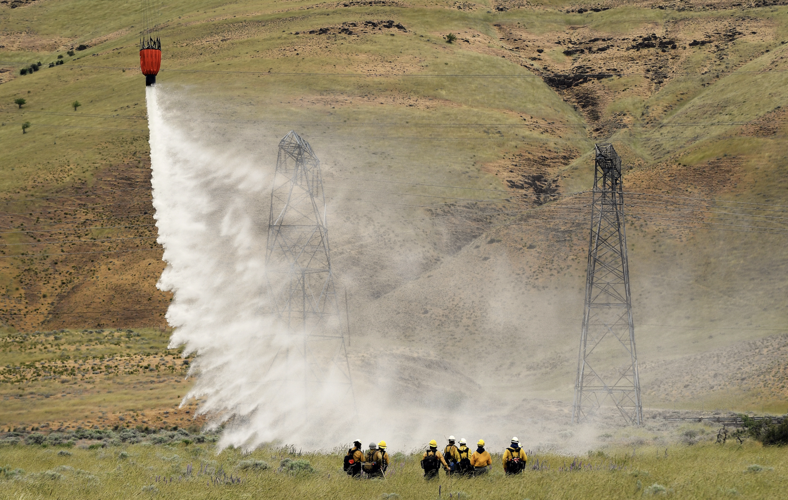
Members of the Klickitat Handcrew watch as a helicopter drops water during a training exercise on private land east of John Day Dam along the Columbia River on May 14. They were learning how to communicate with aviation crews and coordinate precise water drops, simulating wildfire response.
- Helen H. Richardson photo
Klickitat Handcrew ‘Critical 80’ training
Led by Squad Boss Natalie Schroder, the Klickitat Handcrew works on their bread and butter — digging fireline — during the afternoon training session on May 8. They had to rotate through five stations designed to simulate critical skills and scenarios on the job. Completing 99 feet in 20 minutes was the goal at this one, and each tool serves a slightly different purpose, like cutting through roots, scraping and grubbing. Visible are Scout Dale, Alex Barzee and Sean Albro, in that order.
- Nathan Wilson photo
At another station, Sean Albro pretends to have injured his foot, and the squad worked through how to manage an incident where someone needs medical attention. Carrying Albro are Natalie Schroder and Ryan Towell on the left, assisted by Alex Barzee and Scout Dale on the right.
- Nathan Wilson photo
Should they ever be trapped by wildfire, Sean Albro, Ryan Towell and Natalie Schroder practice how to deploy an emergency shelter, shedding everything apart from their water and radios. To prevent oxygen from escaping and noxious gas from entering, it’s critical that firefighters have a tight seal between their shelter and the ground.
- Nathan Wilson photo
The squad deploys from their crew truck before digging fireline. Scout Dale grabs the tools while Ryan Towell and Alex Barzee shuttle packs out to Sean Albro and Natalie Schroder. At other stations, the squad went over positions for mobile attack with a brush truck and, when working in a heavily wooded landscape that restricts movement, progressive hose lays.
- Nathan Wilson photo
Austin Russell, helicopter manager with Washington Department of Natural Resources Helitack, talks with the Klickitat Handcrew and engine personnel for aviation training at the Columbia Gorge Regional Airport in Dallesport on May 14.
- Helen H. Richardson photo / special to Columbia Gorge News
Members of the Klickitat Handcrew watch as a helicopter drops water during a training exercise on private land east of John Day Dam along the Columbia River on May 14. They were learning how to communicate with aviation crews and coordinate precise water drops, simulating wildfire response.
- Helen H. Richardson photo
Richardson’s crew covers Klickitat County, first and foremost. DNR’s Southeast region, which encompasses Leavenworth, Pullman and Yakima, is their secondary responsibility, with the entire state coming third. Despite an abundance of handcrew applications, DNR’s Klickitat Fire Unit is down three engines this year, from seven to four.
“There were plenty of firefighter applications for the engines as well; however, there were not enough qualified applicants for the engine leader position to staff the engines,” said Klickitat Fire Manager Anthony Dobson. Without an engine lead, DNR can’t fill the other four seats.
To help flush out capacity gaps and improve cross-river collaboration, Richardson aims to have a mutual aid agreement signed with the Oregon Department of Forestry (ODF) office in The Dalles, where similar preparation is underway, come July.
ODF started hiring firefighting staff earlier than usual, said Unit Forester Chase Duncan, and they’re also hoping to bring on the two aircraft that get stationed at Dallesport airport and are crucial to firefighting efforts earlier than normal.
Over at Mid-Columbia Fire & Rescue (MCFR), four fresh wildland firefighters continued fuel reduction projects, including tree thinning, limbing and brush removal, throughout Wasco County last month and will remain on staff for the season.
All MCFR firefighters take an annual refresher training on wildland firefighting, command staff complete classes on incident management and MCFR recently hosted an advanced fire weather training for regional agencies.
Division Chief of Operations Josh Beckner emphasized the importance of regional coordination, alongside establishing operational systems before a wildfire occurs.
“Logistics is everything behind the scenes that ensures firefighters can safely and effectively do their job when an emergency happens,” Beckner said.
They plan for water and fuel supplies, sign agreements for meals and portable restrooms, and map access points in wildland areas. They identify areas with heightened risk and ensure communication systems can handle large scale events.
“The 2025 Rowena Fire highlighted how critical communications and infrastructure are, and we continue working on improvements in that area,” he said. Beth Kennedy, public affairs officer for the U.S. Forest Service’s Columbia River Gorge National Scenic Area, emphasized how that’s a shared effort.
Like DNR, ODF and MCFR, Forest Service firefighters spend time getting physically ready for the season, running, hiking trails with gear and doing calisthenics, she said. In the run-up to fire season, local, state and federal fire agencies meet weekly to coordinate.
Key areas are changes to staffing, communications plans and dispatch procedures, Duncan with ODF said. Also, to prepare staff as much as possible, they’ll send local personnel to other areas for further experience, as workload allows. In return, other states come to Oregon when its fire seasons is in full swing, Duncan said.
Wes Long, chief of West Klickitat Regional Fire Authority, said the Gorge was lucky to have fire agencies on both sides of the Columbia River that work well together. That’s not necessarily the case elsewhere, he said.
And weather is another key factor that fire officials keep an eye on. “I think everybody’s nervous about the upcoming season,” Long said. It could be a wet May or a wet June, but the weather predictions aren’t saying that, he said.
He communicates with the meteorologists at the National Weather Service out of Pendleton. “We put a lot of weight on what they tell us because that’s the best way we can plan, short of having a crystal ball.
“It’s gonna be a busy season,” Long said.


