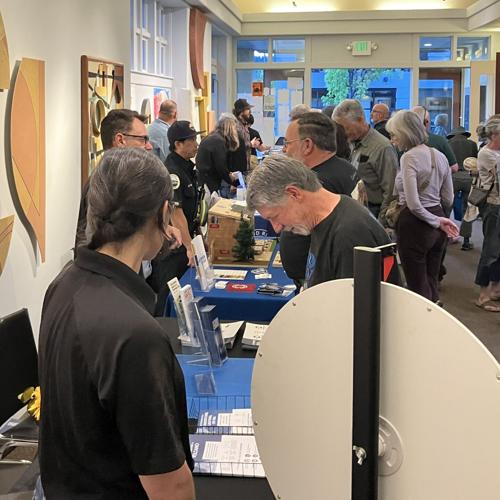
Community members meander through information booths at the "Before Wildfire Strikes: Improving Wildfire Preparedness in Hood River County" event on April 29.
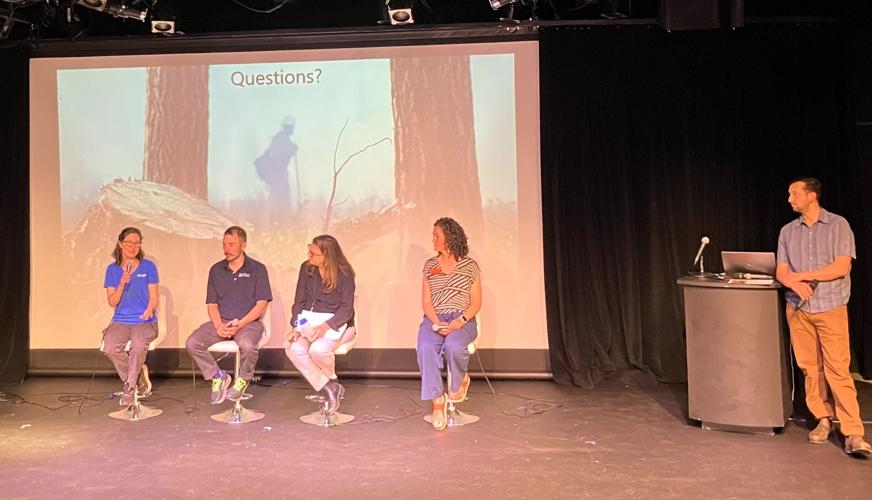
Panelists above, from left to right, are Kate Conley, conservation easement manager at Columbia Land Trust; Andy Dwyer, fire risk reduction specialist with the Oregon State Fire Marshal; Katie Skakel, Hood River County emergency and resilience program manager; and Lauren Kramer, Oregon State University associate professor.
Community members meander through information booths at the "Before Wildfire Strikes: Improving Wildfire Preparedness in Hood River County" event on April 29.
“Before Wildfire Strikes: Improving Wildfire Preparedness in Hood River County,” a free presentation at Columbia Center for the Arts on April 29, brought together hosts Hood River All-Lands Partnership, the Oregon State Fire Marshal, Oregon State University Extension and other local partners to share information and resources on wildfire — starting at 10,000 feet and ending with the makeup of wildfire smoke.
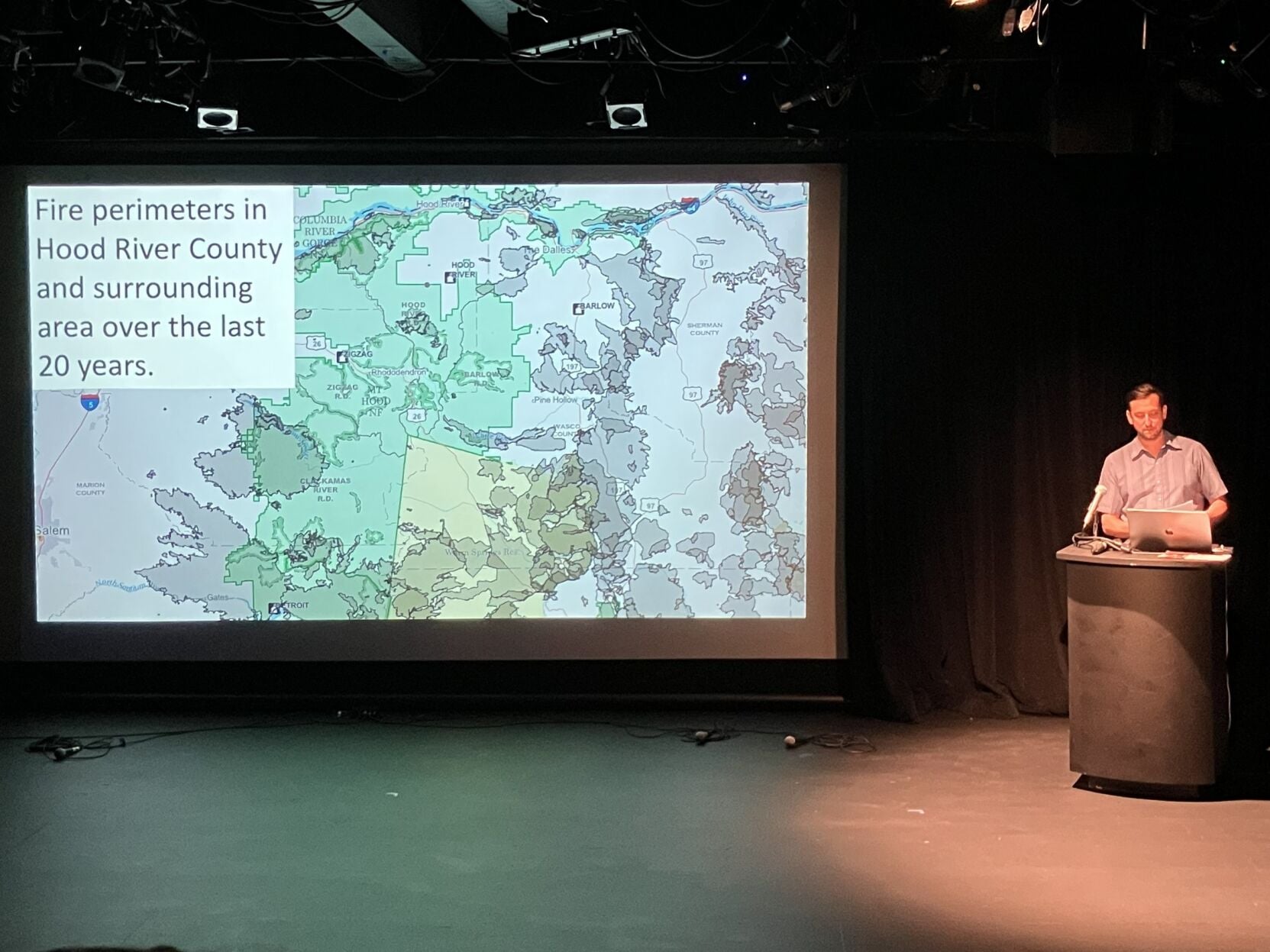
Andrew Spaeth, of Hood River Forest Collaborative, emceed the event. He began with an overview of county fire conditions.
Trisha Walker photo
“That Hood River County faces extreme wildfire risk is an understatement,” said Hood River Forest Collaborative’s Andrew Spaeth, also a founding member of the Hood River Alliance Partnership, who served as the evening’s emcee. “We are in the 100th percentile for wildfire risk among all counties in the United States, and, among counties in the Western United States, we face some of the highest risk of wildfire transmission from the surrounding forest lands to homes.”
Panelists above, from left to right, are Kate Conley, conservation easement manager at Columbia Land Trust; Andy Dwyer, fire risk reduction specialist with the Oregon State Fire Marshal; Katie Skakel, Hood River County emergency and resilience program manager; and Lauren Kramer, Oregon State University associate professor.
Trisha Walker photo
Created environment
“As much as fire is part of the landscape today, historical records suggest that we actually had a lot more fire in the past,” Spaeth said. “We’ve created a really homogenous and overly abundant, dense forest condition, and it’s easy to see how fires can rapidly spread and grow in that new forested environment that we’ve created.”
Over the last three decades, 80-90% of all fires in Hood River County were human-caused, such as from vehicles, debris piles and burns, and abandoned campfires.
“One of the reasons fire is particularly challenging is because we built homes and communities and places that historically had a lot of fire,” he said, adding insurance companies have conducted extensive research on how buildings ignite and emphasizing the importance of establishing defensible space, particularly within five feet of homes. "If it’s clear of if it’s clear of debris, if it’s clear of receptive fuels, you can significantly reduce the potential for structure loss and structure ignition in a wildfire event.”
County preparations
Katie Skakel, Hood River County emergency and resilience program manager, reiterated that most fires are human-caused before going over the responsibilities of her department. (Her predecessor, Charles Young, now works for the Oregon Department of Emergency Management’s North Cascades region, which includes Hood River, Wasco and Sherman counties.)
“We coordinate with all of our state and federal partners to create a safe and resilient community,” she said. “It is also prepping all of our firefighters, our teams, to be ready in the event of an emergency.”
Skakel is also concerned about how the Gorge “locks up” in an emergency event, namely that traffic comes to a stop in town, on bridges, and on the interstate. “We need to address transportation issues,” she said.
That said, a lot is happening around prevention and mitigation. The county is looking to start a Community Emergency Response Team (CERT) to train volunteers on how to respond before, during and after an emergency. And under Young’s tenure, the county received a five-year wildfire mitigation grant and is looking to hire a wildfire mitigation coordinator who would work in the City of Hood River, Cascade Locks and other county communities.
Bottom line: remain vigilant, and report any sparks, be it on the highway or railroad tracks.
“We need to be hearing about it,” she said.
Preparing, adapting, and coexisting with wildfire
Andy Dwyer, fire risk reduction specialist with Oregon State Fire Marshal (OSFM), focused on “structural ignition” and how “continuous fuels” — like grass, shrubs and trees, but also including debris in gutters — can lead a fire directly to the side of a residence.
“OSFM does have the option to do an official defensible space assessment — go through a checklist and do a deep dive around your home,” he said. Those interested should visit oregondefensiblespace.org to schedule an appointment with Wade Gibson, deputy state fire marshall for Hood River.
The risk to wildfire-threatened structures has increased significantly over the past two decades — more than 1,000%. (No, that’s not a typo.) Embers can travel far — Dwyer cited a basketball-sized ember landing in Dallesport during the Rowena Fire.
“I’ve actually seen this happen — a flash fire, a grass fire, moved through a structure. The structure didn’t ignite,” he said. “But what happened was a shed smoldered … that was near the house, within 15 feet, and then that radiant heat fractured the windows on the vehicle near the house, and then the vehicle upholstery ignited, and the vehicle was near the eaves of the home and brought fire into the home.”
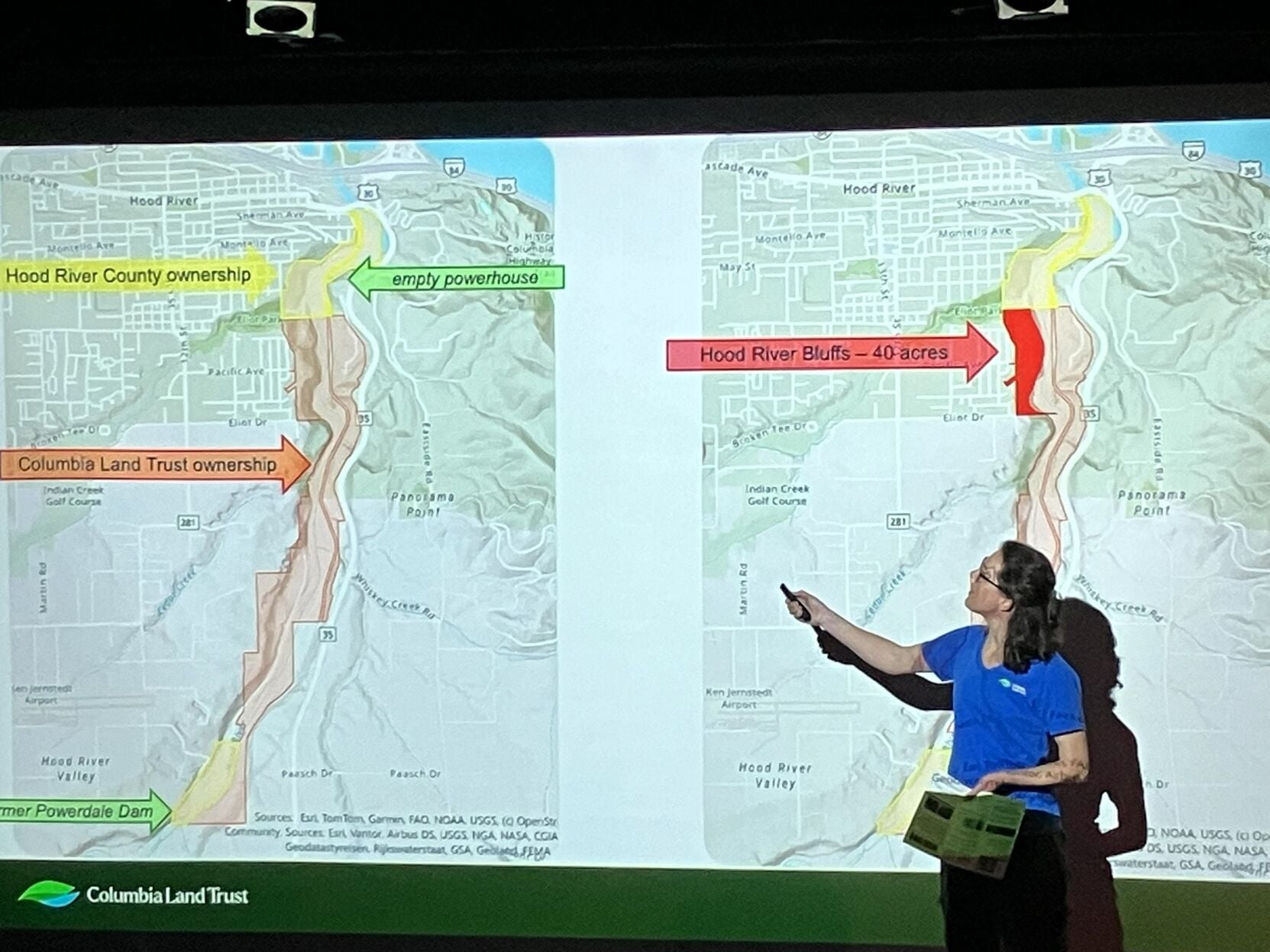
Kate Conley, Columbia Land Trust, presents at the April 29 wildfire prevention event.
Trisha Walker photo
Hood River Bluffs
Kate Conley, area manager for Columbia Land Trust, said the trust’s role in fire prevention centers around ecosystems. “We try to do things like prescribe fire when possible, to get rid of some of those built-up fuels and change the vegetation composition back toward the species that really thrive, even in situations where there’s frequent fire,” she said.
Of course, that doesn’t work in an urban setting — and there are houses right up to the edge of the bluff, on steep, forested land. Instead, the group focuses on removing those potential fuels by hand, such as blackberry bushes.
Using native plants also helps, and volunteer planting events the past two Aprils have bolstered those numbers. But that doesn’t mean the fight is over.
“I would say that the biggest concern out here is going to be the long-term maintenance. Things will keep growing back,” Conley said. “The reason we’re planting those native shrubs is so that it doesn’t all come back in blackberry, but this is ongoing work for all of us.”
Smoke preparedness
The catastrophic Labor Day fires — in which more than 4,000 homes were destroyed and 11 lives lost — saw toxic air conditions in the Gorge as smoke traveled from Southern Oregon.
Oregon State University Associate Professor Lauren Kraemer, family and community health, took the poor air quality to heart. “I felt like we needed to do better, and that our continued droughts and heat and fire are only going to create worsening smoke situations for the future,” she said.
Smoke is a mixture of whatever is on fire, and it becomes more toxic as it travels. She estimates that 60%-70% of Gorge residents are in the “smoke sensitive and vulnerable populations,” including those with pre-existing conditions, pregnant people, infants and children under 21, houseless individuals, and those who work outside.
In response, Kraemer began tracking air quality. At present, more than 50 new monitors have been installed at schools, orchard sites, and other locations to provide real-time data, paid for with grants.
“When I began this work, smoke and fire were kind of separated,” she said. “These things happen together, and we need to be working together.”
For more information — including air quality readings — visit smokereadygorge.org.
•••
Hood River County OSU Extension has a downloadable PDF guide, titled “Before Wildfire Strikes,” that includes more information on defensible space, home hardening, creating an emergency plan, and preparing for wildfire smoke.





Commented