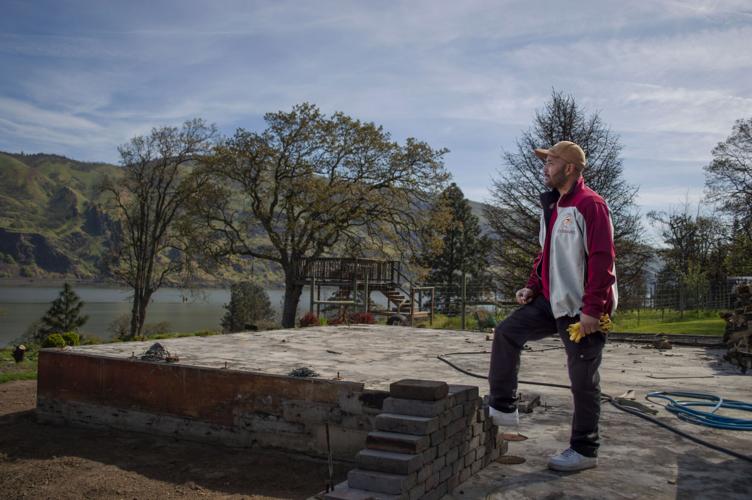
Brian Harris, standing on the foundation of Don and Monte Dickinson’s home, poses for a portrait on April 9. Harris helped protect several homes from the Rowena Fire last summer, but despite his best efforts, the Dickinson’s burned.
Brian Harris, standing on the foundation of Don and Monte Dickinson’s home, poses for a portrait on April 9. Harris helped protect several homes from the Rowena Fire last summer, but despite his best efforts, the Dickinson’s burned.
How two residents helped save five homes, and what factors complicated the initial response to last summer’s destructive blaze
ROWENA — Late morning on June 11, 2025, Brian Harris and Renee Sirois pulled up to Roger Stansbury’s house at the end of Rowena Ferry Road, about nine miles east of The Dalles. Harris assists local residents with odd jobs — landscaping, interior painting, chopping firewood — and Sirois tags along sometimes. That day, a friend wanted to borrow the rototiller Harris left at Stansbury’s.
“If I’m driving by a property and it looks like they could use a hand, not like I’m trying to evaluate them or judge them, but I like to help people,” Harris said. “I’m okay with whatever they think it’s worth.”
While there, Stansbury asked if Harris could clear the overgrowth around his house, worried that, one day, a fire might race down the hill toward his back door. A few hours later, one did.
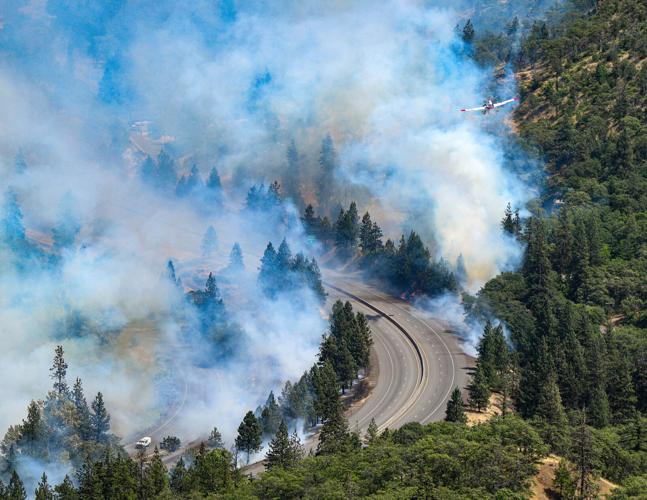
The Rowena Fire ignited just after 1:20 p.m. and torched roughly 3,700 acres, taking 61 homes and 91 outbuildings in the process. An additional 57 dwellings were impacted due to damaged wells and septic systems. Between Mid-Columbia Fire and Rescue (MCFR), Oregon’s Department of Forestry, United States Forest Service crews, the Oregon State Fire Marshal and task forces from adjacent counties, personnel on the fire peaked at over 700.
Harris and Sirois helped save five homes but, inevitably, they watched those of friends, neighbors and customers go up in flames on that horrific Wednesday afternoon.
The two were living together in a single wide trailer at Rowena Crest Manor then, and the same friend who borrowed Harris’ rototiller called to warn about the fire. Immediately, Harris and Sirois jumped in a truck and drove to Stansbury’s, the first structure threatened. Heading west, flames were already shooting through Highway 30’s white guardrails.
MCFR Fire Chief David Jensen was at home hosting a birthday party for one of his kids when he got the call. Considering the dispatcher’s tenor, and that he could see smoke coming down the Gorge from his front porch, Jensen knew it was a significant incident. Driving down Interstate 84, and in conversation with another MCFR fire chief who was looping around from Mosier, they observed at least seven separate blazes across a five-mile area, which Jensen said was “inconsistent” with typical spotting behavior.
“In a standard wildland urban interface response, you have a certain set of difficulties, of challenges you need to overcome, but this one almost had everything with it,” Jensen said. “A high-capacity interstate. You have residential areas. You have the topography, the wind. You have the low humidity and high temperatures, and then the power lines that are running through. All those are complicating for the air and ground resources that we have in the area.”
The Rowena Fire, as seen from Rowena Crest Viewpoint at 2:00 p.m. on June 11.
Gary Elkinton photo
Meyer State Park served as the command center, and by the time Harris and Sirois arrived at Stansbury’s, responders were preparing to burn the hillside. While brush trucks and water tenders could refill at the Columbia River with relative ease, they have limited capacity, whereas backburns can eliminate a wide swath of combustible fuels in a fire’s path.
The conditions need to be manageable, though, and on-scene supervisors must have confidence in their crew and understand what’s going to happen once the drip torches come out, Jensen explained.
“In a grassy area with the wind blowing and low humidity, no matter how much experience you have, that’s still a technical burn,” he said. “Nobody does that every day.”
Harris recalled that Stansbury, who recently had hip surgery, was skeptical. Harris grabbed a hose and started spraying the vegetation lining his back porch, and while a burn scar now surrounds the property, Stansbury’s house is still standing. Crews also performed another backburn on the flat face of Sevenmile Hill just west of the Columbia Gorge Discovery Center and Museum.
Coupled with a bulldozed fuel break around the fire’s southwest flank approaching Chenoweth, which was completed by Thursday morning, those two operations played a key role in halting any further spread toward The Dalles. In the initial stages, however, responders focused on tallying how many people had decided to remain on their property.
“Our primary concern was for the homes under threat at that time, and frankly, the life safety aspect of it. During the fire, we didn’t know how many people were still in there,” Jensen said. “It’s life safety first before property protection and the environment.”
Harris and Sirois stayed until late evening, apart from a brief hiatus. After spending about an hour with Stansbury, they drove Sirois’ pitbull and another friend’s Mercedes out to Thompson Track. There, Sirois got a text from Don and Monte Dickinson explaining how they had left $400 in the barbecue for a prior job, so they got back on the historic highway.
Tooley Terrace hadn’t yet burned, Harris said, but flames were nearing the Dickinson’s property. As standard procedure during wildfires, Northern Wasco County PUD officials cut off electricity to the unincorporated community, rendering hoses useless. Harris started up his lawnmower in a last-ditch effort and quickly ran out of gas. Once an old pine torched in their yard, there was nothing else he or Sirois could do.
“We got smoked out. I didn’t get to see it actually catch, and Renee’s on the phone with Monte as it’s happening. It was heavy,” Harris said. “I’m running out this way, she ran that way, so we got separated. I could hear her yelling and screaming.”
They found each other back on the highway, wanting to leave, but noticed the fire had crawled up the fence that connected a portion of their trailer park. For whatever reason — Sirois accidentally leaving the water on, Rowena Crest Manor having an independent water tank — they still had half pressure.
Hoses in hand and shovels to spread gravel, the two saved four manufactured homes while explosions, maybe propane tanks, maybe transformers, rippled in the background. Ten others got reduced to nothing but scrap metal, and in addition to the Dickinsons, both fielded calls from homeowners asking about how their property faired all afternoon.
“It became this burden to tell people — took the wind out of me,” Harris said. “The last person that called, I didn’t even answer him.”
Harris and Sirois checked in with one final person, neighbor Jack Garvin, to see if they should grab any of his belongings before leaving around 8 p.m. Many of the firefighters on scene, however, worked through the night, faced with impossible decision after impossible decision.
As Jensen explained, the highest priority places to protect are where people remain, whether it’s due to disability, lack of transportation or simply not wanting to let go. When those areas are accounted for, each home becomes a calculated risk based on many factors: adequate turnaround space for a truck, minimal vegetation lining the driveway, a supplemental water source and more all enhance firefighter safety.
And since wildland fires inherently burn in places without adequate infrastructure, once a house catches, it’s almost impossible to snuff out.
“Concentrating on a house that’s already on fire sometimes will mean that other houses burn,” Jensen said. “We tell people that your life is not worth anybody’s property. Our crews will risk a life to save a life, but they won’t risk to save what’s already lost.”
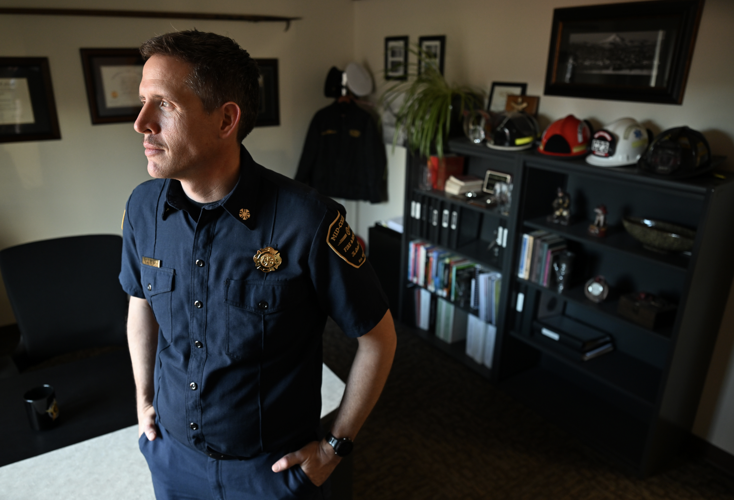
David Jensen, chief of Mid-Columbia Fire & Rescue since December 2024, poses for a portrait in his office on Feb. 10.
Helen H. Richardson photo / special to Columbia Gorge News
By Thursday, June 12, the Wasco County Sheriff’s Office had lifted all evacuation orders, and the Rowena Fire was largely contained. Active personnel dropped to 80 on Saturday, and crews focused on suppression repair over the weekend. In his seven years at MCFR, Jensen has never witnessed a faster state response, and he remains adamantly proud of the station’s crews.
“We asked them to do more than what we as a community should expect any one person to do. We sent firefighters to the hospital that next morning based off what they were enduring, to try to save people’s homes and try to save people’s lives,” Jensen said. “I didn’t hear a single complaint from anybody that they just wanted to go home, or they were tired.
“Fire doesn’t move like we all predict. Every wind gust and every temperature change creates a different impact,” he continued. “I don’t think anybody would say that we could have used some more support in this area, but some things just lined up on that particular day that overextended anywbody’s capacity — seven plus fire simultaneously. Each fire prepares us for the next one.”
Now many months removed, Harris lives in an RV on the Dickinson’s property and Sirois is back in her original trailer. With so many people still displaced, work has been slow, and Harris continues to navigate the psychological toll. He thinks it’s post-traumatic stress, the fear of not knowing what else will crumble.
“When the wind blows, you hear the leaves crackling — that sounds like the fire,” Harris said. “Even now, when it’s really windy at night, I don’t sleep. I’m waiting to go talk to somebody about it. I’ve been having a hard time since the fire.”
•••
Columbia Gorge News plans to explore how Rowena residents are recovering, and what barriers they face, next. If you’d like to share your experience, please contact Nathan Wilson at natew@gorgenews.com.