

Why local environmental organizations oppose the Cascade Renewable Transmission Project, and th lead developer’s response
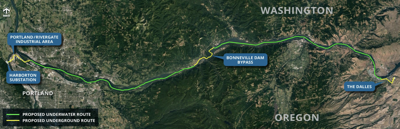
THE GORGE — As the Cascade Renewable Transmission Project trudges through various permitting pathways, Columbia Riverkeeper, Friends of the Columbia Gorge and the Columbia River Inter-Tribal Fish Commission outlined environmental concerns about the underwater, 100-mile high-voltage line that, if approved, would stretch from The Dalles to Portland.
Leading developer, Connecticut-based PowerBridge, says the $1.5 billion venture will help mitigate an energy bottleneck, bringing 1,100 megawatts of electricity that’s more abundant east of the Cascades to load centers in the west, enough to power 800,000 homes for, at most, 50 years.
By running between two states, beneath a federally-managed waterway and through 14 municipalities, PowerBridge and its affiliates must satisfy over a dozen local, state and federal laws.
The U.S. Army Corp of Engineers is currently preparing a draft environmental impact statement for the project, and PowerBridge submitted its preliminary siting application for the portions in Oregon on Feb. 27. As previously reported by Columbia Gorge News, Washington’s Energy Facility Site Evaluation Council (EFSEC) has already began gathering public input, holding both informational meetings and land use hearings in White Salmon and Stevenson last November.
Both states must determine whether the application is complete prior to beginning environmental review, and during a Feb. 25 webinar, Columbia Riverkeeper argued that the initial materials submitted in Washington fell far short.
“Developers are claiming minimal impacts for this project, which is something we are pushing back on,” said Teryn Yazdani, staff attorney for the nonprofit. “To date, there haven’t really been any site-specific studies done.”
The Confederated Tribes and Bands of the Yakama Nation, Confederated Tribes of Warm Springs, the Nez Perce Tribe and the Confederated Tribes of the Umatilla Indian Reservation have all expressed concern over the project for its potential impacts on inundated cultural sites and first foods, including 13 salmon and steelhead runs under Endangered Species Act protection, among other reasons.
“We have expected that, regardless of what we put in the application, there will be additional questions and additional studies that will need to be done,” said Chris Hocker, senior vice president of PowerBridge. “This is a process. It’s not a yes or no quick decision, and for good reason.”
Possible environmental impacts
Yazdani identified a laundry list of environmental concerns, a major one being temperature. During all stages of life, salmon and steelhead are at higher risk of death and disease when river temperatures exceed 20 degrees Celsius, which the National Oceanic and Atmospheric Administration identified as a limiting factor for recovery of listed species in the Columbia Basin.
Temperatures at The Dalles Dam broke that threshold for 81 days in 2025, according to data compiled by the nonprofit Save our Wild Salmon.
Internal modeling shows the effect on overall temperature is “really too small to say minimal,” Hocker said, but studies that account for the Columbia’s underlying geology are yet to be completed. And while most portions of the 12-inch-thick bundle of cables will be buried 10 feet underground, there is variation. When met with surface bedrock, only a concrete slab will separate the cable from water.
A specialized water jet will plow a trench for the line, displacing about 305,000 cubic yards of sediment, which would fill approximately 92 Olympic-sized swimming pools, until it naturally settles out of the water column. Depending on the characteristics, suspended sediment can cause gill trauma and alter fish behavior.
“Despite these potential impacts, the Draft Application dismisses the issue in a couple of sentences,” Yazdani wrote in a comment letter to EFSEC. “The Draft Application does not discuss exactly how much sediment will be suspended, what the impact of that suspension will be on turbidity, how long the sediment will be suspended, how large the plume of sediment will be, etc.”
The cable would also run adjacent to Bradford Island and Portland Harbor, two Superfund sites, along with a paper mill in Camas known to have released cancer-causing chemicals into the Columbia.
PowerBridge and partners believe the planned route avoids all contaminated areas, Hocker said, and a sediment transport analysis has been done, just not included in the application for Washington state. He agreed to share additional studies with an interested party if approved by the reviewing agency, attesting that the plume would be short-lived and contained within a few hundred feet of the trench.
Additionally, Yazdani highlighted a lesser-known harm to fish caused by high voltage cables: distortion of electromagnetic sensitivities. Salmonids use magnetic forces for navigation while sturgeon detect weak electric fields to help locate prey. Any portions of cable less than two feet in depth will produce a magnetic field above background levels, but the application asserts that shielding contains all electric fields emanating from the cable.
Yazdani pointed to a study, however, that recorded “significant” electric fields from a different PowerBridge project that has transported electricity to Long Island, New York, since 2007. It wasn’t immediately clear whether the technology has changed since then. Researchers also demonstrated that Chinook salmon smolts in the San Francisco Bay were marginally attracted to PowerBridge’s cable there, and that migration times for green sturgeon changed, but “activation didn’t appear to impact” the overall migration success.
Still, the effects on several species in the Columbia haven’t been analyzed or weren’t cited in the application, Yazdani said, and the Columbia is fundamentally different than a wider bay. Hocker emphasized that about 150 other studies offer more context and stood by the submission.
The bigger picture, and next steps
Columbia Riverkeeper and other local environmental organizations view the Cascade Renewable Transmission Project as precedent-setting, one that could easily lead to more utilities running under or in the Columbia.
“The Columbia River is not an appropriate test case or pilot location for unproven technology and a new utility corridor,” wrote the Columbia River Inter-Tribal Fish Commission in a comment letter to EFSEC. "No other river in the United States hosts infrastructure of this kind and length, and the Applicant has offered no operational precedent or comprehensive data to demonstrate that the risks to fish, habitat, and cultural resources can be avoided or mitigated."
As such, they have a question more fundamental than the specific ecological health effects: What justifies plowing through a riverbed when transmission lines already stretch overhead?
“For a combination of factors, legal, regulatory, physical, economic, the land-based route is not something we think is feasible,” said Hocker.
Over a decade ago, the Bonneville Power Administration and Portland General Electric scrapped a 215-mile transmission line from Boardman to Salem largely because of environmental backlash, even though the corridor was existing and would only be widened. Hocker took that as a sign, especially since eminent domain wasn’t a problem in that scenario. He also said that the Federal Highway Administration prohibits utilities along interstate roads, so I-84 isn’t a possibility.
On both sides of the river, there’s insufficient space in railroad right-of-ways to accommodate the required construction work as well. State Route 14 presents similar space challenges, on top of cliffs, tunnels and other obstacles that would make hiring a contractor extremely difficult.
Like other sections, Yazdani said analysis of alternative routes was not thorough enough, and she was also skeptical of who would be served by the cable. It recently came to light that the Boardman to Hemingway transmission line, planned to cross five Oregon counties and tap into Idaho Power’s grid, would primarily serve a single industrial customer, allegedly Amazon, rather than thousands of ratepayers.
“We want to serve the system,” said Hocker, adding that Portland General Electric owns the connecting substation and would likely be the principal buyer. “It’s not intended to serve a particular user other than the utility, which, of course, has an obligation to serve its entire base.”
Washington’s EFSEC is still accepting general comments on Powerbridge’s application, which can be emailed to comments@efsec.wa.gov. Oregon’s agency is expected to initiate its review process in late spring, while the Army Corps of Engineers will release a draft environmental impact statement either this winter or early 2027.
This story was updated to include a statement from the Columbia River Inter-Tribal Fish Commission, and to clarify how the four Columbia River treaty tribes view the Cascade Renewable Transmission Project.


Commented