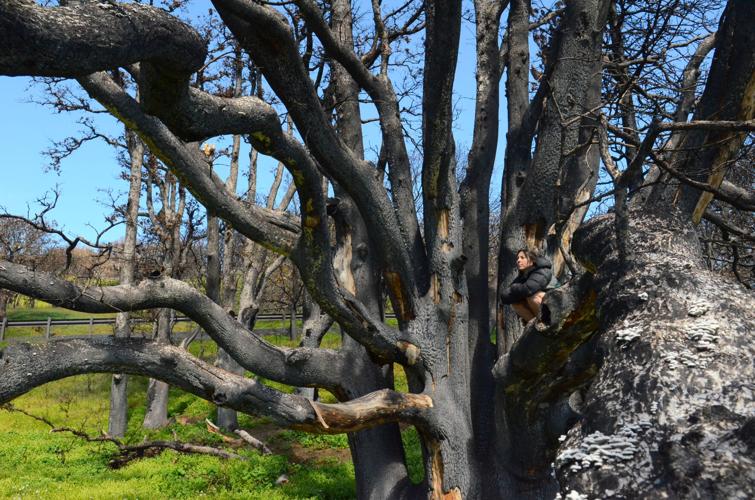
A dead oak tree, likely several hundred years old, found in the Burdoin Fire scar. (Hattie Fletcher for size reference). “When you see the bark pull away from the live cambium like that, whole sections exposed through gaps or peeling and the texture reduced to smooth char, the fire was too hot to survive,” said Lindsay Cornelius with Columbia Land Trust.
THE GORGE — The Oregon white oak is an unusual species — with deep cavities, long winding trunks, and a life span of hundreds of years, it has carved out a unique spot in the Columbia River Gorge’s ecosystem.
Its presence in the Gorge is unusual, too. The species generally lives west of the Cascade Mountain Range from Northern California to Southern British Columbia, but in the Gorge, its habitat stretches to the east.
It’s an outlier that Lindsay Cornelius, manager for the East Cascades Oak Partnership and natural area manager for Columbia Land Trust, can explain.
“This is the only place on the planet where a river the size of the Columbia River bisects an active volcanic mountain range,” Cornelius said. This causes, she added, rapid environmental transitions between the western and eastern Gorge.
The Columbia River corridor funnels western marine air, creating a Mediterranean-like climate — more moderate and moist compared to the surrounding interior plateau. Oregon white oaks are able to grow here, but are not found much further than The Dalles in Oregon and Klickitat County in Washington.
There are also fewer oaks on the western end, Cornelius says, due to fire suppression. “But if you look, the oaks are still there. Many of them are dying in the shade of conifers, but they are there.”
The Oregon white oak is the sole native oak in Washington state, and one of three primary native oaks in Oregon. Cornelius says its adaptability and hardiness are what make it so valuable.
The fire resilience of the Oregon white oak is a multi-tiered story — their deep root system can extend wider than the crown, accessing soil and water other trees cannot. Their bark is thick like a “heat blanket,” protective against the flame. And their waxy leaves, when hydrated, are difficult to ignite.
“If you’ve ever built a burn pile out of just pure oak wood, it’s really hard to get it going,” Cornelius said. “In extreme fire weather conditions — hot, dry, windy — almost anything will burn. And if oak wood gets going, it’ll add heat to the flames.”
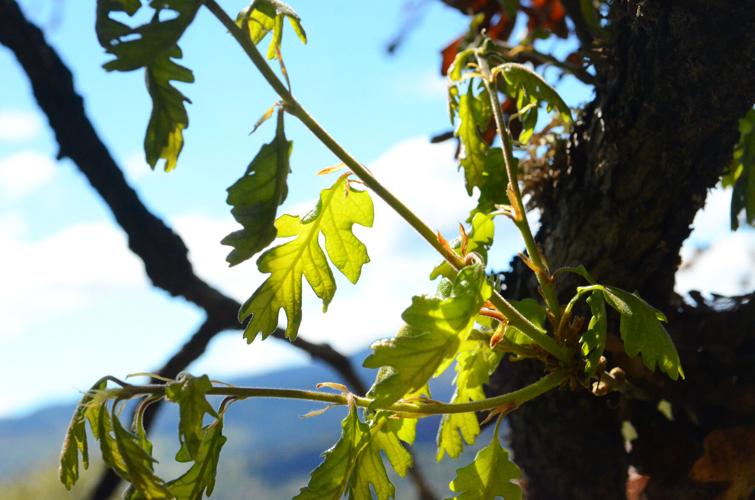
Inside the Burdoin Fire scar from last summer, many of the Oregon white oaks have charred bark and burnt limbs, but in between the branches and at the crown, there is bright new green growth.
“The oaks are well adapted to this landscape, which historically experienced low to moderate-severity fires,” Cornelius said. “If fire kills the crown of an oak, they often resprout after moderate severity fire ... they still have enough resources in that tap root to support a new crown.”
She added that because the new growth is starting from an existing system, it is a considerably faster turnaround than waiting on seedlings — the tree is slow-growing.
Fire regime, she explained, is how frequently a landscape experiences fire based on climate and vegetation. In the oak woodlands of the Gorge, it was every 8-15 years until the early 1900s. Removal of Indigenous people and their lifeways to reservations, commercialization of forest products and construction of permanent infrastructure in the landscape altered that cycle.
That, and impacts from the Big Burn in 1910, led the U.S. Forest Service to adopt the 10 a.m. policy in 1935 — put any fire out by 10 a.m. the next morning. This initial belief in total fire suppression for land stewardship caused a build-up of fuels on the ground floor — litter, duff, coarse wood and even trees.
“Fire is going to move through these overstocked forests hotter and faster than it would have historically because there’s just more fuel,” Cornelius added.
The fuel build-up contributes to higher-severity fires, which burn hot and leave a black scar with over 75% tree mortality, according to Oregon State University.
A dead oak tree, likely several hundred years old, found in the Burdoin Fire scar. (Hattie Fletcher for size reference). “When you see the bark pull away from the live cambium like that, whole sections exposed through gaps or peeling and the texture reduced to smooth char, the fire was too hot to survive,” said Lindsay Cornelius with Columbia Land Trust.
Emma Renly photo
When the Oregon white oaks die, the impact on biodiversity is significant — many wildlife species, from squirrels to caterpillars to blue jays to larger mammals like deer, elk and bear, depend on the trees for shelter and food.
Cornelius says that on this landscape, we need to expect fire and reintroduce it to the land through prescribed burns. Both Mt. Adams Prescribed Burn Association and Mt. Adams Resource Stewards have assisted in bringing back fire to parcels owned by Columbia Land Trust.
“We’ve safely burned more than 300 acres of fire-adapted forest, with plans for much more,” Cornelius said.
Through the East Cascades Oak Partnership, Cornelius wants to highlight information that can improve the health of oak trees and habitats. She suggested their website, eastcascadesoakpartnership.org, to get connected with resources and potential funding opportunities specific to the Columbia River Gorge.
Still, Cornelius knows researchers are still discovering the adaptability of the Oregon white oak, especially in the face of climate change, such as increasing drought and intensifying fire behavior.
“Monitoring and sharing our observations will help us learn and adapt as we go,” she said. “It’s true of all systems — the more you know, the more you don’t know.”



Commented