THE GORGE — “We’re ready for things to be drier than normal,” said Lucas King, fire and fuels program at Mt. Adams Resource Stewards (MARS). The organization works to put good fire, more commonly known as prescribed burns, on the forest floor of fire-adapted landscapes in the Gorge.
The data supports a dry summer — from January to March 2026, Skamania County recorded 5.67 inches below normal precipitation, and Hood River County 4.29 inches below. This, along with a low snowpack, 39% of the historical median as previously reported by the Columbia Gorge News, is a recipe for heightened wildfire risk.
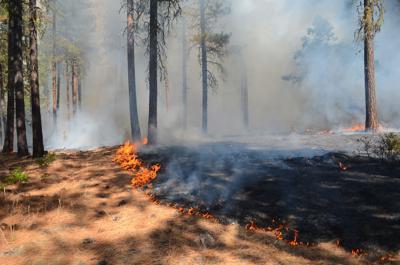
Because of the conditions, King said that fuel reduction efforts are more important than ever, as the forests in the Gorge are far from their historic conditions due to a century of fire suppression. With prescribed burns, the built-up surface fuels — small trees, litter and duff (mostly pine litter and grass) — are recycled back into the soil, creating a healthier ecosystem and possibly preventing a high-severity, catastrophic wildfire.
“We’ve seen forests respond well — large trees have less competition with small trees and brush,” King said, adding that the flora, such as native grasses, also perk up after surface fuel burns.
According to King, the Gorge typically has short burn windows — a month or two in the spring, around April to June, and another in the fall. This year, that time allotment shifted to weeks earlier than normal.
On April 8-9, MARS conducted its first prescribed burn of the season on a Ponderosa pine unit with Columbia Land Trust north of Glenwood. It was an early start for the season and, anecdotally, dryer than average — King says it was a scramble to get the planning, preparation and permitting required, ready in time.
“We probably missed a week, or even two weeks, of burning prior to that just because we weren’t really ready to go,” King said. He says having local staff ready to take advantage of the early burn window is important, especially since they’re aware of the larger climatic conditions and weather influences.
Precipitation, wind, relative humidity and temperature are all closely monitored, along with factors like location, topography and management objectives, when deciding when and where to burn.
Kinds says despite the uncertainty of the weather over the next few months, MARS is approaching the burn window with cautious optimism. “And still, with the urgency that we need to, to try to mitigate the risk of summertime wildfires,” he added.
The Gorge is no stranger to these. Over the past few years, high-severity wildfires have swept the Gorge, altogether burning more than 27,000 acres — Burdoin Fire (2025), Rowena Fire (2025), Williams Mine Fire (2024), and Tunnel 5 Fire (2023).
This year, the fire outlook from the National Interagency Fire Center is predicting above-average wildland fire potential in the Pacific Northwest for June and July. With the potential for high-severity wildfires, King says at MARS, they want to be radically proactive in their work.
“With prescribed fires, we’re kind of flipping wildfire on its head,” King said. “We’re starting with 100% containment, and unlike wildfire, we are able to control where, when, how and what kind of fire we’re applying.”
King pointed to the local organization Mt. Adams Prescribed Burn Association (mtadamspba.org) as an avenue for anyone, even without fire experience, to visit a prescribed burn. He hopes seeing the effects firsthand helps take the fear out of fire.



Commented