
HOOD RIVER — Pirate trails had a history of popping up in Post Canyon, said Rachel Crowder, vice president of the volunteer-run, non-profit, Hood River Area Trail Stewards (HRATS). Through word-of-mouth and outdated maps, she started riding the area in spring 2008 on the unsanctioned trails scattered along the western flank of the Hood River County Tree Farm, run by the Forestry Department.
However, the history of mountain biking trails in the area dates back further.
In the 1990s, after a significant jump in user-built trail construction, conflict began to brew between the county forest management and recreationists. To help ease tensions, the county created the Recreation Trail Ordinance and later a master trail plan to guide development in 2003.
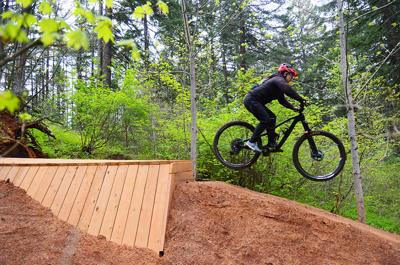
Nowadays, mountain bikers, hikers, runners, equestrian users and motos of all skill levels take advantage of Post Canyon’s trail system. There are more than 40 miles of hand-built and machine-made trails, six staging areas — including Seven Streams, Family Man, Binns Hill, Kingsley Reservoir — and wooden features like bridges, along with mountain bike specific drops, jumps and “skinnies” — long, narrow strips of wood that test balancing skills.
Forming officially in 2012, HRATS partnered with the county after an ice storm significantly damaged the system earlier that year to build and maintain non-motorized trails in the Gorge.
A balance between logging and recreation users was found, and the coordination has continued to this day.
“HRATS works with [Hood River] County to have a collaborative relationship — right now, our relationship is amazing,” Crowder said.
The relationship has been important as the area’s popularity increases; both HRATS and the county are prioritizing creating safe features and maintaining existing trails through repairing berms, clearing sight lines and the trail adoption program — set in place by the county’s recreation trail committee.
“If you don’t know anything was done, it was done well,” Crowder said.
Building a trail or feature looks a little different now than in the ‘90s. Crowder explained the process begins with marking a flag line on the trees, creating a plan and then getting approval from the county and trail committee, which she’s familiar with.
Over the winter, Crowder, along with Craig Spaeth, Megan Barton and around 20 additional volunteers, created the half-mile climbing trail, Chuck Line. She estimates it took 800 hours of work.
“Shovels were on the ground in January — we thought we wouldn’t build until April, but then it never snowed,” she said. “We were done with the trail way before we ever thought we’d start building.”
The creation of the hand-built trail, she said, was inspired by recent expansions and rebuilds from grants and a moderate winter that provided good conditions to build.
The parking passes, $30 for the year or $5 for the day, directly fund grant writing by T.J. Moloney, recreation program manager of the forestry department, and improvements to the trails, such as the rerouting of deteriorating berms on Mitchell Ridge — Oregon State Parks assisted in funding half of that update.
The county was awarded $147,300 in 2022 and $157,710 in 2024 for non-motorized projects through the Recreation Trails Program Grant through the state of Oregon. The grant requires a 20% match, which can include volunteer hours or in-kind contributions.
Already, the funding has provided facility and trail improvements at Family Man, as previously reported by Columbia Gorge News.
This upcoming fall, Crowder says they plan to build two new trails — Upper Remix and Black Out, as well as separate Baby GP into two different uphill and downhill sections.
To also be completed is the Phelps Creek Trail — a “no wheels” trail for equestrian users, hikers and runners. At eight miles long, from Family Man to Binns, it’ll be the longest trail in the system. The Hood River Saddle Club provided additional funding of $1,500 with volunteer support, and the Hood River Running Club donated $6,000.
“They’re building an equestrian staging area up at Binns, so there’s actually a place where people can bring their horse trailer,” Crowder added.
The county and HRATS also received a $150,000 Travel Oregon Grant in 2024/2025 for infrastructure upgrades and trail restoration. The amount covered material costs for machine work and upgraded wooden features — two bridges at Seven Streams and one on Phelps Creek Trail, Toilet Bowl’s entrance and exit and the Three Blind Mice rebuild.
HRATS provided the required 200 volunteer hours.
Local trailer builder Joe Benedetti was hired by the county to modernize the features on Toilet Bowl and rebuild Three Blind Mice, and he then volunteered to build the extension of that trail for free.
“He doubled the trail length — he has around 442 volunteer hours,” added Crowder.
One of the largest additions to the trail system was the acquisition of Haglund Property along Flume Creek on Post Canyon Drive. Hood River County purchased the 48-acre property in August 2024 for $721,000, funded by the forestry budget allocated specifically for forest land acquisition.
Uniquely, letters in support of the purchaswe were sent by multiple entities — Friends of the Columbia Gorge, Hood River County, HRATS and Oregon Parks and Recreation. The land was assimilated into the County Tree Farm, with long-term plans to manage the forest’s health while improving the recreational experience for users.
The county retroactively applied for the Local Government Grant Program, administered by the Oregon Parks and Recreation Division, and recouped $690,280 in funds.
Crowder emphasized that now, recreationists can use the dirt trails parallel to the gravel road, away from vehicle traffic.
The expansions are far from over, and the county continues to seek and apply for grants — individuals interested in volunteering for trailwork can sign up for newsletters at hrats.org.
•••
Our journalism needs your support. Subscribe at columbiagorgenews.com.


Commented