

Oregon House Bill 4153 to bring expanded consumer sales on orchards. A lifeline for some, overreaching to others.
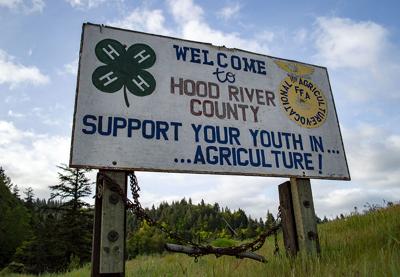
HOOD RIVER & WASCO CO. — “We haven’t had a win in a long time,” said Devon Wells, owner of Pearl’s Place Fruit Stand and Hood River County Farm Bureau president. “Agriculture in general has been taken through the ringer in Oregon.”
Flanked by growers who rely on selling directly to consumers, Gov. Tina Kotek signed House Bill 4153 into law on April 8. The bill establishes an additional use on land zoned exclusively for farming, allowing stores up to 10,000 square feet in size, so long as retail items don’t take up more than 25% of the total area.
Proponents like the Oregon Property Owners Association argue it provides critical flexibility for growers, who continue to grapple with rising input costs and poor wholesale revenue. Oregon already allows farm stands on orchards, but those come with meticulous income and reporting requirements, more limitations on events and regulations vary by county.
Back in February, as previously reported by Columbia Gorge News, Packer Orchards on Hood River’s East Side successfully appealed several conditions of its farm stand permit, a process that took more than four years and cost thousands of dollars in legal fees.
1000 Friends of Oregon, Friends of Family Farmers, the Gorge Grown Food Network and other groups, however, say HB 4153 goes too far. Not only will it place more upward pressure on farmland value, but the legislation also favors large property owners and fails to clarify the existing system. They believe HB 4153 obfuscates what farm stands or farm stores should fundamentally provide: the opportunity to buy pears, cherries, peaches or whatever else that grows nearby.
Diversified income, and well-timed
Wells and his family acquired Pearl’s Place off Highway 35 in the mid-1990s. The owner of Walter Wells & Sons, he employs about 40 people, farms roughly 500 acres and owns a cold storage facility in Pine Grove. The company also cans fruit and does custom packing; in short, his operation is large.
Selling the 10,000 bins of pears that Walter Wells & Sons produces annually through Pearls Place will never be feasible, and just 1% of all the company’s fruit goes to the farm stand, he estimated. But that provides about 10% of their total yearly revenue, and it comes at a time when growers are trying to negotiate various lines of credit.
“That cash really helps us get through the summer months instead of waiting a year to get money from packinghouses, which is just the model,” Wells said. “This is our big spray time — pruning, thinning — lots of labor going on right now.”
Oregon State University’s Extension Service recently published a study that compared the total cost of regulatory compliance, everything from safety trainings to permits and required housing upgrades, across four cherry and pear growers, two large and two small, respectively.
Overall expense per acre varied from roughly $250 for the large cherry farmer to more than $700 for the small pear farmer. That accounts for 6.6% of the latter’s total income, which is substantial given the cost of labor. An analysis of Washington apple growers found that wages consumed 99% of growers’ returns per bin in 2023.
About 10 miles north of Pearl’s Place, Theresa Draper’s situation is quite the opposite. The Draper Girls Country Farm Store, which sits on 40 acres of pears, apples, berries, peaches and more, stays open year-round. That catches both skiers thirsty for cider and u-pickers in the summer, and while some of Draper’s pears go to Duckwall, that may not last for much longer.
“I couldn’t make a living if I were all commercial,” Draper said. “Guess what I’m getting this year? Like 10 cents a pound for that fruit. What do you think our fertilizer bill, our diesel and all that is this year? That’s unacceptable.”
Draper wholly relies on farm stand sales to remain afloat, and so does Mary Sandoz in Wasco County’s Mill Creek Valley. She and her brother own range and hay ground for raising cattle alongside a hog facility that, altogether, can feed approximately 162 people every year, complimented by vegetables grown around their farm stand.
“Direct to consumer is the best route for this farm to pay for itself,” said Sandoz.
For her and Draper, farm stands allow them to carve out a sustainable niche, despite not having the scale to compete with larger farms for wholesale markets, which are also volatile. And now, another pathway will soon be available.
Far reaching
To maintain their permit, Wells, Draper and Sandoz can’t have incidental sales from event fees, retail items and food products made with ingredients outside the local area account for more than 25% of their annual income. Instead of turning over their earnings to the county to prove compliance, HB 4153 shifts the metric to total floor space with few other provisions.
“I’m supportive of agrotourism — I enjoy it. I know farmers have been asking for clarity around farm stands and agritourism events for a long time,” said Sarah Sullivan, the executive director of Gorge Grown. “The purpose of a farm stand or farm store should be to sell agricultural products, in my opinion, and this bill removes that requirement. It also opens up farmland to inappropriately sized buildings and events that now do not have to center local food production and farming.”
Sullivan’s nonprofit aims to bolster regional food security by facilitating farmers’ markets, gleaning fresh produce that would normally go to waste and helping Indigenous peoples reclaim their food systems, among other programs. Gorge Grown supports about 270 growers every year.
Retail items are the only category explicitly restricted in HB 4153. The sale of farm products grown in Oregon or an adjoining county is a listed use, but compliance revolves normal mechanism for county code enforcement: complaints and subsequent investigation.
Further, fees from events aren’t capped at farm stores, and prepared food and beverages made without using local ingredients can be sold for “immediate consumption,” but “not be served in a manner that causes the kitchen facilities to function as a cafe or drive-through dining establishment.” Code and case law aims to prevent farm stands from becoming de facto restaurants.
Of particular concern for Sullivan, though, is the bill’s language related to acres. Operations with at least 80 acres or more must farm 45 acres to be eligible for a farm store, but HB 4153 doesn’t maintain the same ratio for larger plots, meaning that a 1,000-acre orchard can build a store while only cultivating the 45-acre minimum. By comparison, farms less than 20 acres must be growing on at least 10 acres, and only those operations must demonstrate at least $10,000 in earned farm income over the prior two years.
“It really discriminates against farms with smaller acreage,” Sullivan said. “We don’t have huge plots in the Gorge, but I think of the folks that are coming to town and just growing a little bit of hay. Then, you could potentially host a concert on the other 955 acres.”
HB 4153 also allows a number of agritourism activities, including educational tours, play structures, farm-to-table dinners, tractor rides and other holiday events. Orchards with farm stands can host “fee based promotional activities,” intended to encourage the sale of farm products. Those without a farm stand or store go through a separate permitting process where the applicant must demonstrate that planned activates won’t negatively impact nearby farms, depending on the number of attendees.
Process issues, small part of larger system
As directed by legislators and Gov. Kotek, Oregon’s Department of Land Conservation and Development convened a committee meant to address confusion surrounding existing farm stand rules last summer, but the working document, which still needed public input, generated so much backlash that Kotek spiked the entire process.
Clearly complicated and contentious, Jenni Denekas with 1000 Friends of Oregon contends that a short session wasn’t the place to deal with farm stands. The Oregon Property Owners Association (OPOA), which introduced HB 4153, also proposed similar policy the year prior.
“The legislature even said in 2025 that a long session was not an appropriate venue for this. That’s why we went into rulemaking in the first place,” said Denekas, who manages communications for the group. “We were left completely in the dark. We had no idea what this bill was going to say. We had no chance to give like feedback on it, to construct something that would be collaboratively made.”
Additionally, there was no second policy discussion about HB 4153 in the Senate, public testimony wasn’t taken on the version that ultimately became law and of the more than 1,700 comments received prior, roughly 70% were in opposition. Samantha Bayer, general counsel of OPOA, refutes all the above procedural complaints.
“I just don’t agree that there was anything abnormal here,” she said. “This has been the product of a lot of conversation. This did not happen in a vacuum.”
“We had offered, particularly to Friends of Family Farmers, to work with them, to work on amendments,” Bayer continued. “I found what they were putting forth in that [-6 amendment] to be extremely, from a policy standpoint, counter to supporting small farms and family farms.”
She pushed back on the criticism about acreage requirements as well. Under Oregon’s land use law, property owners who let a substantial number of acres fall out of farming face severe tax penalties in order to preserve agriculture, and the language mirrors that already established for wineries on exclusive farm use land as well.
But as Parkdale grower Mike McCarthy countered, just because one law lays out a framework doesn’t mean it should be followed. And in considering Oregon’s agricultural industry writ large, HB 4153 will only benefit a small swath of growers.
“The legislature doesn’t understand the scale of agriculture in Oregon, and that’s the missing link here. There’s no way eight, nine million boxes of pears are going to be sold in farm stores,” said McCarthy, who’s also the president of Ag for Oregon. “There’s not going to be any grass seed sold to the public in their stores. There won’t be any significant amount of wheat used in these stores.”
According to data compiled by Oregon’s Department of Agriculture, greenhouse and nursery products, cattle, hay, milk and grass seed were the state’s most valuable commodities in 2022, whereas pears and cherries didn’t break the top 10. The same year, there were more than 35,000 registered farms in Oregon, but about 25 farm stands are currently permitted in Hood River County, and far fewer in Wasco County.
Looking ahead
HB 4153 will take effect in January 2027. In the meantime, Pearl’s Place owner Devon Wells is grateful for the “breath of fresh air” and expanded opportunity. Anything that encourages folks to understand where their food comes from benefits the industry, and in his view, loose regulations for replacement dwellings on orchards is the true driver behind Hood River County’s astronomically high farmland prices.
“Where [HB 4153] is going to be a problem is when people try to hedge their way through it,” Wells said. “They put offices in it, they make a little event space in it and they do these little things that are outside of conformance. That’s what will give this bill a black eye.”
Whether or not he even applies for the new permit, Wells plans to keep it simple, as does Theresa Draper. Looking back on the decades spent managing her farm store off Highway 35, she’s seen consumer preferences shift, and not necessarily for the better.
“Life has changed since I was a kid,” Draper said. “Parents have to have something for their kid. They think there has to be an activity when, in reality, it should be enough activity that you got in the car and went with your family to visit and look at the beauty.”
For McCarthy, the discourse around farm stands and farm stores serves as a stark reminder of the larger issues impacting agriculture across the state.
“There’s many countries that are shipping in very high-quality produce to the United States at lower prices that we can’t compete with because they have lower labor standards, lower environmental regulations, lower wages,” he said. “I think there’s a lot of things that the Oregon Department of Agriculture could do to help us, instead of spending all their time working on the farm store bill.”
This article was updated to clarify provisions in HB 4153, particularly those related to the sale of farm products and agritourism activities.


Commented