
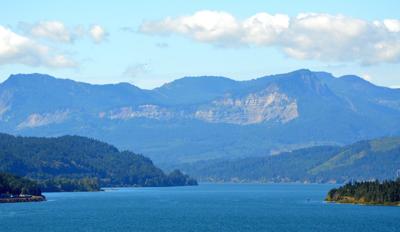
Thursday marks three decades since a reluctant President Ronald Reagan signed the Columbia River Gorge National Scenic Area Act into law.
Reagan reportedly held his nose while he penned a crucial turning point in the long-simmering battle over the Gorge’s fate.
Quickly, nearly 300,000 acres along both sides of the Columbia River — from the Sandy River to the Deschutes in Oregon and Gibbons Creek in Clark County, Wash. to Wishram — fell under federal designation and protection.
The Act ushered in a new era of public partnership, rooting a dual charge for policymakers: protect the Gorge’s natural beauty while encouraging economic development in the small cities dotting its expanse.
The deal didn’t come about by magic.
In the 1980s, controversy over natural preservation came to a head over developments like the Interstate 205 Bridge linking Portland to Vancouver, and a proposed housing subdivision on a hillside across the river from Multnomah Falls.
Preservationists called on Oregon Sen. Mark Hatfield for help addressing what they deemed a growing threat to the region. Hatfield united a coalition, including famed architect John Yeon and Nancy Russell, the Portlander who co-founded Friends of the Columbia Gorge.
Activists and legislators hammered out a Scenic Area Act. Pushback was intense from business groups and logging companies, most vigorously from those in Skamania and Klickitat Counties. The bill failed in multiple incarnations in Congress only to be revived.
The bill finally passed the Senate and House in 1986. It almost died by a pocket veto from Reagan.
Hatfield and Sen. Bob Packwood, who first introduced the bill, were “ecstatic,” the Hood River News reported on Nov. 19.
“It will be a trend, not an avalanche,” the News editorialized on the Act. “Predictions of great developments by the bill’s backers, and those of disaster by the opponents can both be considered as exaggerated — the fallout at the conclusion of a long and intense battle between two factions.”
The legislation created the Gorge Commission, a 13-member appointed panel and staff that oversees land use and development policy for the bi-state region.
Members include governor appointees and county representatives from the six Gorge counties: Multnomah, Hood River, Wasco, Clark, Skamania, and Klickitat.
The commission partners with the U.S. Forest Service, which oversees stringently controlled “special management areas.”
While tensions over land use in the region haven’t completely dissolved, a shared love of the Gorge has bloomed over the years. Tourism, agriculture, industry, and natural preservation have found a semblance of balance.
Since the 1980s, Hood River County has become a water sports and tourism destination as well as a fruit growing mainstay.
The Forest Service celebrated the diverse uses the Gorge enjoys in a news release marking the Scenic Area’s 30th birthday.
“Visitors and locals will undoubtedly celebrate the Scenic Area’s anniversary year in diverse ways: taking selfies at Multnomah Falls, seeking solitude in the Hatfield Wilderness, walking their dogs at Sandy River Delta, soaking in the scenery as they kiteboard or windsurf, or enjoying the fruits of the area’s bountiful agriculture,” Rachel Pawlitz, Forest Service community engagement and public affairs specialist, wrote.
The Gorge Commission remains active in charting the region’s future and partnering with local governments, despite hurdles as state and federal budgets dwindle, and stacks of backlogged work await a reduced staff.
Krystyna Wolniakowski, Gorge Commission executive director, stepped into her “85-mile long, 292,500-acre office” in September 2015. Under her leadership, the commission has adopted legal descriptions for urban areas in the Gorge and launched the “Gorge 2020” Management Plan review.
“I’m very excited to be here as director for the 30th anniversary,” Wolniakowski said Thursday. “It’s just interesting how far we’ve come in the last 30 years, in the way (the Gorge) has changed, while other parts have stayed the same.”
In a newsletter column, she described the commission’s duties as “challenging, but more important than ever, as we prepare for the next decade to preserve the special character, vistas and resources of the National Scenic Area — our jewel of the northwest.”
Wolniakowski looks forward to another 30 years for the Scenic Area.


Commented
Sorry, there are no recent results for popular commented articles.