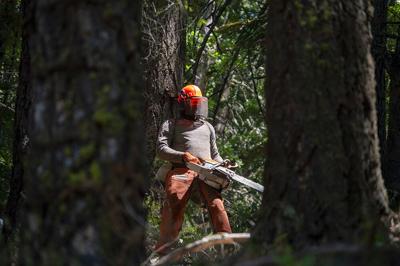
A contractor cuts down immature or dead trees behind Columbia High School, one of several treatment areas that are part of White Salmon’s shaded fuel break, on June 4.
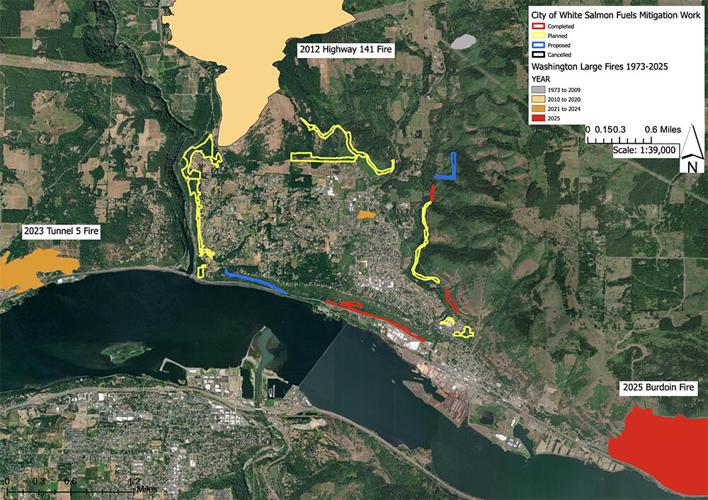
A map of tracts that have been, or will be, selectively pruned and thinned to create a 117-acre shaded fuel break around White Salmon, an effort to slow down future wildfires. Currently, Washington’s Department of Natural Resources (DNR) is working on the furthest north and west areas.
Standing on his back porch off Brislawn Loop Road, Lloyd Dekay explains how wildfire risk is a concern for his entire neighborhood, enough to get Firewise certified and accept state assistance to remove fuels from the bluff below.
A contractor cuts down immature or dead trees behind Columbia High School, one of several treatment areas that are part of White Salmon’s shaded fuel break, on June 4.
WHITE SALMON — When you’re climbing Dock Grade Road, take a gander out left, and you’ll actually be able to see up the bluff. Low-hanging limbs are gone, dead or diseased trees removed and goats may soon clear out whatever’s left of the underbrush.
That’s phase one of a 117-acre fuels mitigation project, which will nearly encompass White Salmon’s outskirts, and phase two is underway. Should a wildfire roll through, it’s designed to knock down flames by eliminating ladder fuels and provide firefighters with an anchor point to attack or light backfires.
Washington’s Department of Natural Resources (DNR) will spend roughly $600,000, all grant funding that expires in late 2028, to complete the project. Bringing it to fruition took more than two decades, however, and just in the nick of time.
“We couldn’t gain traction,” said Alison Martin, forest resilience coordinator for DNR’s southeast region. “The city was the first group to sign on to the project, but it was really hard getting landowners to sign on because they just didn’t know what we were doing.”
Originating as a concept in 2004, support was slow-moving. The COVID-19 pandemic didn’t make communicating with residents any easier, and the project got dropped on Martin’s lap in 2022. Then, the Tunnel 5 Fire ran up Underwood’s bluff a year later. Coordinating with agency colleague Charlie Landsman, who helps establish Firewise communities, and relying on West Klickitat Regional Fire Authority Chief Wes Long to help with canvassing, Martin said that consent forms started flying in. Last summer’s wildfire season only added more impetus.
“Everybody is pretty enthused about this whole program, especially the slope owners here,” said resident Lloyd Dekay. “I think that it’s going to be a big, big boost to the neighborhood.”
Standing on his back porch off Brislawn Loop Road, Lloyd Dekay explains how wildfire risk is a concern for his entire neighborhood, enough to get Firewise certified and accept state assistance to remove fuels from the bluff below.
Nathan Wilson photo
Dekay has lived off Brislawn Loop Road since 2007, and he’s one of 29 landowners collaborating with DNR at no cost to mitigate fuels along White Salmon’s western bluff, an almost continuous treatment stretching from State Route 14 to just before the 141 alternate intersection.
With Landsman’s assistance, McKay and his neighbors are Firewise certified and have received a $4,000 grant for the past three years to create defensible space and harden homes. Landsman explained how there’s “a give and take” in terms of planning — vulnerabilities he identifies versus what the community wants to prioritize — but more extensive projects like the shaded fuel break need a bigger pot.
And as Long noted, there are seldom places more in need of one than the west bluff, and it’s not just because of the steep slope.
While prevailing westerly winds shoot down the Gorge during summer months, diurnals in the White Salmon River Valley shift twice daily. Daytime heating pulls air up toward Mount Adams, but that pattern flips as temperatures start dropping, creating eddies where those two systems collide at the Columbia River.
“In the evening or in the afternoon, that’s our burn period — that’s when we start seeing fire,” Long said. “It’s during that conflict window ... it just grabs those fires and spreads it out.”
Unlike traditional fuel breaks, which typically involve removing all vegetation down to mineral soil, this is a selective thinning and pruning project. Branches less than 10 feet off the ground are cut, then either chipped or ground back into the soil via mastication, and thinning depends on the tree species present.
A map of tracts that have been, or will be, selectively pruned and thinned to create a 117-acre shaded fuel break around White Salmon, an effort to slow down future wildfires. Currently, Washington’s Department of Natural Resources (DNR) is working on the furthest north and west areas.
Graphic courtesy of Washington DNR
Mixed conifer forests generally have an open canopy, so crews are removing Douglas firs, ponderosa pines and grand firs smaller than eight inches in diameter, ensuring that crowns are at least 10 feet apart. Oak woodlands, by contrast, have a closed canopy and are more fire resistant. Crews are keeping these stands more dense, and only cutting down trees that are less than four inches in diameter.
Project funding largely came from the Community Wildfire Defense Grant, administered by the U.S. Department of Agriculture. Back in December, Agriculture Secretary Brooke Rollins issued new terms and conditions for agency partnerships, including compliance with the Trump administration’s executive orders related to diversity, immigration and gender identity.
Since those don’t align with state law, roughly 10 communities across Washington didn’t receive the latest round of federal grant awards. Dollars for White Salmon’s project are fully secured, but DNR’s funding hasn’t been consistent, either. In 2025, state lawmakers cut the agency’s biannual wildfire preparedness budget by half, only to restore the missing $60 million this past March.
“If one shoe drops, all of it’s at risk,” said White Salmon Mayor Marla Keethler, emphasizing the importance of both federal and state support. “If it goes away, we’re not able to do this kind or work of have people that are focused on it.”
The article was updated to reflect accurate terminology for the project. It is not a “shaded fuel break,” but rather a “fuels mitigation” effort.






Commented
Sorry, there are no recent results for popular commented articles.