
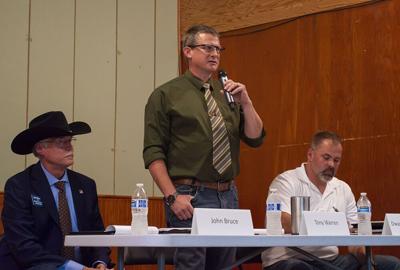

KLICKITAT CO. — With Bob Songer retiring, three candidates are vying to be the first new sheriff of Klickitat County since 2015, and only two will remain after the Aug. 4 primary election. Here’s your introduction.
John Bruce (Republican) has nearly 36 years of law enforcement experience, with two-thirds spent in a command staff position. After starting his career in Allen, Texas, Bruce rose through the ranks to become chief of the Frisco Police Department, overseeing 216 officers and an $84 million budget when he left for Eastern Washington in 2019. Bruce was chief of the Richland Police Department until city administration shifted in 2022 and continues to consult for an international police accreditation commission. Despite being a Texas native, Bruce calls Klickitat County home, and moving was an “intentional choice.”
Dwayne T. Matulovich (Independent) is a lifelong Washingtonian who first served as a volunteer firefighter in Skamania County at age 16. He started on patrol with the Bingen-White Salmon Police Department in 2004 and kept tacking on duties: firearms instructor, field training officer and a member of the county’s former special response team. Matulovich continued those roles when he lateraled to the Goldendale Police Department in 2008 and added search and rescue to the list, eventually acting as the team’s incident commander after joining the Klickitat County Sheriff’s Office (KCSO) in 2015. He left KCSO in 2023 because of his family and “personal ethics,” and has been working for Burlington Northern Sante Fe Railroad since.
Tony Warren (Republican) was born in Skamania County, where his father served as sheriff and where Warren began his law enforcement career as a reserve deputy in 1997. While employed at a Les Schwab in Camas, Warren earned an online degree in criminal justice and joined the Bingen-White Salmon Police Department in 2008, working as a detective for five years until resigning in 2019. Warren then launched his own excavation business that he continues to operate while acting as a detective sergeant for KCSO, which he joined in 2021. Warren regularly participates with the Seattle-based Internet Crimes Against Children Task Force and oversees the office’s field training program.
As of July 17, Warren leads the way with $16,610 in campaign contributions so far, including $550 from Songer himself and $200 from Undersheriff Carmen Knopes. Half of Bruce’s contributions have come from out-of-state donors, the majority residing in Texas, and roughly 48% of Matulovich’s $11,938-total is self-funded. Bruce narrowly has the least cash on hand.
Columbia Gorge News asked each candidate the same six questions; their answers below have been edited for length and clarity.
Question: If you could only pick two, what are the biggest issues facing the Klickitat County Sheriff’s Office right now, and what would be your approach to solving them?
Bruce: First, the biggest issue is the number of deputies. We don’t know if we have the right number one way or the other. Everybody feels like we’re behind, so I would work on that. I have a history of working on stuff like that by creating a personnel study and looking at it from a quantitative background — looking at calls for service, looking at response times, looking at time on scene, whether the calls for service are officer-generated or other — and then calculating out what it would take to not only bring us up to a good number than can respond in a timely fashion, but also to build in time so that deputies can be proactive. That doesn’t always mean writing traffic tickets, it’s also getting out at meetings, stopping in at businesses, talking to folks and just seeing what’s going on. Then, coupled with that, is working with the commissioners to develop a hiring plan once the study is complete. The second thing is developing good relationships with all the other players in the county, and it’s not just law enforcement. I’m hearing that administrations butt heads from time to time, and none will ever going be large enough to do everything all by ourselves. We have to work with all the law enforcement that’s available to us. It’s also about repairing relationships in the communities. We’re a large county, and at the same time, we’re a very diverse county. The sheriff has to be the sheriff for all, not just the ones that voted for him. It’s critical that the next sheriff gets out and meets with all these groups, and gets a feel for whether we are policing in a way that’s consistent.
Matulovich: I recently got the privilege to talk with the current deputies, and the issues that were there when I was there have persisted. Nothing’s really changed, and that would be the leadership. There’s a disconnect between the administration and the deputies. The deputies feel that they’re getting no attention, their voice is not heard and that’s unfortunately leading to burnout because they’re working a lot. I don’t feel that leadership has any idea of the extent, so that’s something I would address. It’s as simple as looking at the schedules. You might have to make some tough decisions that people don’t like, but people need time off to recuperate, because any first responder job is extremely difficult. Having that time with your family or your friends to recharge, or exercising, that helps. Then, adding to that first one is having a staff that works. Unfortunately, the sheriff's older, so getting out and working the road is probably not as realistic as he would like — young at heart, but the body's not cooperating. Having a command staff that can go out there when shortages occur and help out also keeps them in touch with the deputies and the community, so it really starts hitting multiple areas. The other part is trying to build back the trust within the community and that transparency, the accountability. One of the ways that I would address it is by having a trained public information officer, so when there are cases, we don't give out too much information that could hinder the case or revictimize the victim. We don't have to give out the whole report. There's a reason for that.
Warren: The biggest issue is our staffing. We always hear Sheriff Songer say, “We have the same number of people that we did 20 years ago.” We need to add positions, but where do we find the funding? I know there are talks of trying to do a public safety levy, which, of course, is just more money in taxes. If we could get three or four more people, though, it would be huge. Then people can get time off when they want it and we would have more coverage. We try to maintain a minimum of three, but a lot of times we only have two people on, and we’ve got 2,400 square miles to cover. It’s not uncommon for me to go from White Salmon to Alderdale to start a shift for a crash, fire or whatever it may be. For the second one, there’s a lot of efficiency-related things, maybe some public image improving, working on follow-through on cases, getting investigations done correctly and completely, getting reports to the prosecutors and strengthening those relationships. That’s one thing that has bothered me since I came here. Somewhere along the lines, things fell apart between former Prosecuting Attorney David Quesnel and our administration, and it always bothered me that nobody would just walk 40 feet down the hall and figure it out. There’s always back and forth, and that’s not okay because then the community suffers. It’s much more of a struggle for the deputies to get things accomplished when you don’t have the support of the prosecutor. Now that Dave is gone and Alex has filled that criminal role, it’s night and day different. And I’m not saying that it was all Dave’s fault, either. It was my administration as well. I love and respect Bob, and 57 years of law enforcement is amazing. But at the same time, he’s very stubborn. He’s not going to back down from anything, which is good at times and sometimes not.
Question: Sheriff Songer can be a polarizing figure at times. How would you characterize his leadership and time at the helm?
Bruce: I’ve heard people say that he’s one of the best sheriffs that the county has ever had, but he can be polarizing, and that’s a problem. We have to be the sheriff of everybody in the county, and I think we can do it in a more civil manner without going out of our way to polarize.
Matulovich: When he first took office, from my perspective, it was completely different. People were really behind him. I think as time went on, his view or his mission changed. His communication with the public didn’t really explain that complete change, and you can agree or disagree, but you still have to work with the rest of the county. His stances are very firm, which can be respected, but at the same time, it did exactly what you were talking about — it divided our county. The focus should always be on our county, and I feel that it was more about national news media. I don’t feel comfortable in front of a camera, so I don’t plan on being on national news at all. I think that would help focus us back on our county and the issues that are in our county, which he does address, but then like all of us goes off on a tangent or something. We have to stay focused on what’s important — the community and people in our county.
Warren: I have the utmost respect for his 50-some years in law enforcement. He’s got a ton of knowledge — I don’t know anybody else who would have more — but we’ve reached a point with the administration where there’s a bit of a detachment from our daily patrol activities. The guys see that, they feel that. On one side, they want more direct involvement from the administration on the day-to-day activities and calls, especially the major incidents. But on the other hand, I like to remind people that they’re not micromanaging either. As long as you go do your job, you’re fine. They’re not breathing down our necks; they’re not picking on us and telling us we’re doing stuff wrong. It’d be nice to feel more supported, but sometimes that’s a double-edged sword.
Question: If elected, would you consider yourself a “constitutional” sheriff or subscribe to that philosophy?
Bruce: I have no interest in joining some national convention for constitutional sheriffs. There are enough issues to focus on right here in Klickitat County, and I think that’s what has to be focused on. I do see myself as a sheriff who will follow the Constitution of the State of Washington and the United States. For the laws I don’t feel are lawful, I will work with the courts to challenge them, because that’s what the Constitution calls for.
Matulovich: I’ve never really looked into this, and the power of the sheriff is always going to be the power of the people who’ve elected him in there. You vote him in, you vote him out — very strong feeling on that. As for the movement, I don’t need an extra title to be a sheriff, because the sheriff is a constitutional position. I don’t need to follow that ideology because there’s no more or less power; it’s a sheriff.
Warren: Yes, but to a point. The first meet and greet I had, someone asked me if I was a member of the Constitutional Sheriffs and Peace Officers Association, and I didn’t even know what that was. I don’t have any intention of going to that extreme, but I do feel that enforcing and upholding every constitutional right for every person is important. I think that’s the foundation of all the other laws that come after it. If the foundation is not supported and it's falling apart, then what's going to happen to the rest of its structure? My opinions on it align with the Washington State Sheriff’s Association. I’ve gone to some of those meetings, I’ve networked with them and I have a fair number of endorsements from the state sheriffs, but it’s about us coming together on what’s going to be best for our communities. I like to say that I do agree with Bob on a lot of what he says, but I'm not as loud about it. I'm not as hardline on it. There’s some gray area in there, but my campaign is not focused on a constitutional sheriff position, and my administration isn’t going to be either. There’s just no time for it. I want to work more with the deputies; I want to repair all of these relationships and communities. There are other things to do.
Question: Senate Bill 5974, if it survives a court challenge, would implement several reforms for posse member, like prohibiting them from enforcing criminal and immigration law, carrying firearms, using surveillance databases and more. What’s your stance on those reforms, and the posse in general?
Bruce: I support having a posse, and that name, although some people find it offensive, is quite common in sheriff departments across the state. In cities, they usually call them something else, like “Citizens on Patrol.” I’m used to having a good volunteer base. It’s important because we can’t afford to have enough officer deputies to begin with, and it helps to supplement them with volunteers who are willing to go do something free of charge and help out in doing non-law enforcement activities. I’ve been going to the trainings across the county, and I’ve heard them reinforcing that, “We are not law enforcement. We do not have arrest authority.” Regardless of this new bill, they already can’t enforce criminal law, but I think it’s important to change it up. Some of the feelings about the posse are that you can’t tell the difference between a posse member and a deputy, and I agree with that assessment. A standard for the company that I work with is that, if volunteers wear a uniform, it’s distinct from a deputy officer. We would make that change. We would also make sure that they have good policy procedures, and that they’re following said policy procedures transparently with the community.
Matulovich: On the posse, I’ve never really liked them looking like deputies. I think it’s a liability, and I’ve voiced this before, but cops die with their firearms all the time, let alone someone who is not trained with it. So, that part of it wouldn’t be a big change, because I wouldn’t want them visibly armed or looking like a deputy. There definitely needs to be a separation, in my opinion, between a volunteer who’s helping in that organization. A rebranding is probably more of something that I would look toward, and there are some other things that would probably get more people involved, because we are a small community and having volunteers is the backbone. I’m still a volunteer with the county’s Rural 7 Fire Department, and we couldn’t put the fires out if we didn’t have volunteers step up, and that’s the same thing in the sheriff’s office. Does it need to be like the posse? No, I don’t think so. I like the idea of a citizen emergency response team with training tailored to disaster response, because we need people when there’s a wildfire, flood or earthquake. If you have people in the community with that knowledge, we can get federal funding for it. Also, having them help support fairs and parades is great. Getting more people involved in being a volunteer can help them understand what law enforcement does, and if they’re volunteers, they can help with fire departments, they can help with EMTs. We can branch out and make it an umbrella volunteer organization not just specific to the sheriff’s office, but my biggest change is that they wouldn’t look like law enforcement. They don’t need to have a badge and patches. I realize it says posse, but it’s in small print and easily mistakable. Officers are also targets and killed in the line of duty often. I wouldn’t want somebody to get hurt because they looked like a cop and weren’t.
Warren: There’s a select few that are allowed to carry firearms, but they can’t enforce criminal law — they have no authority, and they don’t do it now. I know people have concerns about them doing that, or concerns about an image of doing that, so to me, that’s more of an individual problem than a group problem. Just like anything else, there’s probably a couple of people out there who seem too much like actual cops when they shouldn’t be. There needs to be a little change there, maybe some public education even, so they know what the difference between a posse member and a deputy is. Posse members should not be behaving as deputies. As far as the armed part, I’m still feeling that one out. We’ll have to see where SB 5974 ends up. They do have firearms training, the ones that are armed now, but they also need to have defensive tactics training, weapons retention, and guidelines on when they will be armed. Court security is fine as long as they’re capable, and that helps avoid hiring somebody to do the courtroom security. I like the posse. I think their volunteerism is great. One of the things I like to remind people of is that they do have additional training in first aid and CPR. I went to one of theirs once and it was more advanced than what we get. As a result, there’s more people in the community that might be there when somebody has a medical episode in a grocery store or is in a car crash, and posse members are oftentimes first on scene. I think they’re helpful, but I understand the concern for some people with them, too, and we can work to fix that.
Question: Klickitat is a diverse county, especially in the southwest corner, where a substantial Latino population calls home. Sheriff Songer has made several public statements about assisting U.S. Immigration and Customs Enforcement (ICE). What’s your perspective?
Bruce: Enforcing federal law is not a county’s issue. We do not enforce federal law. Having said that, if any federal agency — ICE, FBI, DEA — comes into the county and is lawfully working and asks for assistance, we’re willing to give that assistance, because that’s what law enforcement does. We partner with DEA all the time on drug issues because they can file things federally, it helps out the local courts quite a bit and you often get a better sentence, so I’m not opposed to working with them. Now, it’s not our job to ask where you’re a citizen, unless we arrest you. Under the Geneva Convention, probably 50% of the nations require us to inform their embassy that we’ve taken one of their citizens into custody. For the other half, it’s up to the individual, and Mexico is an example. If you’re arrested and a Mexican citizen, we have to ask whether you want us to notify your consulate or embassy, and then we’ll document that in the report. It’s not our job to go out and enforce immigration.
Matulovich: If they have the proper paperwork, then they can do their job. I don’t feel that I need to reach out or give them tips. If law enforcement is doing their job, we’re going to hold people accountable for the laws they break, so I don’t feel that we need to put anything out there to come round up people.
Warren: I’ve been present when Bob has said things like, “Come down here, you can ride with me and we’ll round them up,” and I don’t think that’s necessarily right. Under the Obama administration, we would deal with a fair amount of migrant workers, and I would stop somebody who didn’t have any ID, didn’t have a driver’s license, didn’t speak English. I could make a phone call, and immigration services could interview him and pretty consistently tell me within 15 minutes whether he was lying to me or if he was being honest. They would know his family, where he was from, they would have records and documentation, they’d be able to look stuff up. If they were being honest, cool, here’s your ticket and you’re on your way. I’m pretty lenient on that stuff. Sometimes they weren’t honest. We’d get them fingerprinted and they had a warrant, or they’d been previously deported for crimes. I do feel that if they’re here illegally, and they’re going to live and work, that’s fine. I don’t have an issue, just don’t commit crimes. If you know you’re subject to deportation and know you’re illegal, don’t get a DUI, don’t get arrested for assault, don’t deal drugs — be better. I think we don’t need those people in these communities. The Biden administration let so many people in here, but I personally think what’s done is done. We need to have a path for vetting these people so they can have their citizenship right. Yeah, we do have a large Hispanic population here in Bingen-White Salmon — some of them are friends of mine, my son-in-law’s family is Hispanic — so I’m happy to help them where I can. Again, there are rules, but just because someone came here illegally doesn’t mean they need to get rounded up and sent back right now. We don’t communicate with ICE on a regular basis. I don’t know of any other incidents, other than one or two emails from an undersheriff that probably didn’t know better, that have gone out. We don’t call them. I liked it when we could, because then we knew who we were dealing with, but we will not be working with ICE. This is something we’ve talked about at group meetings with the sheriff’s association, other chiefs and attorneys. If ICE needs to come to town and do immigration enforcement, which I don’t see happening here, that’s for them to do. We’re not going to assist them, but if it gets out of control or something happens, we’re going to show up and protect everybody’s safety, whether it’s the immigration officers or the residents.
Question: Are there any policies or intended changes that you’d like to highlight?
Bruce: Well, I don’t know all of the policies and procedures that they have in place today. But, having a background in policies and procedures, I would want to review all of those with the county prosecutor and the union to update those if needed and be transparent with the county about them, so people can see what our policies are. Not all the procedures will be public, because some of those we have to hold close to our hearts, but the major ones, like use of force, absolutely will.
Matulovich: Currently, the county has a warrant team. I would like to go back to a special response team. The county does not have a standard operating procedure for this warrant team, which I feel that is a liability and something I would change. Again, I’m very liability- oriented — I don’t want to just “cowboy it up.” I’m definitely a policy type of person, and we need to follow those policies. We also don’t have other agencies participating in this warrant team, and if we could draw in more people, we could reduce the money we’re spending on it.
Warren: Deputy support for one is going to be big — getting them the training they need, the time off they need and just having an administration that has their back. As long as they’re doing right, then they’re going to have that support. Others on my list here are protecting the rights of everybody, accountability and professionalism. Public trust is going to be built under transparent, ethical leadership that’s committed to efficiently serving everyone with fairness and respect. As for community involvement, having a school resource officer focused on preventing crime before it starts is something deputies want to do, it’s just hard to find the time. Also, strengthening relationships with other departments, not just law enforcement, but the prosecutor’s office and other county officials as well. Lastly, being fiscally responsible and making sure our money is well spent and that we’re not wasting it on unnecessary junk.
•••
Click here to view Klickitat County’s Voters’ Pamphlet. For more information, visit Klickitat County’s election and voter registration webpage.


Commented