
By Emma Renly
For Columbia Gorge News
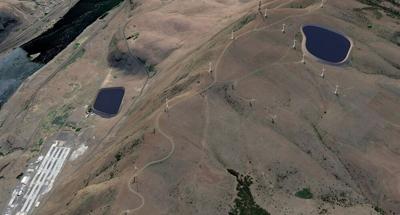
GOLDENDALE — An environmental impact statement for the Goldendale Energy Storage Project, situated adjacent to John Day Dam, states the venture would require an initial 2.5 billion gallons of water to fill two reservoirs.
Doing so is a six-month process, and the closed-loop system will also require an estimated 117.3 million gallons each year to replace water lost through evaporation and seepage. To detect and contain leaks as water travels from the upper to lower reservoir via a 2,000-foot-long underground pipeline — generating 1,200 megawatts of electricity — the lower reservoir will be constructed with a double liner separated by a sand drainage layer.
Additionally, plans show a new water fill line connecting the lower reservoir, built on the former Columbia Gorge Aluminum smelter site, to an existing water supply pump station operated by the Klickitat Public Utility District (KPUD). It pulls water directly from the Columbia, and three wells will also provide groundwater.
KPUD holds water rights totaling 5.08 billion gallons annually under the Cliffs Water System, one of its nine independent water systems in Klickitat County.
The amount is equivalent to a creek running at 35.3 cubic feet per second (cfs) year-round — on a hike, a stream of that size would be easy to step across. In comparison, the Columbia River runs on average 190,500 cfs at the John Day Dam.
KPUD acquired those water rights from the former Goldendale Aluminum Company in 2005. The company previously held an additional 2.3 billion gallons of water rights that were relinquished.
Project owner Copenhagen Infrastructure Partners (CIP) plans to purchase a share of the 5.08 billion gallons of water from KPUD.
“We agree with the finding of no significant adverse impact on ground and surface water hydrology,” said Jim Smith, then-general manager of KPUD, in a 2022 public comment. “In addition to the benefits already mentioned, the project will also provide significant revenues to the PUD for providing water and electricity service, and hence, will provide significant additional benefits to the residents of our county.”
The exact estimation of tax returns to Klickitat County is unknown. While Washington House Bill 1960 guides taxation policy for renewable energy facilities, pump storage was exclusively removed from the language. There’s no other project of this type being privately developed in the state.
The land where both the upper and lower reservoirs are to be constructed is owned by NSC Smelter LLC. Additional water rights have been secured from KPUD for future uses on the land, such as for energy generation, storage and a likely data center.
Despite Yakama Nation opposition, the Federal Energy Regulatory Commission (FERC) issued a 40-year license to the project earlier this year. Construction would destroy treaty-protected resources and sacred land known as Pushpum, or “Mother of all roots,” as previously reported by Columbia Gorge News.
Yakama Nation, alongside nonprofit Columbia Riverkeeper, unsuccessfully sought a rehearing with FERC, later filing separate petitions to the 9th U.S. Circuit Court of Appeals in May. According to a press release from Columbia Riverkeeper, they allege FERC failed its tribal consultation duties and violated multiple federal laws.
Anticipated construction start is in 2027, dependent on the legal challenges, with commercial operation launching between 2031 and 2032.
•••
Our journalism needs your support. Read more and subscribe at columbiagorgenews.com.


Commented