
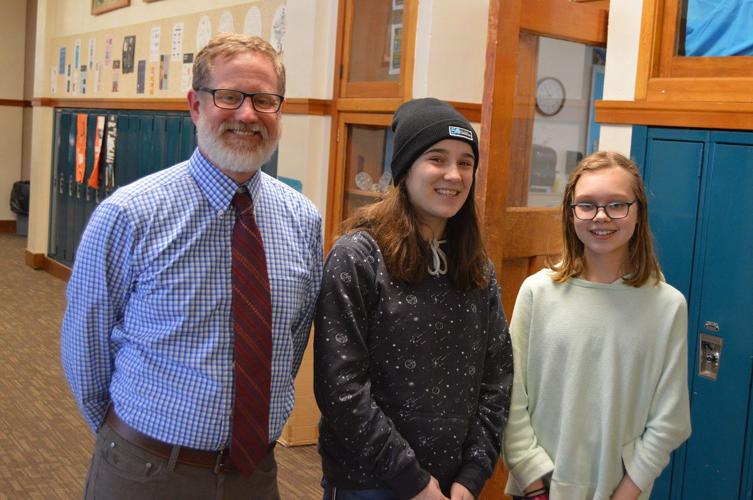
Seventh graders Everley Boonstra and Anna Southall saw a problem at Hood River Middle School and decided to do something about it.
The problem: Plastic cutlery in the cafeteria was being used — and thrown away — daily. At best, it would be landfilled. At worst, it would end up in the ocean, where it effects sea life and humans alike.
The solution: Metal silverware that can be reused indefinitely.
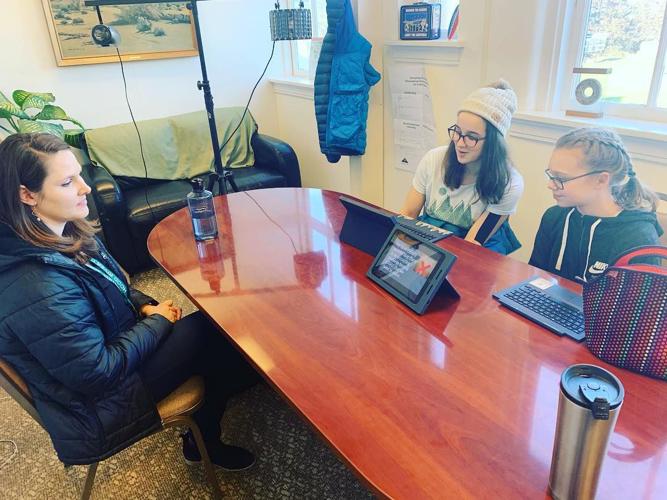
The two began texting in early December, and came up with a plan: They created a slideshow using their school iPads — on their own time — and scheduled a meeting with Principal Brent Emmons a few days later to present their ideas.
“We did a little research and put together a slide show,” said Anna. “It wasn’t accurate the first time, but we got more accurate data for our next presentation.”
The girls had overestimated how many students were eating hot lunch each day and therefore how much plastic silverware was being thrown away.
“They came in with their iPads and a Google slideshow, and presented why plastic utensils are a problem and some solutions to that problem,” said Emmons.
Every week for six weeks, he met with the girls and helped them “uncover more problems and come up with more solutions, like why we have plastic and the issues with metal utensils. I encouraged them to look at things differently,” he said.
“It’s what I love — seeing kids who want to make the world a better place, then act in a respectful and responsible way to engage the right people to effect change,” he said. “To encourage kids to think about solutions to problems that exist now.
“It’s a good manifestation of why we do what we do. Super cool.”
He had the girls interview HRMS Head Cook Veronica Jimenez to get accurate data for an updated slideshow.
“Mrs. Jimenez said around 200 students got hot lunch each day,” said Everley.
Data finalized, the two scheduled an appointment with Heidi Benson, director of nutrition services for Hood River County School District.
“We finalized the data and met with Ms. Benson, and she thought it was a great idea,” said Anna. “We figured out that each year, HRMS throws away 34,800 plastic utensils. We thought that was a big number and we wanted to reduce it or take it to zero.”
“I watched the presentation and thought it was really good,” said Benson, “They put a lot of thought into it — it was really great. These are smart girls, and they really care about the environment and want to make some changes.”
Benson agreed to the reusable utensils. Now in her third year with the district, she had looked into the cost of reusables versus plasticware when she first came on, and found reusables were less expensive, even if they were accidentally thrown away. She had been making the switch in various schools, including Wy’east Middle School last year after a class wrote letters urging the change. HRMS had been somehow overlooked.
“I had it in my mind to switch everyone over, so (after seeing the presentation), I was like, ‘Oh my gosh, we’re not doing this? We need to do this!’ So of course I wanted to make the switch,” she said.
Emmons had concerns about the new silverware being thrown away — from habit after using disposables for so long — so he had Everley and Anna brainstorm ideas for an ad campaign of sorts to let students know about the changeover before it went “live.”
“They had a lot of fun ideas for how to keep kids from throwing away utensils,” Benson said.
The campaign included posters and announcements over the intercom to “help students be aware of the problem before we roll it out,” said Emmons.
The new utensils were set to make their debut Feb. 11 — but school was canceled that day, pushing the debut of the new silverware to Feb. 15.
“They stuck with it and didn’t give up,” said Emmons. “That’s an important part of creating change.
“… They encountered a problem and researched a solution. I like that they stuck with the problem until they could affect change to create a better world.”
The girls plan to continue their reusable silverware campaign in the future. Said Anna, “We want to make a big difference in our community. We’ll continue to do this at the high school. Once we get to the high school, we’ll do a high school one, maybe Cascade Locks.”
*
Benson noted that all schools in the district, with the exception of Hood River Valley High School, use trays for their breakfast and lunch programs. Dinner programs at Parkdale, Mid Valley, Wy’east and Cascade Locks are served using paper boats and plastic utensils due to the limited number of staff during these events available to wash and put items away.
The high school and Cascade Locks both use plastic utensils; at Cascade Locks, again, because of staff, and at HRV, because students are spread out around the building during lunch period.
Even if students do throw away the odd utensil, switching to reusables does save the district money, Benson said. “At Mid Valley, we save $3,000 through the whole school year just by switching to silverware,” she said.
The high school and Cascade Locks both use plastic utensils; at Cascade Locks, again, because of staff, and at HRV, because students are spread out around the building during lunch period.
Even if students do throw away the odd utensil, switching to reusables does save the district money, Benson said. “At Mid Valley, we save $3,000 through the whole school year just by switching to silverware,” she said.


Commented
Sorry, there are no recent results for popular commented articles.