
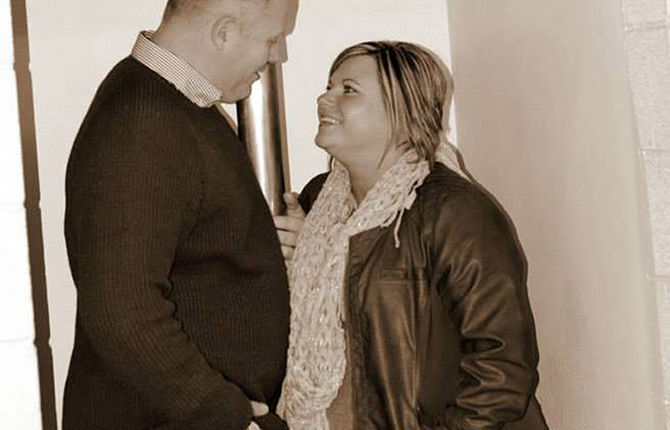
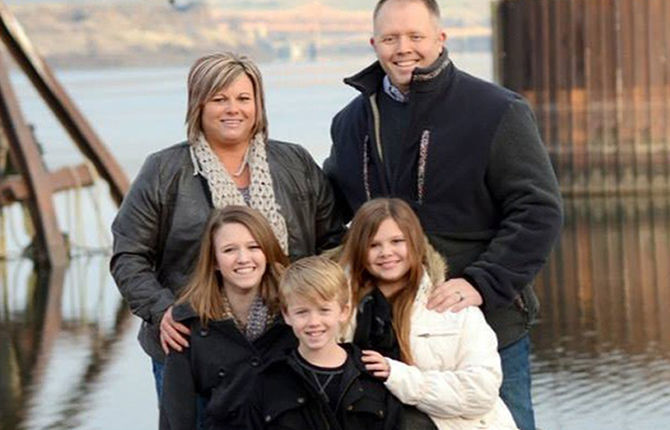
Cheree Gillette recently attended the funeral of a 34-year-old childhood friend who died of Acute Respiratory Distress Syndrome.
The loss of her friend particularly shook Gillette, because she herself had nearly died from the same illness early this year.
Gillette, 40, a longtime The Dalles resident and coach, now lives in her native Hermiston with husband Jeremy, a paramedic/firefighter who worked at Mid-Columbia Fire & Rescue.
Together, they tell a story of beating very long odds through their faith, her doggedness, his willingness to stand up to doctors, and, quite possibly, a trial drug.
She only recently began to feel fully recovered. The timing is perfect, because “My biggest thing right now is telling people to get their damn flu shots. I will never miss one again, for any reason.”
She didn’t get a flu shot last winter — she always had a cold, it seemed, so she took a pass — and ended up getting H1N1 flu, which went into viral pneumonia, and then into Acute Respiratory Distress Syndrome, which has a less than 15 percent survival rate.
“Unless you are running a fever, we suggest everyone get vaccinated,” said Teri Thalhofer, director of the North Central Public Health District. The very young and old are especially susceptible to flu, which kills thousands yearly.
Cheree spent 23 days in the hospital, 14 of them in a medically-induced coma. Jeremy was told twice to prepare for his wife’s death.
The saga began in late January, when she got really sick. She saw a physician’s assistant, and told him she’d had a flu-pneumonia combo before, and probably had it again. He tested for flu, which later came back negative, listened to her lungs and said “something was rattling around in there,” but never x-rayed her chest. He sent her home with a cough prescription she had to ask for.
Two days later, Jeremy finally insisted she go to the ER. She could barely lift her head, much less walk. She was soaked in sweat, nauseated and gray. At the hospital, her oxygen saturation was 78 percent, and normal is 95-100 percent. Her lips were blue. Breathing treatments worked only briefly.
The last thing she remembers was getting moved to the ICU.
Jeremy takes over telling the story. The next day, he continually pressed for her to be intubated —where a tube is placed down the throat and hooked to a ventilator —and transferred to Portland.
At mid-afternoon, when she had “all but stopped breathing,” she was intubated.
A follow-up x-ray “was really, really, really bad,” he said. Her lungs were nearly completely filled with fluid. There was just a half-dollar patch of clear lung at the very top.
She was Lifeflighted to Oregon Health & Science University.
When Jeremy got to Portland, “The doctors took me out of the room and told me they didn’t think she’d survive it.”
Getting that news “was the single most horrible thing I’ve ever heard in my life,” he said. “There’s no way to articulate how that feels when somebody tells you your wife’s not gonna live. It’s very helpless. But it just seemed to happen so fast, it didn’t make sense. She went from a sore throat on Tuesday to being in ICU on Saturday. The worst part was figuring out how to tell my kids.”
They never did disclose to their three children, Mariah, Kennedy and Cody, how serious their mother’s illness was. They asked friends not to discuss it in front of their own kids. Facebook updates were strictly upbeat.
At OHSU, a junior doctor wanted to put her on a trial drug, an enzyme to let her body kick out fluid. A friend told him the trial was at a fairly safe stage. “It couldn’t hurt,” he figured. “From then on it was a waiting game, she got better in small bits and pieces.”
The second day, they put her in a pronation bed that totally enclosed her, rocked her back and forth, and held her prone for 16 hours out of every 20. The lungs have more surface area on the back, “so they rolled her on her stomach so the fluid would roll on her front and free up more surface area” of the lung, Jeremy said.
But then, Friday at 4:30 a.m. he got a call that she’d been accidentally extubated when she was given a chest x-ray and he needed to get back to the hospital right away — he was staying in Portland with friends — because they didn’t know if she’d survive.
“Her vocal chords were so swollen it was hard to re-intubate,” he said. The episode cost her all the progress she’d made that week.
Back to square one, she still crept incrementally better. Progress was so slow it was described to Jeremy as “millimeters on a scale of miles.”
Early the following week, her lone kidney started to fail. The doctors suggested end-of-life planning, and Jeremy and her siblings told them in a “rather pointed” meeting that they weren’t thinking that way.
They changed meds and her kidney function started improving.
Running back and forth to The Dalles, Jeremy spent all the time he could with Cheree while his mom helped hold down the home front. He’d lay on the ground beneath Cheree’s bed as she lay encased and prone. The only place he could actually touch her was a three-inch square spot on her back.
About four days before Cheree woke up from her induced coma, another person at the hospital with her illness died, shaking everyone badly. “It kind of came to a head,” that day, Jeremy said. “They weren’t dropping one of her settings the way the initial doctor said. I kept asking and asking and asking and it just wasn’t getting done,” even by 11 p.m.
Cheree was under the care of a day-shift doctor and a night-shift doctor. Both doctors were using different, but both medically accepted, protocols. Jeremy asked to talk to both doctors the next morning, and he laid down the law. “I said, ‘You can’t do this. You can’t go back and forth on treatment because you don’t know which one works.’ I made the daytime doctor in charge.
“So the daytime doc took the reins and we stayed with his protocol and in three days she woke up.”
He can’t remember what day it was, but he remembers how it felt. “She woke up and she was a little loopy form all the medications they gave her, and I was just really glad to see her awake. She opened her eyes for the first time when I was in there with her.” He paused, overcome, and told a reporter, “Give me a second, would you?”
Cheree’s retelling is more lighthearted: “My first memory was talking to my brother and sister and telling them I wanted a Slurpee.”
A couple days later, her prognosis began improving rapidly, “literally every couple of hours,” Jeremy said.
They expected her to be on a ventilator for a week after she woke up. But when they took her off it as a test, “she breathed on her own right away.”
She was so weak she couldn’t talk or walk. She was moved to a general care floor for about a week, where she worked hard at getting better and plotted her escape from the hospital.
She became a local legend when some of Jeremy’s co-workers came to the hospital with a patient, and dropped in to visit her. She tried to talk them into letting her sneak into the empty ambulance and hightail it home.
The plan was to release her to a rehab facility, but she improved so rapidly she just went home – on Valentine’s Day.
She was still very sick and confused about what had happened. Though she’d lost 20 pounds, she was swollen from steroids and lying on her belly. When she first came around, her eyes were swollen shut. She looked like a car crash victim, Jeremy said.
She struggled to realize that she’d basically “gone to sleep in January and woke up in February.”
Her second day awake was very emotional for her. “I was teary and the reality of how long I had been gone away from my kids had hit me, and that was tough.”
But the fact that she nearly died didn’t hit until she got home. “And even sometimes, obviously, it still hits me now. The seriousness of it. A lot of it, I had to be told.”
The pronation bed left a “pretty decent scar” on her face. At first, she had a “really hard” time with it. Eventually, she came to see it as her “battle scar” and her “price for being here.”
It’s faded a lot, but “I would guess it’s always going to be there. Kind of a precious reminder, I suppose.”
Such grave illnesses are traumatic and Cheree saw a counselor three times for treatment of Post-Traumatic Stress Disorder. “It was hard for me to realize I had missed out on three weeks of my life, which sounds crazy, but it was, wow, to go to sleep and wake up and it’s later and all of this stuff has happened around me. It was weird.”
The pronation bed, in particular, was traumatizing. She had nightmares about being confined in it. Finally, she asked to go see the bed, to see how it worked, so they paid a visit to the hospital.
The nurses who cared for her were “elated” to see her, she said. “They’d seen a lot of death, so I think it was nice for them to be able to see something positive.”
She learned to deal with the trauma, with the help of some medications and breathing techniques, “and really, just talking it through.”
Having lived, she felt like “all eyes are on me now. ‘What’s she going to do next? She’s this miracle, she’s survived.’ It was really overwhelming… We had so many people in the community come together and take care of us and it was such a blessing, but I’m not always good at accepting that, so it was overwhelming.”
Jeremy planned a big bash for her 40th birthday on May 18, but Cheree didn’t want that. “I just wanted to be with my family and not make a big to-do.”
At first, she felt she had to do something big with her life to prove God spared her for a reason. Now, it’s evolved to her thinking that “I have to take care of me.”
She’s always cared for others, including coaching volleyball, basketball and softball. “I think in taking care of myself, I’m going to figure out what that purpose is, if that makes sense.”
She credits God and Jeremy for her life. “I fully believe him being my advocate, that and faith, is what saved my life. He didn’t back down. He didn’t let them change his mind. He said, ‘This is how it’s going to be and that’s it.’”
Jeremy, meanwhile, credits his wife’s fighting spirit and both say the trial drug must’ve played a part. They weren’t told if she got the placebo, but a comment from a researcher tipped it for them.
Cheree asked how other patients in the trial were doing, and he said, “There aren’t any.”
She was tired for months. Her voice was gravelly. Only now does she feel like “I’m getting my sass back.”
Going to her friend’s funeral recently was “really hard. At one point you feel like, ‘Why did I survive but she didn’t?’ But when I spoke to her mom and gave her a hug, she said, ‘They marvel at you down there. You are just a miracle to them.’”
She said, “A lot of doctors had heard of me -- the survivor.” She also heard she’s been the subject of some case studies.
Her 23 days of hospital care cost $1.5 million, but a good insurance plan meant little out of pocket expense.Her illness prompted a review and a major change in their lives. “We just kind of took a look at things and said, ‘You know, it’s time to go home,’” Cheree said. “Which is funny, it was hard to leave The Dalles. Because The Dalles is home. I miss it. I miss the people.”


Commented
Sorry, there are no recent results for popular commented articles.