
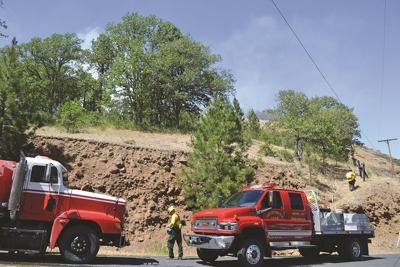
The fire danger rating on Klickitat County lands protected by the state Department of Natural Resources went from “moderate” to “high” last Saturday, the DNR announced the day before.
Moreover, the DNR raised the industrial fire precaution level (IFPL) in the County from Level 1 to Level 2, which the DNR calls a “partial hoot owl” shutdown.
Under partial hoot owl regulations, most forest industrial operations, including firewood cutting, on public and private lands protected by the DNR are limited to the hours of 8 p.m. and 1 p.m. Fire equipment and fire watch are mandatory under Level 2 activities.
A countywide ban on outdoor burning in areas protected by the DNR and by local fire districts took effect June 1, per order of the Klickitat County Board of Com-missioners. The moratorium began a month earlier than normal because of drought conditions in the County.
The County has been hit with some small fires already this fire season, but those were manageable. Fire chiefs are hoping for less but nothing more.
Fire District 3 Chief Chuck Virts said the district is running ahead of total call volume so far this calendar year. Current numbers are 150 responses versus 67 for the same period a year ago.
“In terms of wildland incidents, we are also ahead of last year’s totals,” Virts said. “This year’s first wildland response was in February. That’s unusual and is reflected in the numbers for the district so far this year: eight wildland fire events so far versus three one year ago.”
Virts said he did not have countywide district-by-district statistics, though he did touch base with DNR “to get a feel for their experience to date.”
He learned DNR’s total responses are currently at 45.
“On a comparison basis, they are at half of last year’s responses, which were 89 for the entire year,” Virts noted. “Overall, the fire season is shaping up to be a busy one, based upon the experience of our district and DNR.”
As for the IPFL increase, Virts said Level 2 is now in effect in the County and all of central Washing-ton as far north as Chelan and Douglas counties. Skamania County is still at Level 1, under which fire equipment and fire watch are required during and after operations.
Elsewhere, managers of the Cold Springs Fire near the city of Brewster in Douglas County announced Monday the fire was contained about noon. Demobilization of firefighters occurred about two hours later.
State fire assistance was mobilized under the Washington State Fire Services Resource Mobilization Plan in support of local firefighters working to contain the Cold Springs Fire. Washington State Patrol Chief John Batiste authorized the mobilization of state firefighting resources on June 13 at the request of Douglas/Okanogan County Fire District 15.
The fire started at about 10 a.m. last Saturday, June 13. The cause of the fire is under investigation by the DNR. The fire grew to an estimated 1,064 acres before containment was achieved. One residence, homesteads, and wheat crops were threatened by the fire, but no evacuation orders were issued.
Mobilization specialists from the Fire Protection Bureau ordered 24 engines, four water tenders, a bulldozer, a 20-person hand crew, two helicopters, and a Type 3 Incident Management Team to supplement the resources that were already fighting the fire.
Total cost of mobilization for the Cold Springs Fire was estimated at $175,000.
According to DNR, under the State Fire Services Resource Mobilization Plan, the Fire Protection Bureau coordinates the initial dispatch and continued administrative oversight of re-sources and personnel for the duration of the incident. The Mobilization Plan is implemented to provide a process to quickly notify, assemble, and deploy fire service personnel, equipment, and other resources from around the state when fires, disasters, or other events exceed the capacity of local jurisdictions.
Fire District 3 had to call for state assistance in September 2012 for the large-scale Highway 141 Fire in the Husum area.


Commented