Some clouds this morning will give way to generally sunny skies for the afternoon. Areas of smoke and haze are possible, reducing visibility at times. High 96F. Winds NW at 5 to 10 mph..
Tonight
Clear skies. Areas of smoke and haze are possible, reducing visibility at times. Low near 60F. Winds light and variable.
Welcome to February! Our shortest month continues to provide great views of the bright planets and the stunning winter constellations — when skies are clear.
Nights are still long in February, but sunrise is coming earlier and sunset later. At the start of the month, sunrise will be at about 7:27 a.m., with sunset at about 5:12 p.m., a daylight length of 9 hours and 44 minutes. By the end of the month, sunrise will be at about 6:45 a.m., and sunset will slip back to about 5:51 p.m. Daylight will increase by about an hour and a quarter in the month.
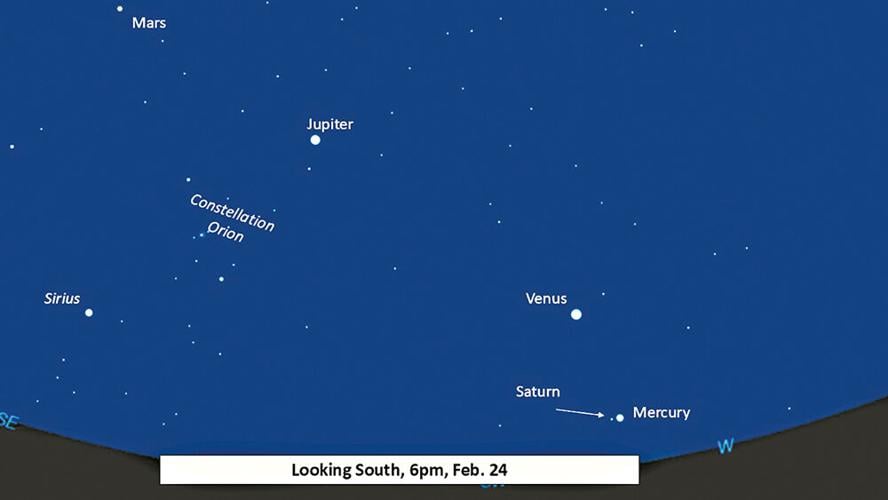
February continues the run of great months in which to view the bright planets, although Saturn leaves the evening sky during the month. Mars and Jupiter ride high in the southern sky, with Mars located in the constellation Gemini, with Jupiter to the right of Mars, in Taurus. Venus is a bright beacon low in the western sky. Saturn is located below Venus in the west, and by the end of the month will hug the western horizon. If you have a good view of the western sky, look for little Mercury below Venus, after about Feb. 20. It will be a bit brighter than Saturn. On Feb. 24, Saturn and Mercury will appear right next to each other, low in the west. Look at about 6 p.m. if you have a good view low in the west.
Visit the Goldendale Observatory to view the planets and other celestial delights. Observatory Director Troy Carpenter told me, “February 2025 is a month of planets. We get our last glimpse of Saturn and his popular rings until late summer. The crescent phase of Venus will be viewed all month, along with bright Jupiter and his famous moons. The red disk of Mars, who was at opposition in January, will also be offered. And our all-time favorite object, the Orion Nebula, will be seen every night which weather and moon phase permit.”
Before heading to the Observatory be sure to get an appointment — check out the “visit” link on the website at goldendaleobservatory.com for details.
February’s full Moon will be on the 12th, with new Moon to follow on the 27th. We’ll have a beautiful sight at the start of February, with the waxing crescent Moon located just to the left of brilliant Venus, and above Saturn, low in the western sky. On the 5th, the Moon will lie just to the right of the star cluster Pleiades. The Moon will lie above Jupiter on the 6th, and just below Mars on the 9th.
As Earth moves through its orbit around the Sun, the constellations we view continue to change. Bright winter constellations, including Orion, dominate the southern sky. The great square of Pegasus and Cygnus the Swan drop to the western horizon. In the east, Leo the Lion rises above the horizon, just to the right of the Big Dipper. Looking north, we see the “W” of Cassiopeia in the northwest, and Ursa major (with the Big Dipper) in the northeast, on the other side of Polaris, the north star. You may observe a bright star low in the northwest — that is Deneb, the brightest star in Cygnus. That constellation and star are high overhead in summer months.




Commented