
By Nathan Wilson
Columbia Gorge News
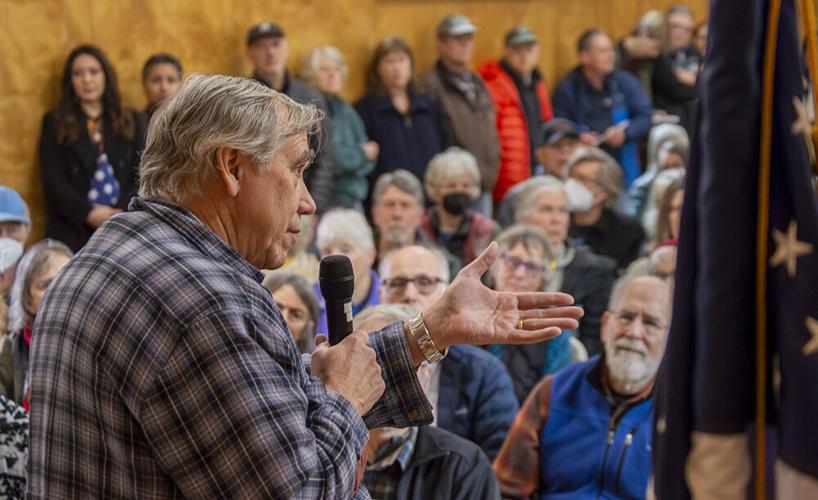
HOOD RIVER & WASCO CO. — On Friday, Feb. 6, Oregon Sen. Jeff Merkley held two well-attended, wide-ranging town halls in Mt. Hood and The Dalles. Just off Highway 35 south of Parkdale, the first question raised touched on immigration enforcement.
“We now have secret police in America,” Merkley said. “We have watched police with no markings — who they are, nothing on their car — go and grab people off the street or knock down their doors and grab them, disappear them.”
In response, he’s backed legislation to ban the U.S. Department of Homeland Security (DHS) from employing facial recognition technology and create a pathway for holding Immigration and Customs Enforcement (ICE) agents civilly liable. Other provisions, like once again protecting sensitive locations, prohibiting officers from racial profiling and improving identification, are among the list of 10 reforms that Congressional Democrats are pushing for prior to the department’s Feb. 13 funding deadline.
A day prior, Senate Majority Leader John Thune called the demands “unrealistic,” even though some, like requiring a judicial warrant to enter private property, have decades of legal precedent. The appropriations bill for ICE, which follows the killing of two U.S. citizens in Minnesota that sparked local protests, as previously reported by Columbia Gorge News, also includes funding for the Federal Emergency Management Agency and airport security personnel.
“ICE has so betrayed the law, including constitutional law, that they’ve completely lost their legitimacy,” Merkley said in a separate interview. “I think that agency needs to be torn down to the studs and rebuilt from scratch.”
But on whether those across the aisle will claw back any funding, he isn’t confident.
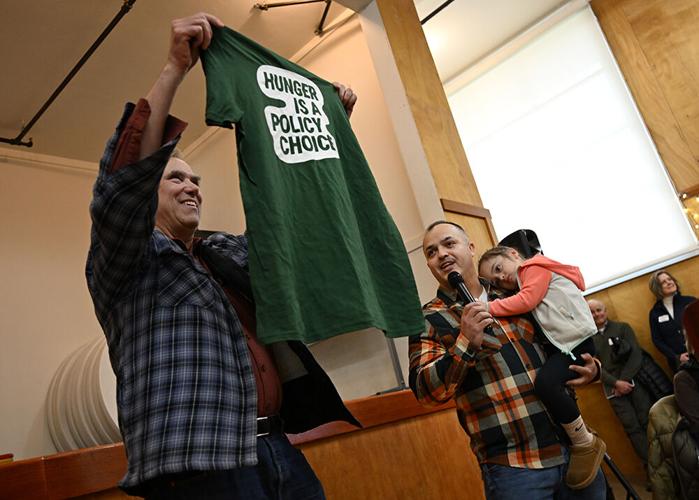
For their work in supporting local residents and documenting ICE arrests, Merkley awarded Arturo Leyva and Samuel Murillo, two of the Hood River Latino Network’s co-founders, with an American flag that was flown over the Capitol. Out east, Merkley presented the same honor to United Way of the Columbia Gorge, which fundraised money for those impacted by the Rowena Fire last summer.
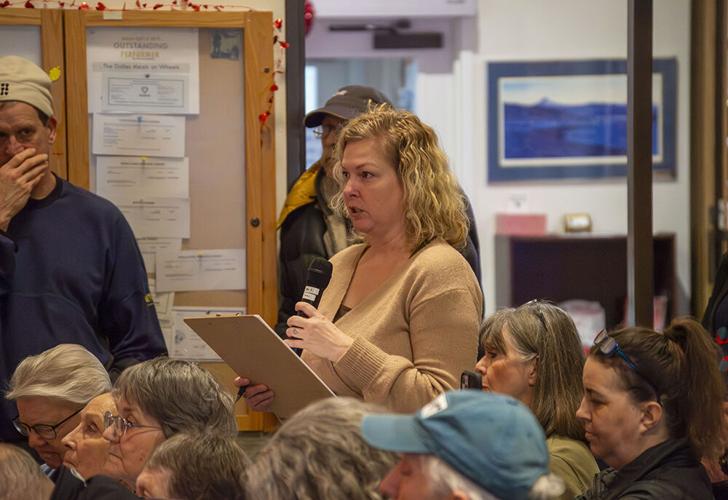
Attendees at both events questioned Merkley about artificial intelligence. While he didn’t take a stance on The Dalles’ effort to store more Dog River water via a bill sponsored by Rep. Cliff Bentz, which city officials deny is for the purpose of satisfying Google’s future demand, Merkley emphasized the acute stress that data centers place on water and energy resources. In an ideal world, he wished that AI “would just go away.”
Other topics included cryptocurrency, threats to national parks and monuments, the pharmaceutical lobby, election security and corruption (including Amazon CEO Jeff Bezos’ recent $40 million licensing of the “Melania” documentary). Asked if there were any recent examples of bipartisanship in Congress, Merkley could only remember one: voting to release the Epstein files.
A common throughline, however, was executive overreach and the erosion of norms that used to guide a functioning government. Several people acknowledged Merkley’s efforts to fund local projects, like securing $2 million for the Big River Community Land Trust to build affordable housing. But given the administration’s tendency to withhold funding, he was skeptical whether those dollars would ever trickle down.
“The strategy of the executive branch has been, ‘Well, we can just ignore this, and if you don’t like it, take us to court.’ And the courts can’t move fast enough to respond to that,” Merkley said to those at the Mid-Columbia Senior Center. “In a strongman state, one person decides, and that’s the president.”
At multiple points, he referenced a handout outlining 10 strategies often employed by authoritarian governments across history. From weaponizing the justice system to suppressing dissent with the military, he said that President Trump is employing each one and identified two main ways to prevent further backsliding: robust, peaceful protests and overwhelming turnout come midterms.
“I don’t have the votes to pass these bills now, but there might be the votes in January a year out, and that’s what I’m hoping will be possible,” Merkley said in closing. “To be frustrated and angry alone is to be depressed, but to be frustrated and angry and organized with others is to be energized and effective.”


Commented