

THE GORGE — This young nonprofit started with giving a few youth who identified as Black, African American, Black bi-racial or Black multi-racial a much-needed space to celebrate and learn about their culture.
“With others who looked like them and understood their experience, they soon learned that their families as well as adults identifying in the same way also were feeling isolated and seeking connection too,” wrote Robin Style, one of the organizers.
Now Black in the Gorge (BiG) is growing to encompass annual celebrations, fundraising, and a new scholarship for locals.
Among the founders were Ann Harris and her daughter Stephanie, who worked as a counselor at Wy’east. Three years ago, “She engaged with a student of color, a Black student, who was very frustrated being in this white world and didn’t really know how to identify herself and be herself and know herself,” said co-founder Linda Floyd.
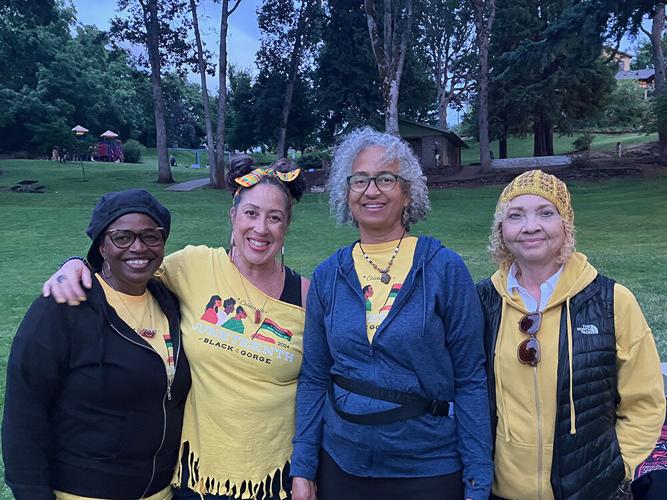
So a group formed Black in the Gorge and started seeking donations, experiences, and ways to celebrate the Gorge’s vibrant multiracial arts and culture. About 40 have joined up.
“It’s a great organization that provides mutual support for inhabitants of the Gorge who identify as Black, who feel isolated. And we continuously provide cultural programming and events that help bring the community together in unison and in unity, to celebrate Black heritage and multicultural heritage,” said August Oaks, one of BiG’s newest members. “There’s not many organizations that do that here.”
Just 1% of Hood River and Wasco county residents identified as Black, and a little over 3% selected two or more races in 2024 U.S. Census data.
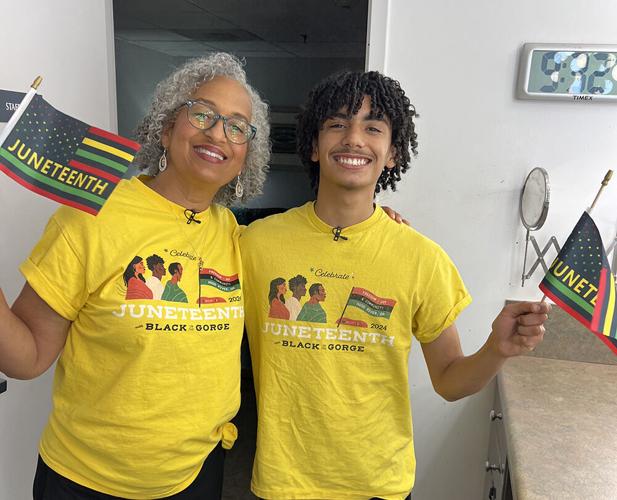
Quincy Butler, one of the first students aboard the new nonprofit, called Juneteenth its biggest achievement — an annual celebration in Hood River that draws more locals every year with speakers and music including Gorge Freedom Choir, BIPOC vendors, tables and activities. The holiday honors those in Texas who weren’t informed they were free until June 19, 1865 — three years after President Lincoln’s Emancipation Proclamation ended chattel slavery in the United States.
“I was frustrated being here, in this white world, and trying to find a Black community,” he said. “And so this group has really given that to us. And especially for younger people like that, it’s really important to their development.” Butler started a Black student union at his school (with the help of BiG co-founder and teacher, Evelyn Charity), graduated, and his heading to Morehouse College, an HBCU (Historically Black Colleges and Universities) where he’s studying political science and urban studies and has started a local campus chapter of Democratic Socialists of America.
It’s for students like Quincy that BiG is creating a scholarship for Gorge residents: Most local scholarships are specific to the Portland metro area, leaving Gorge students out in the cold. Butler said, “When I was applying for college, there wasn’t many scholarships for Black students that applied to those who lived in the Gorge ... So what we aim to do with the Black in the Gorge scholarship is to provide that for black students that want to continue their education.”
They’ve got funds in the Gorge Community Foundation, and are working through the financial requirements to start awarding the grant in the next couple of years.
BiG also focuses on celebrations and experiences of, by and for the Gorge’s Black, Black bi-racial, Black multi-racial community. They’re accepting personal donations and sponsorships of celebrations like Juneteenth and Black History Month events, as well as private group experiences like last year’s trip to Portland Art Museum’s “Black Artists of Oregon,” hoping students and adults can learn about their history and culture, make new connections and nourish old ones, and feel less like they’re “living in a fish bowl.”
They also hope more young leaders like Butler will join so they can pass on what they’ve learned and expand leadership.
“The best thing I’ve gotten out of it is just providing that space for the Black community and especially the youth. And I think that, going forward, we should try to engage more with youth and try to give them a space to be confident in themselves from a young age,” said Butler.
Black History Month
BiG and Columbia Center for the Arts will open a Black History Month exhibit called “Black Infinity House” through March First, meant to engage all the senses, featuring all black and BIPOC artists, with workshops and movies.
The idea behind Black Infinity House “is just to kind of celebrate the infinite nature of blackness,” curator Oaks said. “Because a lot of people try to define what it means to be Black, but there are so many different forms and ways that people identify as Black, and express themselves.”
There’s also improv club, which requires no previous experience and works “kind of like a community gathering,” according to its co-leader and BiG member Jade Noël Parker.
And, all the Black History Month committee members chimed in to say they welcome allies to their celebrations. “I think a lot of times people are like, ‘I can’t go because I’m not Black, or I’m not of color, or whatever,’ and it’s like — no, we want everyone to come out and feel comfortable to just celebrate what we are.”
•••
Find the full list of upcoming events at www.blackinthegorge.org. You can find them on instagram, @blackinthegorge, or email blackinthegorge@gmail.com for more information.


Commented
Sorry, there are no recent results for popular commented articles.