
How a community coalition reshaped its relationship with NORCOR
THE DALLES — When the NORCOR Community Resources Coalition formed in February 2018, its relationship with the regional jail was openly adversarial.
At the time, the Northern Oregon Regional Correctional Facility (NORCOR) was the last facility in Oregon with an active contract to house detainees for Immigration and Customs Enforcement (ICE). Officials at the jail, which serves Wasco, Hood River, Sherman and Gilliam counties, said they depended on the ICE contract for revenue, but the agreement had led to protests, packed jail board meetings and a 2017 lawsuit filed aimed at ending the deal.
“Immigration issues had really become more inflamed … so in various ways people began to try to help end that contract,” Connie Krummrich, a plaintiff in the lawsuit and a founding member of the NORCOR Community Resources Coalition, recalled.
In August 2020, the NORCOR board voted to end its contract with ICE, rendering the lawsuit moot in the Oregon Court of Appeals. And in 2021, the Oregon Legislature enhanced the state’s sanctuary laws, originally passed in 1987, which effectively banned state, county and city law enforcement from cooperating with ICE. The loss of the ICE contract exposed a deeper issue facing the regional jail: money.
“There’s not enough revenue generated from taxpayer dollars [in the four counties] to fully fund the jail,” Krummrich said.
From its beginning, NORCOR, located in The Dalles, has relied on outside contracts to make up the difference. Its contract with ICE had been one of its most lucrative.
Once coalition members understood the jail’s financial realities, they began helping NORCOR identify alternative funding sources that would allow it to operate without an ICE contract. Over time, that work expanded into learning how the jail functions day-to-day, addressing conditions inside the facility, and improving communication between jail staff and the broader community.
“Essentially, it’s because of the relationships we established with various staff here and all of us had a broader interest in criminal justice,” Krummrich said. “ We met people here who we believe are trying to help people.”
Other groups that fought to end NORCOR’s contract with ICE didn’t pursue those relationships.
Amber Rose, who organized repeated community actions protesting NORCOR’s relationship with ICE, says she supports abolishing prisons. “So I don’t want to spend my time figuring out how a jail can be sustainable,” she told Uplift Local.
Still, she appreciates the coalition’s efforts to improve inmate conditions. “I do think NCRC does great work,” Rose said.
Today, the coalition consists of six members, all from Wasco County, though the group hopes to eventually include representation from all four member counties. The coalition meets monthly with NORCOR staff and regularly attends and presents at jail board meetings, where members advocate for inmate welfare and transparency.
This collaborative approach continues under current NORCOR jail commander Joyce Orendorff, who took the role in 2023.
“I think it’s been good to be able to sit down and have those honest discussions, to hear from [the coalition’s] point of view and have them hear from our point of view,” Orendorff said. “We continue to sit down and have those conversations when things come up.”
Orendorff said the coalition has supported several initiatives to improve conditions for people housed at the jail, including providing sleeping masks to help inmates rest despite bright lighting, and the creation of NORCOR’s in-house Medication Assisted Treatment (MAT) clinic for inmates struggling with opioid addiction.
“There’s kindness in it, but it’s also making sure that we maintain a safe and secure environment,” Orendorff said.
She said that balance — security paired with rehabilitation — is central to the jail’s mission.
“Here our job is not to hand down punishment, the judicial side will take care of whatever that is,” she said. “We’ve got to remember that a lot of these individuals that are in our custody are going to be going right back out onto the streets. So it’s important to help them to think differently and do differently.”
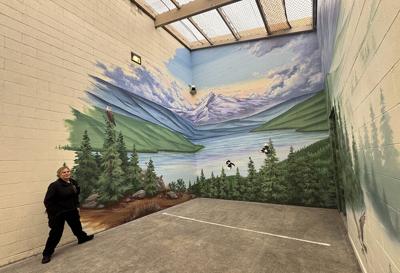
A bright and visible example of the evolving partnership is a mural that was added to NORCOR’s recreation yard last year. Previously, the space consisted of white stone walls and skylights. Now it features a forest scene inspired by the Columbia River Gorge, complete with hidden characters like Bigfoot.
The mural was painted by local artist Denae Manion, with help from a small group of selected inmates. Orendorff said the idea came after she visited the Umatilla County Jail and saw similar artwork there.
“She came back and told us with a lot of excitement,” Krummrich said. “We became excited immediately of course, understanding the impacts it would have on inmate mental health and multiple other benefits.”
The coalition led efforts to secure grant funding for the project, reaching out to Hat Creek Consulting in Hood River for guidance. That process ultimately connected the group with the Roundhouse Foundation, which provided grant funding to make the mural possible.
The same grant, combined with inmate welfare funds generated through commissary purchases, also allowed NORCOR to offer art classes during the holidays, giving inmates an opportunity to share their work with family members. Additional art programming is planned in the coming months, supported by a separate grant from the Wasco Cultural Trust.
“After the rec yard was finally done, and the first adult in custody got to go out there, they were just in awe and they appreciated it too,” Orendoff said.
•••
See full notes from various NORCOR board meetings by Gorge Documenters Lynda Ontiveros and Emily Harris at www.columbia-gorge.documenters.org.


Commented