
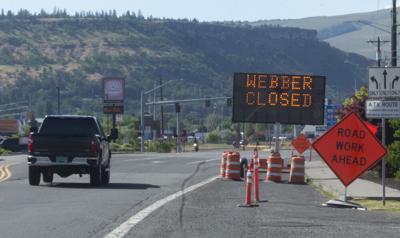

THE DALLES — Owners, employees and patrons of the Bargeway Pub & Catering packed The Dalles City Council meeting on April 27, addressing business impacts tied to the ongoing closure of Webber Street, which has significantly halted traffic in the port area.
Steve Kane, co-owner of the food and live music venue since 2019, opened the audience participation portion of the meeting, highlighting a discrepancy between what he’s been told and what actually happened.
According to Kane, he spoke with public works in mid-March and learned that Webber Street would remain open until nearby Terminal Avenue reopened. “I was told access would be maintained, either flagged or open, depending upon the phase of the work ... expected to happen mid-May through late June,” he said. “Then, on March 26, I learned through Facebook that Webber Street would be closing March 30.”
The work and subsequent road closures are part of The Dalles’ Westside Interceptor – Phase 2 project, a significant underground infrastructure upgrade intended to expand sewer and stormwater capacity on the city’s west side.
Briefly, in partnership with staff and project contractor Crestline Construction, Kane reached a solution by establishing a flagged, one-way access lane allowing customers through the work zone and into the port area. Because Terminal Avenue has since reopened, through access is now prohibited, though the access lane still exists.
In the first five days post-removal, Bargeway’s gross sales dropped by 60%.
“That is not survivable,” Kane said. “Every summer, we create about 30 additional jobs in this community. Without customers in seats, those jobs do not exist. All I’m asking is this: reconsider access to the main entrance to the port. Give us a fighting chance. We’re not asking to stop the project. We’re just asking for access.”
City Manager Matthew Klebes clarified that port access remains via River Road (west), the Union Street underpass (east), and recently reopened Terminal Avenue. The city has additionally moved or updated signage to inform motorists of the River Road detour route and expects to deploy a reader board on Union Street now that the Cherry Festival is over.
“We’re continually open to updating or changing the signage that we have with the material we have to communicate these routes as best we can,” Klebes said.
Bargeway Operations Manager Nolan Hare asked the council to amend the Westside Interceptor – Phase 2 project by adding flaggers and restoring direct, controlled access to port businesses. He deemed detour routes unclear, poorly marked, and too complicated for many visitors, especially people coming off the freeway looking for a quick meal.
“People aren’t coming,” Hare said. “We’re already reducing staff hours. And we’re not alone in this — it’s affecting the entire port area, multiple businesses, multiple teams and a significant number of local jobs.”
Hare also raised safety concerns, noting his experience managing large events at Lewis and Clark Festival Park and pointing out that Union Street is already a known congestion point on high‑traffic days. Forcing all port traffic — business, freight, and event-related— through that corridor and across the railroad crossing, he argued, creates a predictable bottleneck and increases the risk of accidents. “We're asking for practical adjustments,” Hare finished. “Because without access, this is not just construction impact, it's economic displacement.”
Klebes stressed that city staff are reluctant to resume one-way flagging through the work zone, citing concerns about time impacts on Crestline’s progress. From the beginning, the city’s goal has been to maintain at least two port access routes; now that Union Street and River Road are both available, staff believe Webber must remain fully closed.
“I want to acknowledge that these projects are having an impact ... and express our openness to working with the impacted businesses as best we can,” Klebes said. “During that process, if there are signage improvements that we can make or change, or if there are other ideas, we are all open to reviewing those.”
On April 30, council reconvened for a special meeting, weighing five potential options to either accelerate the project, improve signage, or reimplement one-way, flagged access to the port.
Ultimately, they elected to accelerate construction, ordering Crestline to work seven days a week at a cost of $118,000. Since the original project bid was far enough under the engineer’s estimate, council felt there were sufficient funds left to pay the $118,000. By working on weekends, the project would be finished June 26, well before the traffic expected over Fourth of July weekend.


Commented
Sorry, there are no recent results for popular commented articles.