Cloudy with occasional rain during the afternoon. Potential for heavy rainfall. High 58F. Winds W at 10 to 20 mph. Chance of rain 100%. Rainfall around a quarter of an inch..
Tonight
Cloudy with periods of rain. Low 37F. Winds W at 10 to 15 mph. Chance of rain 100%. Rainfall may reach one inch.
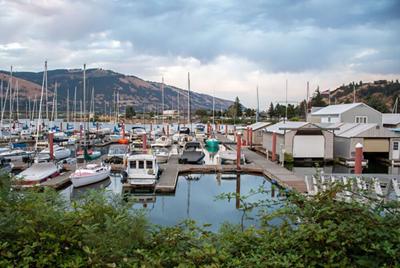
HOOD RIVER — The Port of Hood River’s Marina Basin should be managed as a shared, multi-use community asset, serving not only marina operations but also broader public recreation.
That was a key takeaway from an online, public survey the port conducted in December, as directed by port commissioners during a fall 2025 planning workshop. Megan Channel, the port’s waterfront coordinator, advised commissioners at their Jan. 19 meeting that 521 people responded to the survey.
“This really reinforces future planning needs, with clear and consistent support for improving public access,” she noted. “There was also strong support for strengthening marina services.”
Among other findings, the survey underscored the marina basin’s local popularity, with nearly half of respondents visiting several times per week, Channel reported. People placed special emphasis on walkability, recreation, boat slips, dry storage and youth programs.
There was cautious support for commercial activity, conditioned upon proper management of parking and traffic, environmental protection, “ensuring public benefit, and avoiding exclusive or incompatible uses,” Channel’s report noted. Affordability and long-term sustainability also scored high in survey rankings.
One issue prompting the survey was a request last fall by Scott Webster, CEO of The Fruit Company, for exclusive use of the marina’s commercial dock for a day-tour cruise vessel. If exclusivity were not granted, Webster requested a short-term docking agreement and future development of an additional dock.
At their meeting Jan. 19, commissioners agreed only to short-term use. The vessel in question is about 100 feet long, comparable in size to other cruise vessels using the marina, such as National Geographic’s Lindblad Explorer, noted Kevin Greenwood, the port’s executive director.
At the same meeting, commissioners approved several other initiatives arising from the marina survey:
• Staff will convene a marina stakeholder group to review survey themes, priorities, and “explore areas of alignment and tradeoffs.”
• The port will conduct a marina master plan update to reflect current and anticipated uses, with continuing public engagement.
• And on a related note, the port will issue a “Request for Developer Interest” (RFDI) to solicit concepts for redeveloping the Marina East and Marina West sites. Comprising 2.6 acres in the Marina Basin, the parcels include two aging structures, one leased to Oregon Department of Motor Vehicles and the other to an acupuncture clinic. (At one time, the port offices and Hood River Chamber occupied the Marina East building.) The RFDI does not commit the port to any particular course of action, but will inform future decisions.
‘New era’ for port revenue begins July 1
Apart from the marina, commissioners and staff are also tackling other issues, many centered around a common dynamic, as replacement of the Hood River Bridge means the end of tolling revenues for non-bridge uses such as the airfield, waterfront recreation and economic development initiatives. That revenue stream — historically amounting to 60% of overall revenues — has largely supported port operations since 1950, when the port acquired the structure from the Oregon-Washington Bridge Company. An increasing percentage of toll revenues already support the replacement project, led by the bi-state Hood River–White Salmon Bridge Authority.
As of July 1, 100% of toll revenues will be dedicated to operations and maintenance of the current bridge and preparatory work toward bridge replacement. Contingent on federal funding, the new bridge should be completed by 2032. (Bridge tolls will continue, partly to repay a federal loan which will help pay for the new bridge.)
As one step toward meeting the revenue challenge, commissioners at the Jan. 19 Port of Hood River meeting approved a staff reorganization plan. The port had 32 full-time equivalent (FTE) employees in October 2022. Ten of these positions were eliminated when tolls were fully automated, and several middle management positions aren’t being replaced, leaving current staff at 19.5 FTE.
“We need non-bridge assets to be self-sustaining,” Greenwood said, noting the port commission established this as a priority three years ago. “The whole purpose is to make the port more efficient as we enter a new era without bridge tolls to help cover port operations.”



Commented
Sorry, there are no recent results for popular commented articles.