
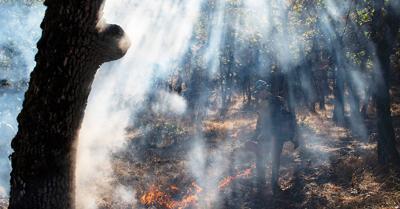

With no dedicated funding for the new U.S. Wildland Fire Service, how are those in land management reacting?
THE GORGE — Generating little noise outside of land management circles, the Department of the Interior (DOI) officially began a massive reorganization effort to bring its firefighters under one consolidated helm, dubbed the U.S. Wildland Fire Service, on Jan. 12.
The profound shift to “streamline decision-making” and “improve operational efficiency,” as cited in the agency’s announcement, began by executive order last June, which Columbia Gorge News covered. Initially, President Donald Trump mandated the merger to occur within 90 days — during the height of fire season — prompting backlash from boots on the ground, former agency chiefs and those in government.
He also directed the U.S. Forest Service (USFS), which maintains a larger firefighting force than the Bureau of Land Management, National Park Service and two other DOI entities combined, to leave its parent agency, the Department of Agriculture, and join DOI.
But modifying cabinet designations would require an act of Congress, and lawmakers aren’t budging, at least not yet. The bill funding those agencies for fiscal year 2026, which Trump signed, kept USFS separate and denied the administration’s $6.5 billion request for the Wildland Fire Service.
“The bill does not endorse the consolidation of federal wildland firefighting into one agency,” reads a summary of the package from Washington Sen. Patty Murray. “Instead, it specifically provides funding to continue wildland firefighting using the longstanding practice of funding both the U.S. Forest Service and the Department of the Interior to allow Congress to consider legislative proposals for such a major change.”
Even without appropriated dollars, however, DOI is still pushing ahead internally. Brian Fennessy, who was recently selected to lead the new agency, said he will issue a “blueprint for our shared unification in the coming weeks,” according to an email sent to staff and obtained by Columbia Gorge News that coincided with the announcement.
“It’s all been kind of a black box operation,” said Timothy Ingalsbee, the executive director of Firefighters United for Safety, Ethics and Ecology, a nonprofit based in Eugene, Oregon. “There’s almost no information coming out.”
And with an abundance of federally-owned land Gorge-wide, the implications are important and local, especially as a snow drought continues to afflict the Cascades.
Mixed reactions
Ever since its founding in 2019, a singular firefighting entity at the federal level has been one of four main policy reforms pursued by Grassroots Wildland Firefighters. Riva Duncan, vice president of the nationwide nonprofit who served part of her 32-year tenure with USFS in Southern Oregon, explained why.
“Those of us who spent our entire careers working in this profession, mainly for the Forest Service but also for the other agencies, have been sounding the alarm that they weren’t taking care of firefighters,” she said. “Now, we’re looking at huge retention problems that affect the taxpayers of the United States, and we owe it to them to have an effective, efficient and robust workforce.”
In the three years prior to 2024, permanent wildland firefighters left USFS at a rate of 45%, according to a ProPublica investigation. And that was before a wave of firings and deferred resignations that took place early last year, as previously reported by Columbia Gorge News, when USFS lost at least 500 employees in Oregon and Washington, if not more.
While there have been increases since, an entry-level wildland firefighter earned $15 per hour in 2021, and hazard pay, regardless of classification, hasn’t kept pace with the reality of increasingly intense blazes and longer seasons. Duncan pointed out other systemic issues: lack of preventative cancer screenings, poor mental health resources, consistent sleep deprivation. The list goes on.
For instance, it took USFS until last September to acknowledge the long-term health impacts of smoke inhalation and reverse a decades-long ban that restricted firefighters from wearing masks while they work.
With every wildland firefighter under one roof, Duncan sees an easier path toward stronger occupational protections alongside better wages and benefits, plus the inevitable cost-savings that could come with having just one human resources department, one onboarding system, one dedicated budget.
“If they’re getting proper healthcare, if they’re getting proper rest, that makes them better at their job,” said Duncan. “If they feel like they’re acknowledged for the work that they do through benefits, then they’re going to stay for longer.”
Another federal wildland firefighter in Oregon, who requested to remain anonymous for fear of reprisal, largely agreed with Duncan. Beyond improving workplace standards and eliminating redundancy, she noted how standardizing training would help improve safety across the board, and formalizing a basic organizational chart instead could be a welcome change, too.
But she has one overarching concern: A situation where fuels management personnel — the people who oversee prescribed burns, thinning and other projects designed to build resilience at a landscape level — are consumed by this new service and relocated from their current offices, or a complete separation between fire professionals and resource specialists.
“It would be detrimental to the work that we do in both fire suppression, and in forest health and hazardous fuels reduction projects,” she said. “I can see there being a lot of unmet need for the land bases that we currently represent and that we currently work in.”
Ideally, she continued, all those personnel would simply continue their typical day-to-day but receive a paycheck from a different agency because, despite all the jurisdictional lines, collaboration is already baked into the system. Ingalsbee similarly stressed the importance of closely coordinating fire management with land management.
And to that end, he was particularly alarmed by one sentence in Fennessy’s all-staff email last month.
“Our primary purpose and mission is wildland fire suppression,” Fennessy wrote.
When a draft of Trump’s executive order was leaked last spring, it contained similar language regarding the new service’s purpose. For Ingalsbee and others, that signaled a reversion to fighting fires without any acknowledgment of their ecological role, which has inadvertently led to fuel-laden forests nationwide.
Trump’s final order, however, dropped the suppression-oriented verbiage, and Fennessy also acknowledged that “we have a duty to improve fire mitigation across all bureaus.” From what she’s seen and heard, Duncan believes that aim is genuine and that personnel on all sides of fire, from suppression to fuels reduction to post-fire recovery, will be brought into the agency.
“Things are going to be messy. There are going to be mistakes made. It’s not going to make everybody happy,” said Duncan. “Maybe I’m being naïve, but my organization will be watching for all of this, and we will speak up if we see things that aren’t going the way they should.”
Next steps
It’s unclear whether the Wildland Fire Service will be operational come this summer. In a more detailed secretarial order, DOI acknowledges there will be a “transition period” but failed to provide a specific timeline, as did a DOI spokesperson who stressed that the department’s actions are limited to internal reorganization.
“The announcement reflects initial planning and coordination steps within the department, not the creation of a new, independently funded agency or a unification with another federal department,” the spokesperson said over email. “No new funding is being obligated, and no structural changes requiring congressional authorization are being implemented at this stage.”
They also emphasized that maintaining readiness was a top priority during the consolidation process. On funding, however, there’s a clear disconnect between DOI and Congress, as the secretarial order tasked department administration with “taking the appropriate steps to provide funding for USWFS.”
On Feb. 5, the service hosted a town hall for DOI employees affected by the change, and Ingalsbee said he’s aware of National Park Service personnel who have received transfer notices. In the appropriations bill, Congress also directed DOI to contract an independent research firm and “conduct a comprehensive study on the feasibility” of bringing USFS firefighting operations into its fold.
“In the Constitution, Congress has the responsibility for designing the executive branch — what’s the structure, what programs get funded and so forth,” said Oregon Sen. Jeff Merkley. “This administration says, ‘We don’t really care what Congress said, we’ll just transfer funds an we’ll do whatever the hell we want.’”


Commented