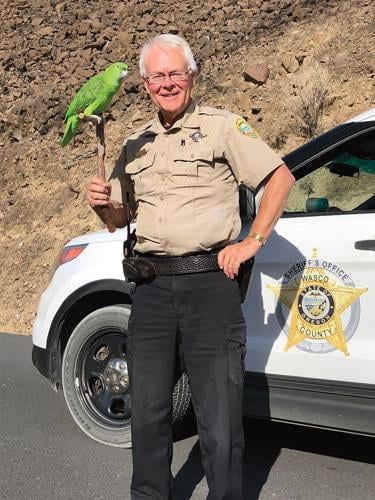
Jay Waterbury is pictured with a large parrot he encountered while patrolling the Deschutes River for the Wasco County Sheriff’s Office. He came across the bird and its owner, a visitor from New England, and just had to get his picture taken with the bird.Contributed photo
THE DALLES — When Jay Waterbury retired as The Dalles police chief in mid-2016, his “retirement” lasted about six weeks.
“I was bored,” he said.
He soon found himself back in uniform, this time working as the forest patrol deputy for the Wasco County Sheriff’s Office.
He’d actually razzed the sheriff’s department for years about eventually coming to work for them in forest patrol, and he was as good as his word.
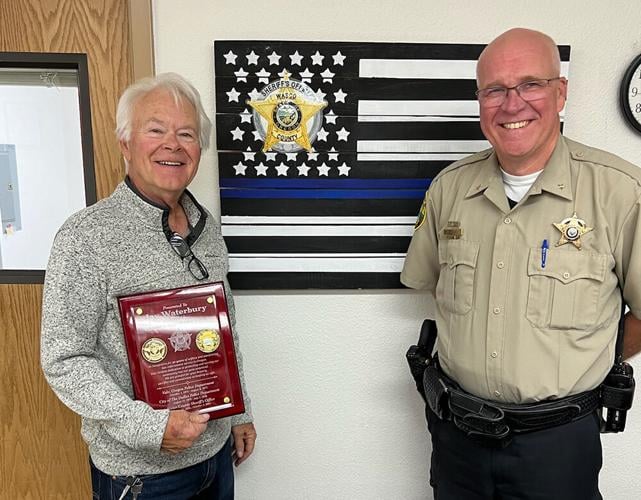
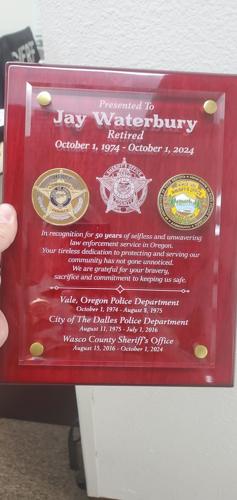
And on Oct. 1, he retired again, this time for good, wrapping up eight years as the seasonal forest patrol deputy. At 72 years of age, he has put in a remarkable 50 years in law enforcement, probably double the typical career length in that field.
“None of this would have been possible without the support of my wife of 50 years, Vicky, and my girls Haley and Tessa,” he said.
He enjoyed driving to the 24 campgrounds in the Mt. Hood National Forest that lie within Wasco County. He visited with folks, handed out stickers to kids — “It’s mainly a PR thing” — and more than a few times, got people out of some tight spots.
One was a young mom and her two little boys — vehicle broke down, no cell service. They were on their way to her sister’s wedding. Waterbury came upon them, radioed dispatch to get in touch with her dad, then drove her and the kids 40-50 miles out to meet him.
“Dad thought I was the best thing since sliced bread. I took care of his little girl,” Waterbury recounted.
“To me, helping people is the job. That’s what officers are for is to help people. And sometimes by helping that means someone has to go to jail, or get a ticket. That’s what I enjoyed doing, seeing if I could give people some assistance up there.”
Jay Waterbury is pictured with a large parrot he encountered while patrolling the Deschutes River for the Wasco County Sheriff’s Office. He came across the bird and its owner, a visitor from New England, and just had to get his picture taken with the bird.Contributed photo
When he first talked to Wasco County Sheriff Lane Magill about doing the job, “He wanted me to do it on Friday, Saturday and Sunday, and I said, ‘I’m retired,’” Waterbury recounted.
He picked his own hours, but he put in 10-hour shifts, sometimes up to three a week. It was a great job; he got to drive around the woods, looking for people who might need help.
Magill said it was “a unique situation” to have such an experienced employee. Suffice it to say, he said, “I never had to supervise Jay Waterbury.”
Calling Waterbury an influential mentor of his, Magill said, “He has a natural leadership ability for people to follow him and listen to his advice and his experiences.”
And he responded to calls along with other deputies, as needed.
Waterbury also sometimes worked in the forest in wintertime, and once got his patrol car stuck in snow and had to radio for help. “We’ve never let him live that down,” Magill said.
Aside from the lighter stuff of handing out stickers, the job saw Waterbury ensuring people were obeying fire restrictions, and telling people who maybe partied too hard the night before to calm down.
During forest fires, he had a key role of clearing campgrounds.
And even though for officer safety it’s unwise to respond to a domestic violence call alone, sometimes he had no choice.
In his eight years, the biggest change he saw is “there’s a lot of people living out in the forest now.”
A closeup of Waterbury's plaque.
Contributed photo
He noticed this change especially after the COVID-19 pandemic hit. “They usually don’t go to campgrounds because you have to pay for those. They have dispersed camping — you can camp anywhere you want in the forest, there’s a 14-day limit, but you can be driving anywhere in the forest on these spur roads and there’ll be these camps, and they’re full of garbage.”
A car left unattended in the forest for just a few days will soon have its windows broken out, he said.
But for Waterbury, the best part was helping people. He saw a lot of cars broken down. While the stranded people had no cell service, he could use his police radio to get them help.
About a dozen times he helped people who ran out of gas. Waterbury always wondered, “Didn’t you realize there’s not many gas stations up here?”
He would take the stranded driver to a gas station where they would get gas, then take them back to their vehicle.
But he now recognizes it’s time to pull the pin, as they say in law enforcement — for real this time.
“Being a policeman at 72 years old is not something that you should be doing. It’s a younger man or woman’s ballgame.
“Now I have more time to go to all the grandkids’ ball games and cross country meets and all that stuff, and golf a lot,” he said.
Looking back, he’s grateful for the opportunity to continue his career as long as he did. “There’s not a lot of people that can do 50 years in law enforcement. I don’t know how it happened to me, but it did.”



Commented