
By Sean Avery
Columbia Gorge News
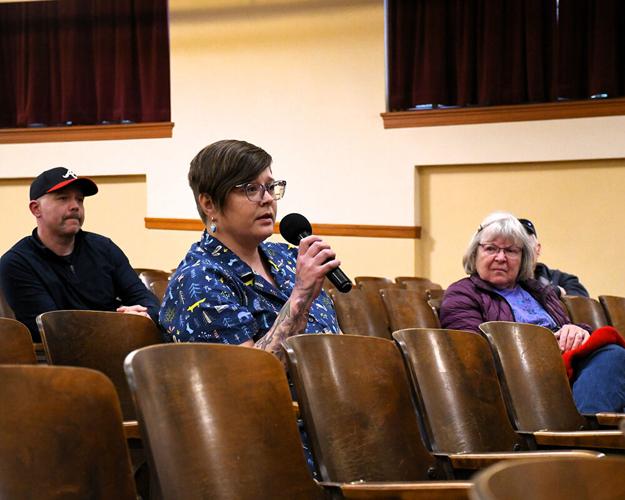
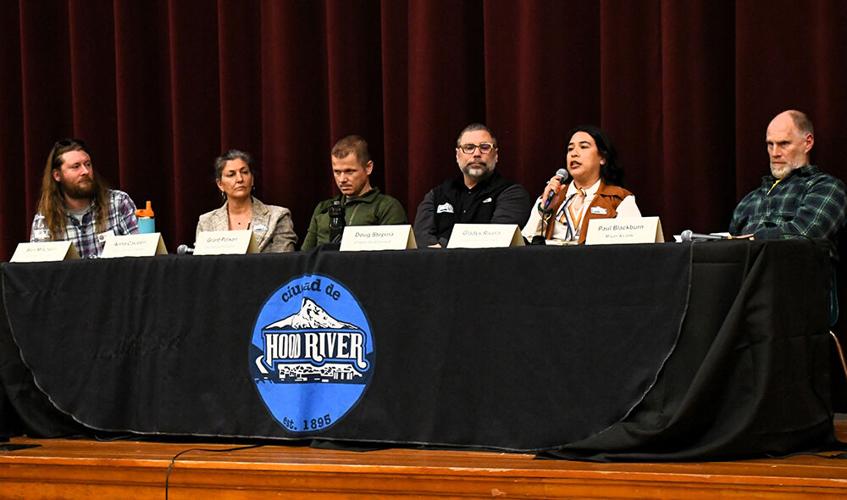
HOOD RIVER — For the first time in Mayor Paul Blackburn’s tenure, the Hood River City Council met as a quorum at the Hood River Middle School auditorium, hearing questions and concerns on Immigration and Customs Enforcement (ICE) from a passionate, but sparsely populated audience on April 23.
City Manager Abigail Elder began with a refresher on Hood River’s status as a sanctuary city, meaning it does not assist ICE enforcement and aims to make services accessible to everyone regardless of documentation status.
She then outlined key steps the city has taken to address community concerns, including staff training, December’s emergency declaration, and virtual listening sessions run by The Next Door Inc. (TNDI) that allowed community members — especially those afraid to speak publicly — to share what they need from the city.
TNDI representatives, Executive Director Janet Hamada and Director of Health Promotion and Family Services Elizur Bello, touched on dominant themes community members shared during listening sessions, namely constant worry about what could happen to themselves and their families, racial profiling regardless of status, impacts on small businesses, and youth taking on extra responsibilities.
Ruben Mosqueda, who supervises the substance abuse disorder program at the Mid-Columbia Center for Living, described how ICE sweeps have harmed his Spanish-speaking clients. “We went from 100% attendance to about a quarter, and there were two individuals who never resurfaced,” he said. “That’s really unfortunate, and never should have happened.”
Martha Verduzco-Ortega, director of the Hood River Latino Network (HRLN), painted a vivid scenario: parents too afraid to pick up their own children from school, sending strangers instead while watching from the window, hearts racing.
“Seventeen people have been detained by ICE in the Columbia Gorge since May of last year. Each of these individuals has names, a family, a story,” she said. “Imagine living each day in fear that your loved ones could be taken away at any moment, that a simple trip to the grocery store could turn into a nightmare. This isn’t just distant fear — it’s the daily experience of many in our Latino community.”
After Blackburn opened the floor for public comments, Wasco County Commissioner Phil Brady shared how residents in The Dalles have been uniting to support affected families and warned about the upcoming cherry harvest, which typically attracts 5,000 additional workers to the area. “Growers are fearful they might not get a crew this year,” he said. “Last year, there were cherries left on trees because crews were not willing to come up.”
Leslie Naramore, executive director of the Mid-Columbia Community Action Council (MCCAC), thanked the council for their attention to constituent concerns. “It would have been really easy just to say nothing, so I wanted to commend you on your efforts,” she said. “I also want to say thank you to TNDI and the HRLN for all the work you are doing. We’re all in this together.”
Simon Murillo of Cascade Locks didn’t come with prepared remarks, but felt moved to thank the council for taking action. “I am grateful for you guys standing on the right side of history,” he said. “You’re taking a step forward that might bring some bad publicity, but I think in five to 10 years, you guys are going to look like shining stars.”
Next, one by one, council members shared closing remarks. Ben Mitchell expressed that the candid community testimony council received from youth over the last few months has helped change his mind on Hood River’s sanctuary city resolution — even if it was largely symbolic given Oregon’s longstanding sanctuary status. “There’s a lot that we can’t do, unfortunately, but I’d still like to do more if we can,” he said.
Councilor Anna Cavaleri thanked participants for their feedback and emphasized that what makes Hood River special is “the people that are in it.”
Councilor Grant Polson said he would save detailed policy comments for the upcoming council meeting, where they’ll combine new feedback with prior input. His goal is to craft a well-thought-out, durable policy that the community can look back on in five years and think they “really got that right.”
Councilor Doug Stepina noted the room’s small turnout doesn’t reflect the number of minds in Hood River gripped by the issue. “If we weren’t with our Latino community at this moment, then they would turn their back on us forever, and rightfully so,” he said. “So I hope this serves as a blueprint for how we can work together on every issue, good things and bad, as we go forth.”
Finally, Council President Gladys Rivera said she’s grateful the council is willing to act — unlike previous councils that have stayed silent — and stressed that they cannot govern with fear. “I truly hope that the policy that we’re setting today is really beneficial for the long run,” she said. “So I appreciate everyone for being here, and thank you all for your comments.”


Commented