
By Nathan Wilson
Columbia Gorge News
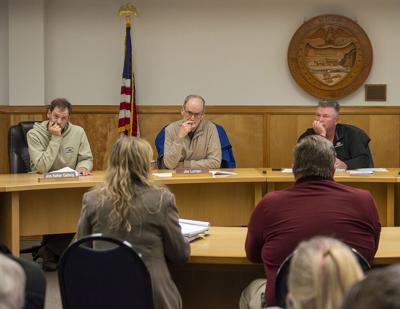
HOOD RIVER CO. — Planning commissioners continued Thrive Hood River’s appeal of the county’s decision to tentatively approve a 48,960 square-foot, last-mile Amazon warehouse and distribution facility near Odell on April 22. Now, the final decision is expected on May 27.
Hood River County’s Planning Department signed off on the proposed development, located off Highway 35 on land owned by the port, in late February. Amazon agreed to purchase the site for $3.41 million, and wholesale distributing or outlet facilities are permitted outright in M-1 zones, limiting potential review criteria.
Just north of Davis Drive, the warehouse would neighbor Neal Creek Forest Products, Lester Moving & Storage, the G.S. Long Company and Cardinal Glass Industries, a building that’s 10 times larger. According to a traffic impact study (TIS) prepared by NV5 Engineers and Consultants, an average of 32 line-haul trucks, 134 delivery vans and 382 passenger vehicles are expected to enter or exit daily.
The number of passenger vehicles and vans will jump about 30% during peak online shopping periods, like over the holidays, bringing the maximum daily total to just over 700 trips. Most traffic (around 70%) will exit heading northbound on Highway 35 or come from Interstate 84, but that’s dependent on where orders are placed.
Between delivery drivers and on-site workers, the facility would employ about 190 people.
As previously reported by Columbia Gorge News, the county determined that Thrive’s basis for appeal wasn’t applicable prior to last Wednesday’s hearing, but the land use advocacy nonprofit still sought a forum for the public to voice outstanding concerns. One person commented in support of the proposal while nearly two dozen spoke against it; as expected, given the record, traffic worries dominated.
“Amazon has told you that you’ll hear hours of testimony opposed tonight, but because it’s permitted outright, you must approve it anyway. That’s not planning, and it’s truly not your role,” said John Mills, who sits on Thrive’s board of directors. “I think we have the potential to be another ‘Blood Alley.’”
Mills was referring to Highway 26 behind Mount Hood. Per the county’s zoning code, Amazon must demonstrate that site access won’t cause dangerous intersections or congestion, but roadway capacity, speed limits and number of turning movements are the only factors that need be considered. Mills pushed for a more comprehensive analysis, particularly one that addresses seasonal traffic variations.
NV5’s report looked at four nearby intersections — Highway 35 and Neal Creek Mill Road, Highway 35 and Sunday Drive, Highway 35 and Davis Drive, and Neal Creek Mill Road and Sunday Drive — and found “nominal impacts” at each. Data was collected during peak hours on one day last September, which NV5’s National Traffic Director John Karnowski affirmed was standard practice.
Keith Cleveland, Hood River County’s principal planner, also defended the study.
“Those items listed by Mr. Mills as missing from the TIS are not required by any standard applicable to the proposed development, nor were they requested by any agency responsible for traffic safety and management,” he said, emphasizing that Oregon’s Department of Transportation (ODOT) affirmed the study on several occasions.
Nevertheless, adjacent property owners shared stories of overturned fruit trucks, near misses and blind corners on the highway that turn slick during ski season. An avid bicyclist said he would feel less safe, and one farmer questioned whether Amazon’s drivers know how to navigate around tractors on the road.
After Thrive filed its appeal, NV5 performed an additional crash history analysis and identified 16 accidents at the four studied intersections from 2020-2024. The majority came from cars turning off Davis Drive, where about 10% of Amazon’s traffic would be routed. Along the entirety of Highway 35, however, ODOT recorded 451 crashes between 2015-2024. One resident called the TIS “myopic.”
“You have to constrain it in some way to make it reasonable, and that’s what the study was,” said Karnowski, who edited one of the premier books defining TIS procedures. “We looked at the [intersections] that were the most likely to be impacted by turning movements.”
Although not a factor that commissioners can base their decision on, others questioned why the county would permit a company with a history of mistreating workers. Earlier this month, a man collapsed and died at one of Amazon’s warehouses in Troutdale, but employees were reportedly told to keep loading packages for more than an hour afterward, as one commentor pointed out.
Further, Amazon’s contracted delivery drivers were injured at a rate of 18.3 per 100 full-time workers in 2021 while trying to fulfill daily quotas, according to a report from the Strategic Organizing Center. That’s 13% higher than the national industry average for courier workers, capturing everything from muscle strains to dog bites. In 2024, Amazon’s injury rate at its warehouses was 66% higher than the rate at non-Amazon warehouses, based on numbers from the same coalition of labor unions.
And one study specific to New York City recorded a 78% increase in injury-causing car accidents after last-mile facilities opened.
Apart from traffic, former attorney Maryellen Barilotti also disputed the basis for Amazon’s permit application. Since the corporation is serving retail customers rather than other merchants, she argued the warehouse isn’t a wholesale facility, which isn’t explicitly defined in the county’s allowed uses for light industrial zones.
Commissioner Jay Lyman sought clarification on that point after testimony from the public and applicant concluded. Given that distribution, packing and storage are listed uses, Cleveland emphasized that the county’s interpretation was very straightforward.
Other commissioners asked technical questions about how drivers are routed, whether expansion could happen in the future (it’s unlikely), what informed the collection date for traffic data and more. They ultimately granted a request from adjacent property Josh Owens to continue the hearing, which Carrie Richter, the attorney representing Amazon, was amenable to.
“The zoning here is industrial, and clearly from the testimony we’ve heard, these folks would like the zoning to be something else,” Richter said during her rebuttal. “The zoning could be something else, but it can’t be something else today, and it can’t be something else to affect this particular application.”
New comments and testimony from the applicant, appellant and members of the public can be emailed to planning@hoodrivercounty.gov up until April 29 at 5 p.m. The deadline for comments rebutting prior testimony is May 6, and then the applicant has a week to provide closing testimony, since they have the burden of proof.


Commented