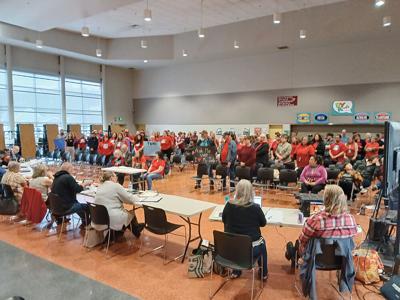
THE DALLES — During last month’s school board meeting, representatives from the District 21 Education Association (D21 Ed Association) union, representing licensed staff of the North Wasco County School District (NWCSD) and Mosier Community School, and the North Wasco Educational Support Professionals (NW ESP) union, which represent classified staff, gave a joint presentation on issues employees are facing in the district, including the district budget and transparency in bargaining.
During the meeting, D21 Ed Association President Jodi Ketchum stated that both unions were served with letters attempting to open contract bargaining with a different method than in the past. On April 1, they were verbally informed of “three things [the district] wanted to impose,” and told that after 90 days without a mutual agreement, the district could impose cuts. Ketchum stated that the unions responded, via letter, that they were not open to bargaining in the new manner and were open to bargaining as they had in the past. Ketchum said the unions were later served with a letter stating they had missed their deadline to respond and had waived their bargaining rights.
Columbia Gorge News later met with union officials, who said that this year is a “reopener” year, meaning that while contracts are valid for three years (current contracts until 2025), articles like salary and insurance benefits are reopened for negotiation annually, accounting for things like changes in insurance and Cost of Living Adjustments (COLAs).
According to Ketchum, in last year’s bargaining, the unions accepted a partial COLA, with the D21 Ed Foundation accepting a 3% increase and the NW ESPs accepting 3.5%. “We took a little less so the ESPs could take a little more … to try to get our lower income staff a little higher. So we were hoping for pay raises again this year to make up for the fact that we didn’t get a full COLA last year.
“We were shocked to be approached in that manner when we were already planning to reopen; it was a very aggressive way to come at us,” Ketchum said.
“What they said was not untrue,” Randy Anderson, interim chief financial officer (CFO) for North Wasco County School District (NWCSD), told Columbia Gorge News regarding the statements the unions made in the meeting about the initial attempt at opening the bargaining process. When asked what prompted the district to attempt changes, Anderson cited one reason being “nervousness” about having the funds to make it through the year.
“Timing and trying to make quick correction for the things that we can in order to not further any deficits,” District Communications Director Stephanie Bowen added.
Reported by both former district CFO Kara Flath at the March 21 regular school board meeting, as well as in a statement from the school district, in January NWCSD received an increase in its State School Fund from $24.5 to $24.8 million due to being anticipated to hit above it’s projected enrollment numbers. In March, due to the district ultimately falling 130 students short of its projected enrollment numbers, the NWCSD’s State School Fund was reduced to $23.4 million.
“That’s a little painful,” Flath said of the $1.3 million reduction during the March 21 meeting.
The district also cites the ending of the Elementary and Secondary Schools Emergency Relief (ESSER) funds as another impact on the district’s budget. According to Superintendent Carolyn Bernal, besides going towards measures to mitigate the spread of COVID-19, ESSER dollars were utilized to add additional staff and resources for learning loss, as well as capital improvement projects that could help prevent the spread of COVID-19.
“With ESSER dollars, you had to report on how you utilize those funds, and you had to have your expenditures approved and they had to be allowable expenses, so we went through that whole process,” Bernal said.
With school districts receiving ESSER funds during the 2021-22 school year, they have until Sept. 30 of this year to expend any remaining ESSER III dollars.
“The COVID-19 pandemic brought unforeseen challenges, requiring rapid adaptations to ensure the safety and wellbeing of our students and staff. Federal relief funds played a crucial role in enabling us to address these challenges effectively, however, as these funds are now reaching their conclusion, we are compelled to reassess our financial priorities and make difficult decisions to navigate this fiscal reality,” Bowen said in a public statement.
According to Bowen, the district implemented a budget and hiring freeze last school year “as a prudent measure to manage our budget responsibly,” meaning when positions became vacant through retirement, resignation, or attrition, the district would evaluate whether or not to refill the position on a case-by-case basis.
“Around February of last year, we began analyzing and looking at cutting in approximately $1.4 million out of the budget for [20]23-24, and we identified about $750,000 of cuts through attrition. So, things that became vacant, and we just decided not to refill them,” Bernal said. “And then the other remaining we just did like a 15% across the board cut to everyone’s budget, saying like you’re going to have 15% less to spend next year. So, cutting and reducing the budget didn’t just happen this year, we began doing it last year.
“Every position that we can capture through attrition and not refill is one less person we potentially would have to do like a reduction in force,” Bernal said.
Bernal stated that the district’s overall goal is to keep the reductions in the budget “as far away as possible from the classroom” in order to avoid any harm to students and keeping staffing intact. She did note that, should a teaching position become vacant, the district would analyze classroom sizes and enrollment numbers to determine whether they would refill the position or if the class sizes can be consolidated, which would ultimately result in increased class size.
That is something the unions hope to avoid. According to Ketchum, the district has seen classroom sizes of 30-34 students in a classroom due to budget cuts in the past.
“That’s not something we want to see again,” Ketchum said. “We’ve brought up at the board meetings, the disruptive learning. With such an escalation in disrupted kids that are unregulated, when you have that many kids in a room, it becomes a very unsafe situation.”
Both the district and unions confirmed that the school district has reached out to both unions to reopen the bargaining, which is set to begin May 15.
“We’re going to enter into good faith bargaining with both associations starting on the 15th, under the traditional bargaining rules” Anderson said.
When asked how they felt about the district’s offer to reopen the bargaining process, union representatives said they felt “hopeful.”
“I think sending this letter was an offer of good faith,” Ketchum said.
NW ESP Co-president Sylvia Brock said that in this upcoming process, she was most concerned for the ESPs and low-income staff. “Lots of our single income members are living below the poverty line as it is. So, we’re concerned about that and not getting a raise … that only puts them farther in the hole that way.” Brock said, “I’ve talked to one member who, by the time she pays her rent, and her bill, her monthly utilities and stuff, she has $200 to live on as far as food and gas after she pays that. So, we’re really concerned for our members.”
“We know that you can’t just make the money up here, but we also feel very strongly that there are some better ways that the district could be budgeting their money, so we’d like to be brought to the table to discuss those ideas,” Ketchum said.
“I’ve had a good relationship with the union’s since starting here as superintendent, we’ve had very good bargaining sessions with them, and so I look forward to continuing our style of bargaining and bargaining in good faith with them and reaching an agreement,” Bernal said.
Columbia Gorge News will continue to provide ongoing coverage as this story progresses.



Commented
Sorry, there are no recent results for popular commented articles.