
(NASA/Daniel Rutter via SWNS)
By Stephen Beech
Two "super-puff" planets lighter than cotton candy have been discovered by scientists.


(UniofBirmingham/AmandaSmith via SWNS)

(Karim Agabi/IPEV/PNRA via SWNS)

(NASA/Daniel Rutter via SWNS)
By Stephen Beech
Two "super-puff" planets lighter than cotton candy have been discovered by scientists.
They are among the lowest-density giant planets ever detected, according to a new study.
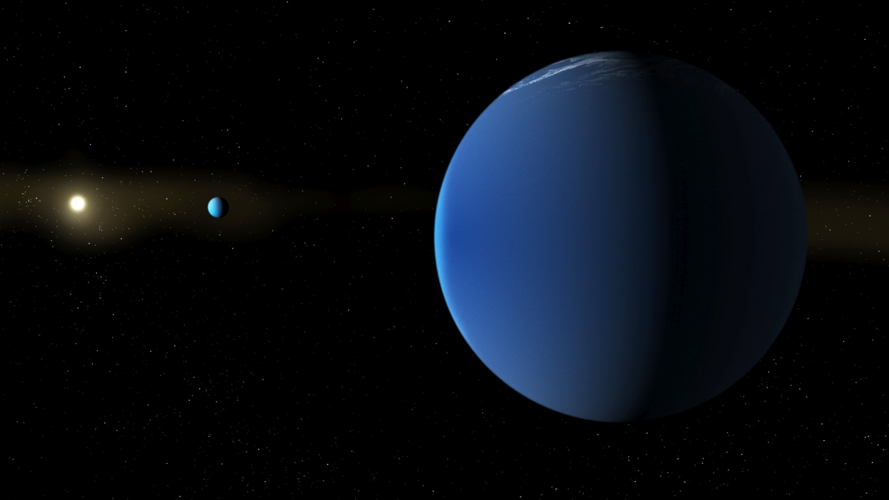
The two planets, named TOI-791 b and TOI-791 c, orbit a dwarf star located around 1,110 light years from Earth in the southern constellation Volans.
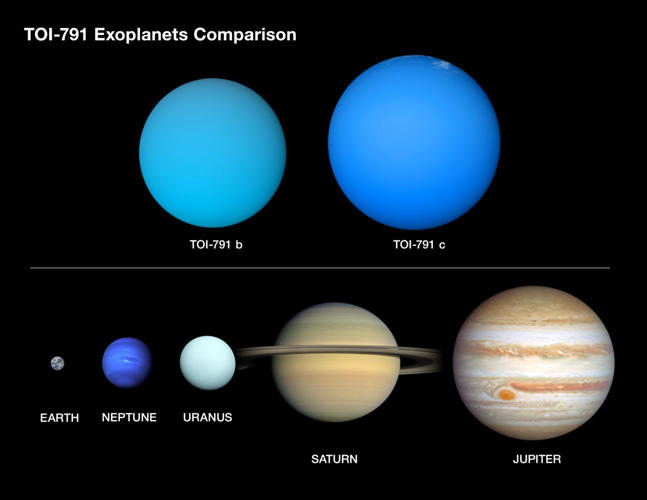
Although both planets are around the size of Jupiter, researchers say they are "extraordinarily" diffuse.
TOI-791 b has a density of just 0.038 grams per cubic centimetre, while TOI-791 c has a density of 0.047 grams per cubic centimeter.
By comparison, Jupiter’s average density is 1.33 grams per cubic centimetre - around 28 to 35 times greater, according to the study published in the journal Monthly Notices of the Royal Astronomical Society.
The new planets' densities are even lower than candy floss, which typically has a density of about 0.05 grams per cubic centimetre. In contrast, Earth’s density is 5.5 grams per cubic centimetre.
The planets are “siblings” - believed to have formed together from the same disc of gas and dust surrounding their young star.
They are also locked in a rare gravitational relationship known as a 5:3 mean-motion resonance - meaning that for every five orbits completed by the inner planet, the outer planet completes almost exactly three.
The research team says that gravitational interaction causes the planets to repeatedly "tug" on one another, producing measurable shifts in the timing of their transits across the host star.
They said only four other systems are known to contain multiple super-puff planets, making TOI-791 an "exceptionally rare" laboratory for studying how these planets form and evolve.
The research was led by University of Oxford scientists working with researchers from the University of Birmingham and the Université Côte d’Azur in France.
Lead author Dr. George Dransfield, from the University of Oxford, said: “Only a handful of these super-puffy planets are known, and it is even rarer to find two in the same system.
"Their extremely low densities make them fascinating targets for understanding how planetary systems form and evolve.”
Dr. Dransfield said TOI-791 b and TOI-791 c were first identified as candidate planets in 2019 and 2023 respectively, by volunteers participating in the Planet Hunters TESS citizen-science project.
(UniofBirmingham/AmandaSmith via SWNS)
By TalkerThe project searches data from NASA’s Transiting Exoplanet Survey Satellite (TESS) for possible new worlds.
Researchers then measured the planets’ densities by combining observations of their sizes and masses using telescopes around the world.
When a planet passes in front of its host star - an event known as a ‘transit’ - it slightly dims the star’s light.
The amount of dimming reveals the planet’s size.
The researchers also detected subtle variations in the timing of the transits, caused by the two planets gravitationally tugging on one another as they orbit the star.
By analysing the timing shifts, the team was able to estimate the planets’ masses and calculate their remarkably low densities.
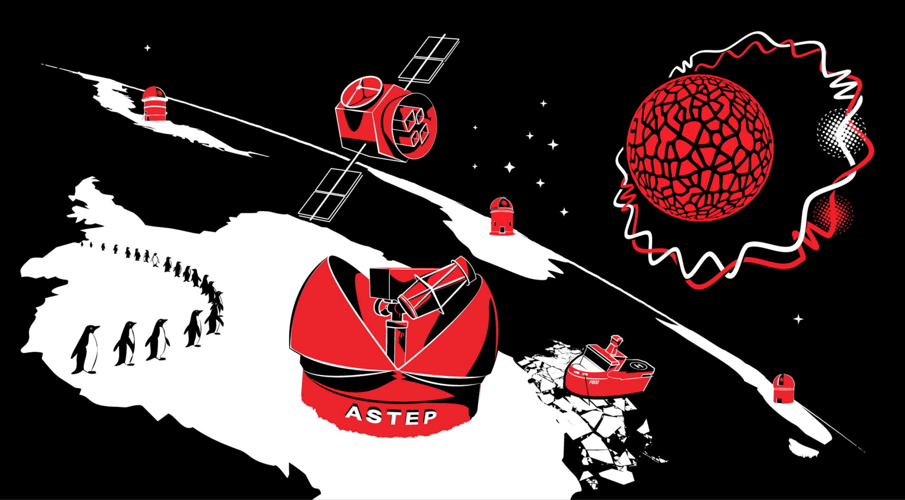
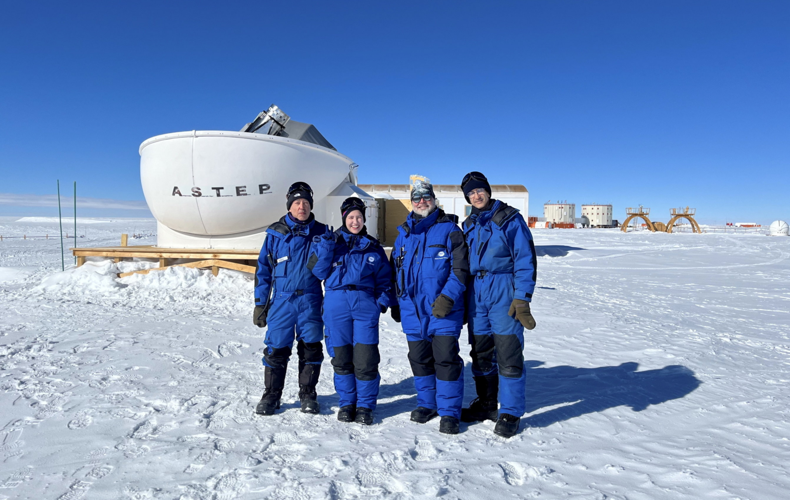
The discovery relied on eight years of observations, including from the ASTEP (Antarctic Search for Transiting ExoPlanets) telescope at Concordia Station in Antarctica, jointly operated by researchers from Université Côte d’Azur.
They explained that the Antarctic winter provided a unique advantage: months of continuous darkness enabled astronomers to capture the planets’ exceptionally long transits, each lasting more than 11 hours, in a single uninterrupted observation - the longest continuous planetary transits ever observed in their entirety from the ground.
(Karim Agabi/IPEV/PNRA via SWNS)
By TalkerAstronomers are still debating how super-puff planets form.
One leading theory suggests that they possess enormous hydrogen- and helium-rich atmospheres that make up a significant fraction of their total mass.
The researchers intend to carry out further investigations to understand more about how the planets formed, and to rule out some of the leading super-puff explanations.
Study co-author Professor Amaury Triaud, from the University of Birmingham, said: “This system offers a unique laboratory for understanding how super-puff planets form and evolve.
"We propose to carry out space-based observations using the James Webb Space Telescope to assess if the puffy atmosphere contains carbon-, nitrogen-, and oxygen-bearing species, revealing new insight into how these unusual planets formed.”
Co-author Professor Tristan Guillot, from the Université Côte d’Azur, said: “These multi-planetary systems are complex, with gravitational interactions between the planets that evolve over very long periods, tens of years or more."
He added: "This discovery highlights the importance of continued international collaboration in astronomy.
"Bringing together observations from Antarctica, space telescopes and observatories across several continents was essential to revealing the true nature of these extraordinary planets.”
Originally published on talker.news, part of the BLOX Digital Content Exchange.
Information from the News and our advertisers (Want to add your business to this to this feed?)
Success! An email has been sent to with a link to confirm list signup.
Error! There was an error processing your request.
Sign up to receive notifications when a new Columbia Gorge News e-Edition is published.
Would you like to receive our news updates? Signup today!
Receive weekly updates on obituaries and death notices.
Oregon Capital Press presented by Columbia Gorge News
Receive updates on upcoming promotions and special sections.
Receive weekly updates on local sports news.


Sorry, there are no recent results for popular videos.


Sorry, an error occurred.
Already Subscribed!
Cancel anytime
Thank you .
Your account has been registered, and you are now logged in.
Check your email for details.
Submitting this form below will send a message to your email with a link to change your password.
An email message containing instructions on how to reset your password has been sent to the email address listed on your account.
No promotional rates found.
Secure & Encrypted
Thank you.
Your gift purchase was successful! Your purchase was successful, and you are now logged in.
| Rate: | |
| Begins: | |
| Transaction ID: |
A receipt was sent to your email.


Commented
Sorry, there are no recent results for popular commented articles.