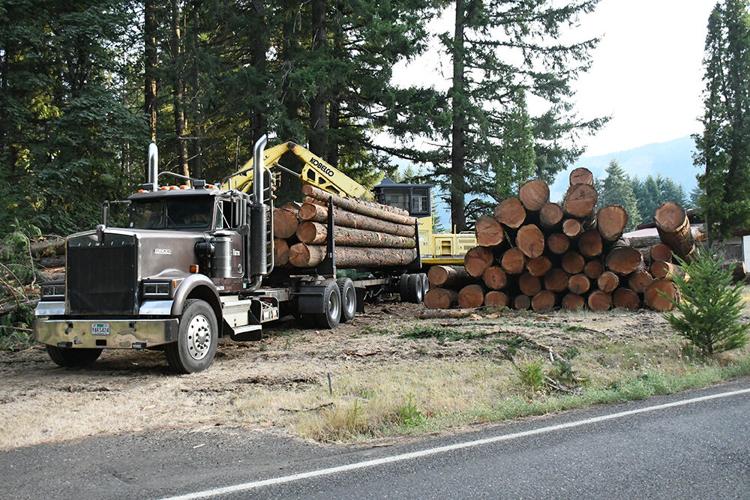
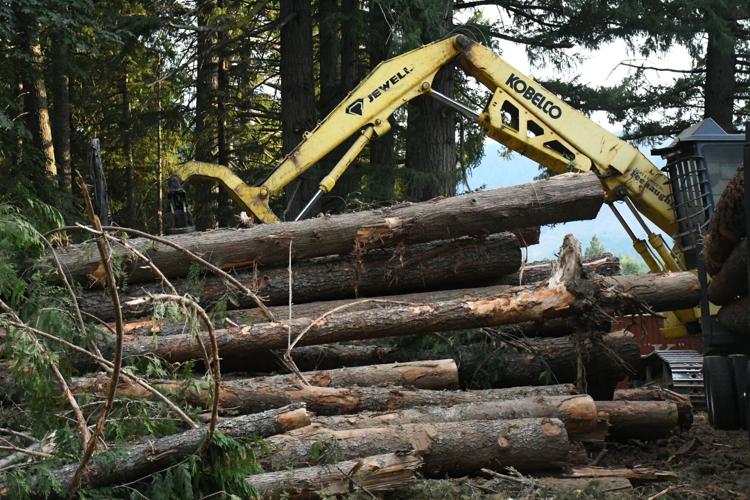
Loggers have been thinning and felling trees in the Little Interpretive Forest, adjacent to Mill A School in unincorporated Skamania County, since July 29.Sean Avery photos.
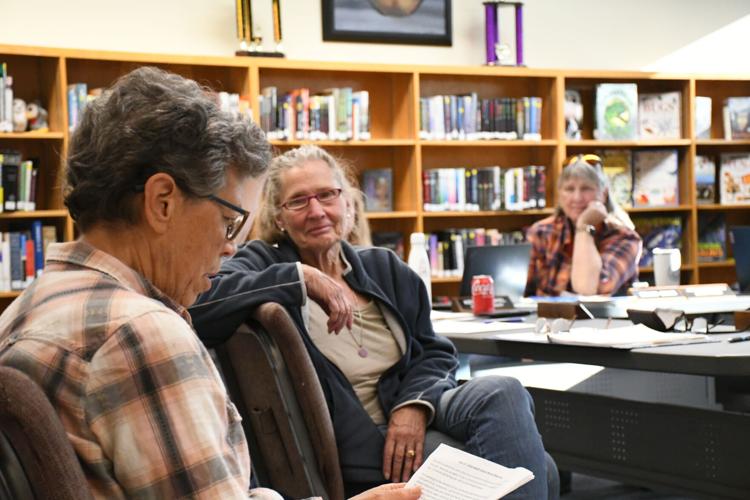
Former forest surveyor Lynn Bergeron (left) delivers remarks to Mill A School District board member Joan Stevenson Graham (middle) and board chair Anita Gahimer Crow (right).
Loggers have been thinning and felling trees in the Little Interpretive Forest, adjacent to Mill A School in unincorporated Skamania County, since July 29.Sean Avery photos.
MILL A — Mill A School, a K-8 located in unincorporated Skamania County, just northwest of Underwood, is completely surrounded by woods. But there’s one patch of trees that’s particularly meaningful: the Little Interpretive Forest (LIF), which serves as an on-campus outdoor classroom and natural space for students.
In the last few weeks, the LIF has been significantly altered, arguably decimated, according to furious parents and community members. What the school district promised as a carefully planned stewardship project, citing safety concerns, has rapidly evolved into a commercial logging operation.
The public, including a scientist, a logging specialist, and campus neighbors, voiced their concerns at the Mill A School District (MASD) board meeting on Aug. 17. Rather than condemning or defending any involved party, understanding that the damage is done, commenters oriented the conversation toward growth and transparency.
“How are we as a community going to move on from this event?” asked Lynn Bergeron, a former contract field worker under the Clinton administration’s Northwest Forest Plan. “Healing is not going to happen without full disclosure of what happened and why.”
Bergeron held the floor for a half hour — well beyond the traditionally allotted three minutes. Considering her habitat survey work in the Gifford Pinchot National Forest, contract fieldwork for local timber companies, forest stewardship coursework at Washington State University, tenure on the MASD school board, and 2011 involvement in upgrading 900 feet of an irrigation ditch running through LIF, the room was more than willing to hear Bergeron out.
Former forest surveyor Lynn Bergeron (left) delivers remarks to Mill A School District board member Joan Stevenson Graham (middle) and board chair Anita Gahimer Crow (right).
Meanwhile, the board did not respond to any comments made, complying with the state’s Open Public Meetings Act, which confines discussion and action to official agenda items.
The complaint and alternative options
The project began in late 2025, when an abutter, Rebecca Stonestreet, informed the school of a potential problem: a single Douglas Fir on the edge of LIF was leaning towards her land. If the tree fell, it would likely take out a fence corner, damage structures on the property, and give deer access to her garden. Notably, an alder tree was also leaning on Stonesreet’s fence.
The trees represented a visibly dangerous hazard, shifting liability to the MASD under state insurance laws. “If that tree fell and caused damage other than just cleanup, it would be considered an ignored hazard and negligence rather than an act of God,” Bergeron said.
Bergeron laid out a couple of alternative options that the board ultimately ignored, whether intentionally or obliviously.
For one, they could’ve hired a qualified arborist to safely and surgically remove the hazard trees, and possibly negotiate the cost with Stonestreet. “This would have been the most timely and appropriate option because, at that point, the school wasn’t dealing with a whole forest problem,” Bergeron said. “They were dealing with two single trees.”
Although Stonestreet provided the school with the name and contact information for a certified arborist (Ryan Cafferky of A Life With Trees), whom she paid to assess the situation, the school never contacted him.
Since there were additional concerns about the overall health of LIF, the school also could’ve hired a Department of Natural Resources (DNR) stewardship assistant forester to evaluate the area for free. These individuals walk the property, assess conditions, give management advice, and help clients write their own forest management plans.
Not only would this option have made the school eligible for cost-share assistance and tax reduction, but it would have presented a worthy education project for the students: participating in the DNR’s stewardship planning course and writing a plan for LIF.
But the board turned their heads. According to Bergeron, there are two overlapping reasons: they were simply unaware these options existed and had an “unjustified urgency to get the project done before school started.”
In a follow-up with Columbia Gorge News, Board Chair Anita Gahimer Crow clarified administration’s urgency: “District instructors expressed concern for student safety from fallen, and falling branches, which had increased over time and with recent wind events,” she said.
The oversight
So how did a concern about two hazardous trees morph into a Class III commercial timber harvest, according to DNR definitions?
In December, then-Vice Principal Amy Lomax contacted a consulting forester with Pacific Coast Forestry (PCF), selected due to his “extensive experience in local sustainable forest management and ecological forestry in the Columbia River Gorge,” Crow said.
The forester delivered a services proposal for a pro bono timber cruise to gather the stats on LIF, and later made recommendations on how much timber could or should be removed, considering financial implications. Superintendent Kelly Stickel presented the proposal to the board at their December meeting.
In January, the board decided to pursue a whole-parcel project, authorizing Stickel and Lomax to continue developing the plan “from the viewpoint of LIF as an educational environment which students visit in-person on a regular basis,” Crow said.
In March, the school asked PCF for a formal service contract, signed on June 4.
For work to officially begin, the project required a DNR-signed Forest Practices Permit (FPP); on July 13, DNR signed the FPP, which greenlit a Class III harvest (as opposed to a Class I stewardship project), prompting a board review at its July 20 meeting. Notably, at the time of this meeting, there was no logging contract in hand.
When Bergeron watched the meeting back, she noticed visible uneasiness exhibited by board members. “There were unanswered questions, incorrect assumptions, and unknowns, and the board had yet to see a logging contract,” she said. “One thing was clear on the permit, however: it was for a Class III commercial timber harvest.”
It wasn’t until the July 28 meeting, after the board shared a flyer that contained no mention of a commercial harvest, instead promising “responsible stewardship,” that a logging contract was approved. The deal was made with a sole bidder, and work began the very next day.
According to Crow, language used on the community flyer was produced by the forester on the district’s behalf and articulated its emphasis on creating “a safe forest environment.”
Repercussions
Fast forward to today, and many large, healthy Douglas Firs have been removed, including some in already-thinned areas. Remaining trees are spindly, with few branches and broken or missing tops from logging damage.
“You could call us tree huggers ... but if you walk through [LIF] now, it is devastating,” said Sandra Tingaud, concerned resident. “Those trees were not diseased; they were not unsafe, and it’s just super confusing to me how it got to this point.”
Several trails, interpretive signs, and earlier education features are damaged or gone. Another speaker, Jim Califf, described the forest floor as “a pile of dust” with all understory vegetation torn up.
Steve Butcher, a former logging specialist with the U.S. Forest Service, said he expects more trees to die or blow over because wind protection from larger trees is gone. He also warned that logging across and into the irrigation ditch, leaving it full of limbs, bark, and debris, will cause water to back up toward neighboring properties. Locals have been hand-clearing the ditch themselves to restore flow for gardens and fire protection.
“I watched kids go through there for 30 years. They liked it. It was a break from the playground, the bus, the classroom. It was an enjoyable walk through there. You can’t walk through there now,” Butcher said.
Meanwhile, felled trees are being trucked out as poles to Roseburg, according to Butcher, indicating commercial value. “Take your share of the money, and get it replanted,” he said.
After the ongoing harvest and subsequent clean-up concludes, “we’ll be exploring ways for our community to help make sure students have lots of opportunities and choices to grow their forest classroom,” Crow concluded in her follow-up.
Lessons and next steps
What started as an attempt to make things safer for kids has resulted in a far greater, community-wide hazard. The urgency of the attempt — the board’s expeditious goal to have the project complete by school’s start — may have resulted in its failure to read, correctly interpret, or sit with the implications of the fine print.
But the board’s lack of awareness surrounding stewardship is not where they went wrong, according to Bergeron; it was its failure to involve the community sooner, underpinned by a blatant lack of transparency in its erroneous July 21 flyer, sent out just one week before logging began.
“People are legitimately upset. They feel blindsided and deceived about what was an irreversible action with a huge impact,” Bergeron said. “When we witnessed the first week’s truckloads of trees, we went into stun mode, disbelief. As the logging continued, we became outraged. If the project was halted altogether, or at least postponed until a more acceptable scope of work could be negotiated, the shock and outrage at the outcome would have been avoided.”
As the public comment portion of the meeting concluded, speakers requested the board amend the logging contract to chip, rather than burn, slashed biomass in LIF, so the forest can retain its nutrient-dense, soil-building properties.
They pleaded for a real restoration plan for LIF, funded using logging revenue: rebuilding signs, replanting, and managing vegetation (including invasive species).
Chiefly, they urged the board to be more transparent going forward, to offer visible accountability and a formal apology, and to treat this as a lesson in what good stewardship should look like.
“The forest is not a park; it’s messy. But it’s a miraculous cauldron of life,” Bergeron said. “No doubt, over decades, LIF will heal. It will heal because nature is an expression of divine intelligence. So are we, and that divine part of us seeks to forgive and heal. Let’s work with that.”




Commented