
CHARLIE VANDEN HEUVEL
Columbia Gorge Beekeepers Association
The new year soon approaches, according to the calendar. The honey bee queen slows her egg laying down significantly in November and December of each year.
There are three castes comprising the bee colony: Queen (female), Worker (female) and Drone (male). Each begins life as the queen lays an egg into a brood cell. Each caste has a unique cell.
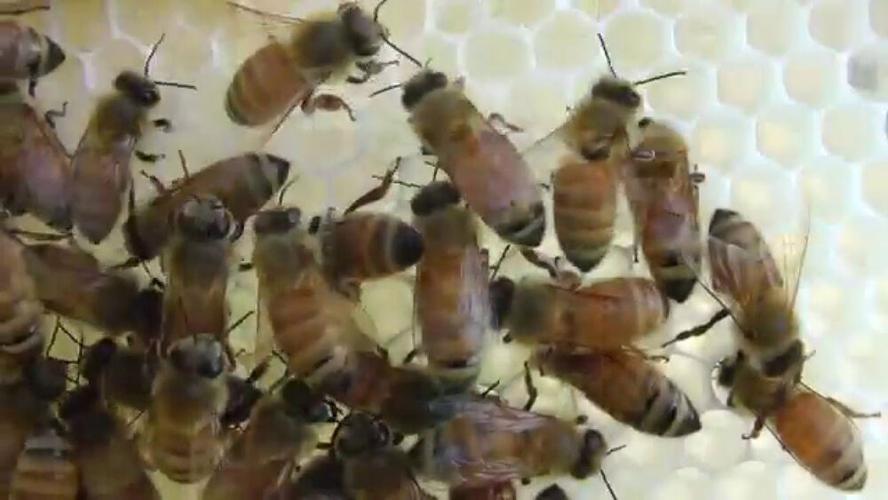
The Queen’s brood cell appears on the ‘face’ of the honey comb, appearing vertically similar to a peanut shell. The Worker cell is typically 4.6 to 5.1 mm in diameter. The Drone cell is larger in diameter: 6.4 to 6.6 mm.
The Queen and Worker brood are fertilized eggs while the Drone is unfertilized. The Drone is unique and haploid, having only 16 chromosomes while the Queen and Worker (diploid) have 32 chromosomes.
The life span of the Worker, who comprises the bulk of the colony, is about six weeks. Similar to army troops in combat, replacements must be injected frequently. Thus, the Queen’s daily egg laying ranges from 1,500-2,000 to sustain the total population.
The Queen essentially restarts her egg laying in January at the rate of around 300 per day. She must replace the 15,000 or so ‘Winter Bees’ and increase the overall population of the colony to around 50,000 by May.
West of the Cascades, the dominant nectar source is blackberries. With the numerous duties to maintain a functioning hive, the population requires significant numbers to meet the demand.
Once the nectar flow is over by mid-June, the Queen reduces her daily egg-laying back so the hive eventually returns to the ‘Winter Bee’ level.
The Worker bee is responsible for the bulk of the work: cleaning each brood cell; nursing the larvae that transitioned from the queen egg; building wax; tending to feeding and care of the queen until the Worker transitions to foraging outside the hive; gathering nectar (honey), pollen, water, and propolis.
The roles of the Worker are age related, similar to how a human baby transitions through a number of stages (newborn merely eats and poops, crawling, walking, talking, etc.).
The honey bee colony is considered a superorganism, as there is no leader or director of work. The duties are driven by physiological changes (hormones and brain chemistry), coupled with the needs of the hive both internally and gathering of stores.
The young Workers (Day 1-10) begin their life by cleaning out the cell they just hatched from, and then they starts to feed larvae (grub-like worms).
The middle-aged Workers (Day 10-20) expand their sphere to cleaning the entire house, building wax comb, processing nectar into honey, storing food, and regulating hive temperature.
Older workers (Day 20 and above) take up a new set of duties from guarding the hive entrance to collecting nectar, pollen, water, and propolis.
In part, the duties of the Worker change the with development of two glands in the head region: the hypopharyngeal and mandibular glands. Together, they produce a substance called Royal Jelly to be fed to the Queen for the entirety of her larval stage and for the first couple days of the Drone and Worker larvae.
The entire colony is driven by the outside ecological system. As nature provides foliage offering nectar, the colony-aged worker exits the hive to gather this morsel mainly in the spring, summer and fall.
Unlike the majority of humans, the honey bee colony’s focus from January onward is the following winter. The hive must gather sufficient nectar to sustain itself during the cold wintry months.
But foragers are unable to exit the hive unless the temperatures are above 50º, moisture is minimal, and wind is less than 3 knots. The typical Pacific Northwest climate finds spring to vacillate daily (or hourly), frustrating the honey bee colony’s effort.
It is not just a matter of gathering groceries: The availability of nectar and pollen is vital to the nourishment of larvae. As pollen or nectar becomes scarce due to weather, the queen will reduce or even cease her egg laying.
That drive, along with the behavior of the bee hive, is linked to the nature surrounding their abode. The absence of nectar producing plants, weather, and pests or diseases have a dramatic effect on the colonies’ ability to become fully prepared for the impending winter.
Consider giving a few dollars toward Project Apis in support of their funding (https://www.projectapism.org/partners/#give).
The Columbia Gorge Beekeepers Association meets on the third Wednesday of each month, http://www.gorgebeekeepers.org/, at the Hood River Extension, 2990 Experiment Station at 6:00 p.m. A different subject is presented by an entomologists or experienced beekeeper. All are welcome. Visitors may attend in person or via Zoom. You may reach out to the club for login information by emailing admin@gorgebeekeepers.org. You may also enjoy a visit to the Hood River Extension to view the three bee hives maintained by the Columbia Gorge Beekeeping Club, and financially by the Hood River Master Gardeners, Klahre House and the Columbia Gorge Beekeepers Association.


Commented