THE DALLES — After thorough deliberation with property owner Kathryn Montag and her neighbors, The Dalles Historic Landmarks Commission (HLC) approved Application No. 222-25, greenlighting the demolition of a historic, but dilapidated, garage.
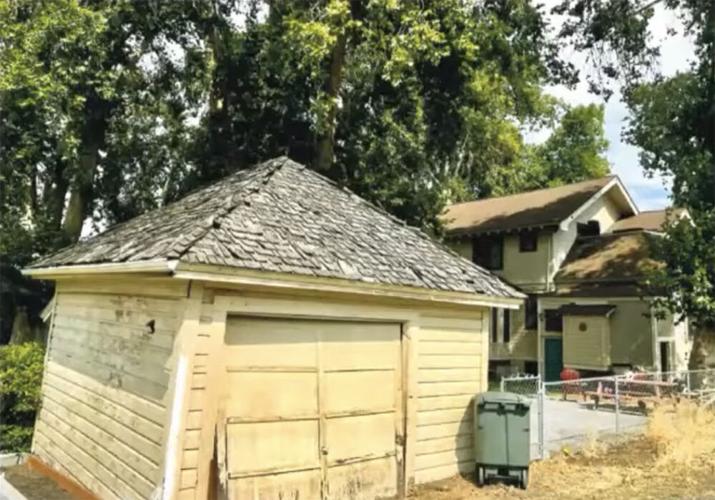
Montag’s 420 E. Eighth St. home, once owned by pioneering doctor J.A. Reuter, is designated as a contributing structure in the National Register of Historic Places. But its detached garage, which sits at the southwest corner of the property, is considered non-contributing and, according to Montag’s request, “is in poor condition, poses a safety hazard, has a crumbling wood floor, no foundation and is creating instability.”
In her application, Montag shared construction plans for a larger replacement structure that would match the paint and materials of the existing, historic residence, which was built in 1890.
The first to testify in favor, Montag characterized the garage as a nonfunctional eyesore — a small but hazardous antique unsuitable for her large electric car, which requires a charging port. She then said that the massive trees in and around her property have caused “thousands of dollars worth of damage” to her vehicles.
Still, Montag understands the structure’s historic appeal, which prompted her decision to involve the HLC. She would welcome the installation of a second informational plaque similar to the sign currently in front of her home — a popular stop for passersby, she said.
“I’m all for history; that’s why I bought the house,” she said. “But the garage has outdone its time and does not serve its original purpose. Allow me to add value to my home.”
She floated the idea for the garage, or at least elements of the build, to be salvaged and housed at a local museum or historical site, as long as it comes at no expense to her.
Neighbors Bob and Joanna Stanek could not attend the hearing in person; instead, they provided Montag comments to read aloud. The garage, which separates the properties’ backyards, “is no use for anything except wild and feral cats,” they said. “We’re very surprised the windstorm didn’t bring it down.”
Fellow neighbors Angela Ray and Bill Lennox expressed similar support for demolition, believing a new, improved structure would enhance the area’s safety and visual appeal.
Only one individual, Richard Wolf, testified in opposition to the application, recognizing the garage’s legacy as one of the first “auto houses” in the area, built when there were only about 6,000 cars nationwide. He encouraged the HLC to adopt the Secretary of the Interior’s standard requiring properties be used for their historic purpose with minimal change to their defined features, stating that creative features must be repaired rather than replaced whenever possible to match the original in design, texture and visual quality. “It’s beautiful workmanship,” Wolf said. “It should be appreciated, not destroyed.”
HLC members Eric Gleason and Victor Johnson, who spearheaded the commission’s brief response, were initially reluctant to approve a full-on demolition and replacement of the garage. They mentioned that the structure’s classification as a non-contributing resource was a clear error, a misclassification in the National Register. “I’ve got a soft spot for these kinds of things,” Gleason said. “It’s special, there’s no denying it,” Johnson added.
Nonetheless, the HLC concluded that Montag’s request and her collaboration with the city were a good-faith move, and that her complaints, as a property owner, were justified.
They directed their focus to finding a compromise, salvaging any materials they could without further inconveniencing the applicant.
City Attorney Jonathan Kara chimed in, explaining that salvaging the entire garage would be expensive and impractical. He noted that Montag and the HLC should aim to salvage any identifiable original materials, such as lumber framing, siding boards, doors, or windows, and incorporate them into the new garage or donate them to a local historical organization.
With all comments and insights in mind, the HLC motioned to approve the application, amended with an extra condition for approval, encouraging Montag to commit to potential collaborative salvage efforts.
The updated conditions of approval are as follows:
1. Work shall be completed in substantial conformance to the pictures and proposals as submitted and reviewed.
2. The applicant shall submit plans for a demolition permit to the City of The Dalles.
3. The applicant shall submit plans for a building permit to the City of The Dalles and then Wasco County Building Codes.
4. The applicant shall submit a Physical Constraints Permit to be reviewed and approved by the City Engineer for all cut/fill grading and groundwork required for the construction of the new detached garage structure if the total amount of cut/fill exceeds 50 cubic yards.
5. The new replacement garage exterior materials and colors shall be compatible with the historic residence and match as closely as possible as proposed.
6. If historical artifacts more than 75 years old are found on the site in relation to the proposed project, resulting from land disturbance, excavation, or grading activities, all applicable state laws and regulations shall be followed in accordance with the guidelines of the State Archaeologist.
7. The applicant is required to notify the Community Development Department of any alteration of approved plans.
8. In recognition of the historic nature of the auto house, the applicant may work with the HLC to document, salvage and reuse as much of the structure as feasible.
The garage will come down. How much of it will be saved, reused, or donated will come to light in the coming weeks as Montag, her contractor, the HLC, and historical organizations work towards the proposed compromise.
“We trust you, and you trust us,” Johnson said, hinting at a healthy, synergistic partnership to come.




Commented