
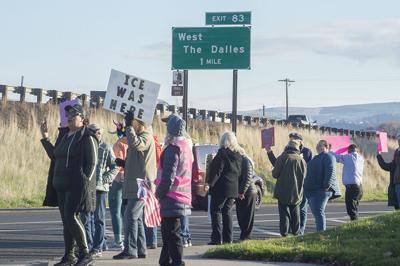
THE DALLES — Wasco County officials told activists and Latino community members that they would investigate supportive measures for families of individuals detained by U.S. Immigration and Customs Enforcement (ICE). This came with remarks from Commissioner Phil Brady decrying the Trump administration’s immigration policies and behavior of ICE agents in The Dalles.
The Dec. 17 county board meeting began with public testimony from many Latino community members and supporters describing widespread fear among a community paralyzed by the recent uptick in random abductions and forceful altercations involving masked agents.
Educator and farmworker Elda Dorado, and her translator Nubia Contreras, asked commissioners to consider collaborating with organizers to establish procedures and points of contact for families impacted by ICE enforcement activities.
Responding to these requests and the outpouring of public testimony, Brady made a statement first in Spanish, then English.
“You do not deserve this punishment,” he said in English. “The principal base of our government is the social contract: we respect the laws because the laws protect us. And what’s happening now, I recognize, is not protecting the community.”
Brady compared the Trump administration’s immigration policies as similar to governments in Latin America, which maintain control through intimidation.
“I know that the Hispanic community is suffering more than anybody, but the suppressors have the objective of making everybody feel afraid, including those who stand beside them, including our government, because we have seen the federal government block funds if we don’t do ‘the right thing,’” he said, using air quotes.
Brady concluded by promising to have staff come up with proposals of how the county can collaborate with nonprofits like the Mid-Columbia Community Action Council (MCCAC) and The Next Door Inc. (TNDI) to support affected families. These proposals will be presented at the Jan. 7 county board meeting, he said.
Community in turmoil
Much of the same public testimony had been given previously at a Dec. 8 meeting of The Dalles City Council.
“What we are witnessing right now is not an abstract policy debate, it is the real time destruction of families,” said an unnamed individual representing Omar Perez and Latinos Unidos. “Parents are being detained without warning. Children face the risk of coming home from school to an empty home. Families are afraid to drive to work, attend medical appointments or even report crimes, because of the fear that any interaction could lead to separation from their loved ones.”
On Nov. 30 a man was forcefully taken from the Home Depot by masked agents wearing immigration enforcement labelled gear. A video circulated by The Oregonian shows the man calling out a phone number as several agents drag him out of the store. In the background of the footage, a woman’s voice calls out, apparently to the agents, “Thank you! We support you!”
“The polls indicate the grand majority of people in the United States disapprove of what the federal government is doing,” Brady said at the meeting.
This month, Pew Research found that 53% of Americans believe that the current administration is doing “too much” to deport undocumented individuals, up from 44% in March, while Gallup stated that more Americans than ever believe immigration is good for the country, with opposition falling by 30% since last year.
Despite Trump’s characterization of his immigration crackdown as targeting the “worst of the worst,” ICE data published by The Deportation Data Project shows two thirds of the 644 Oregon detainees have no criminal record.
Several other testimonies to the board noted that, following many abductions of U.S. citizens and immigrants lawfully in Oregon, Latino residents are fearful of being targeted for the color of their skin.
In September, the Supreme Court issued a temporary ruling, Vasquez Perdomo v. Noem, formally clearing the way for ICE agents to make immigration stops based on a suspect’s skin color, language, accent, presence at Home Depot or other racial stereotypes.
Elizabeth Fernandez, care coordinator for MCCAC, told commissioners she was born in White Salmon but fears her 10- and 3-year-old boys would be left without a parent if she were to be detained for her skin color.
Fernandez pointed to the unfairness of targeting the Gorge’s Latino community, saying, “They’ve put hard work into our city. This is their home, and they deserve to feel safe.”
One-fifth of Wasco County’s population is of Hispanic descent, and that number increases during harvest seasons with two-thirds of Oregon’s registered farm worker housing in the Gorge region, according to estimates from the National Institute of Health.
“If these kinds of ICE activities continue, people may no longer travel here for the migratory work they’ve done before, like weeding, harvesting and especially helping with the local cherries,” said Dorado. “This would have a direct impact on our local businesses, schools, and all of us living in this community, including putting more pressure on orchards and potentially leading them to bankruptcy.”
Support for families of detainees
While the commissioners did not vote upon or take direct action during the meeting, Brady and Commission Chair Scott Hege expressed support for many of the ideas floated during public comments.
TNDI Executive Director Janet Hamada suggested that county leadership set up a private listening session with individuals directly impacted by ICE, a concept echoed by Fernandez and MCCAC Executive Director Leslie Naramore.
Others recommended more direct intervention from the county.
“You have the ability to send a clear message today that in this county, families matter, that children deserve safety, not fear, that our local government will not turn its back on our residents in crisis,” said the representative from Latinos Unidos. “I urge you to allocate funding to establish a dedicated officer task force and work with community organizations to create meaningful protections and resources now before more families are permanently harmed.”
Hege noted that the county is unable to directly provide resources to families, but he expressed a willingness to pursue collaboration through partner organizations, MCCAC and TNDI.
“We’re with you,” he said.
The next Wasco County Commissioners meeting is Jan. 7 at 9 a.m. at 401 E Third St., The Dalles, or online at www.wascocountyor.gov.


Commented
Sorry, there are no recent results for popular commented articles.