
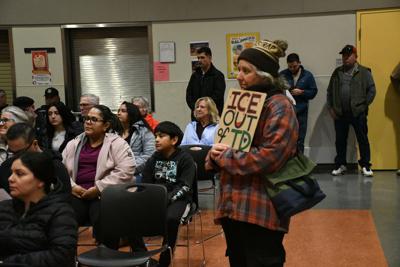

THE DALLES — The Dalles City Council meeting on Feb. 23 covered a wide range of topics, including a presentation from the University of Oregon’s (UO) Sustainable City Year Program (SCYP), impassioned public comment concerning street closures, and a public hearing on an updated employment land strategy, which was adopted unanimously.
Prior to adjournment, the council approved a three-year strategic plan and directed City Manager Matthew Klebes to finalize a grant agreement with The Next Door Inc., building on its Jan. 12 resolution, which prompted Klebes to pursue community support actions associated with local Immigration and Customs Enforcement (ICE) impacts.
UO SCYP
The UO SCYP is a year-long partnership model between the university and cities across Oregon, where multiple classes and disciplines — architecture, planning, public relations, etc. — help tackle city-identified projects. The program was born in 2009, helmed by SCYP Director Megan Banks, who presented to the council alongside The Dalles Community Development Director Joshua Chandler.
“We know the world needs research, we need ideas, we need solutions, and leveraging the role of universities for the benefit of society is extremely important,” Banks said. “But as you know firsthand, change happens at the local government level.”
SCYP helps cities accelerate initiatives they don’t have the staff capacity or budget to fully address, while providing students with applied, real-world learning to prepare them for the workforce and familiarize them with Oregon’s local governments. “We want to put the public back in public universities, and we do so by engaging with the public state,” Banks added.
The program requests that elected officials and community members participate in events, presentations, and open houses with students. If applied to The Dalles, the city would designate a primary staff coordinator to work with the university, while individual city staff would serve as technical leads on specific projects.
Chandler identified potential ventures students could assist with in The Dalles, namely existing initiatives in economic development, housing, historic preservation, tourism, and transportation.
Staff has laid out a conceptual work plan for up to 15 projects, with an estimated total cost of $195,000, averaging roughly $13,000 per project. The city expects its share to total around $130,000 spread over approximately two years, with that number potentially dropping if State Historic Preservation Office (SHPO) grants come through or fewer projects are pursued.
The cost is framed as significantly cheaper than hiring multiple traditional consultants for comparable work, with the understanding that students generate groundwork and studies while staff handle implementation.
The council reacted positively, albeit cautiously supportive, to the SCYP proposal, asking clarifying questions about cost, long-term value, and follow-through — ensuring studies translate into concrete next steps. “Obviously, we need to be mindful of the dollars involved,” Councilor Dan Richardson said. “I understand that the production of a study or plan is a student's deliverable. I would encourage your proposed city’s deliverables to be the next step…if you’re going to accept a study, it's not done on your end until you have a way to apply it or put it into action.”
Public Comment
Ellen Potter, executive director of The Dalles Art Center (TDAC), objected to the proposed nine-day closure of 4th Street for the Northwest Cherry Festival, which she said would harm several businesses and organizations with entrances situated along the roadway.
TDAC’s major fundraiser, which accounts for 90% of their monthly revenue, is scheduled during the closure and cannot be moved. Potter also raised accessibility concerns for elderly patrons, people with disabilities, families with young children, and school groups. “It will be disastrous if the street closure happens and that fundraiser suffers,” she said.
The last time the festival was held on 4th Street, Potter continued, TDAC experienced significant overuse of facilities, causing damage. “Our bathrooms were flooded, and we experienced loss or theft of services through electrical boxes outside of our building,” she added.
Finally, Potter expressed concern about process and communication, noting that she had repeatedly tried to contact The Dalles Chamber of Commerce and had been completely ignored, prompting her visit to City Hall. “The question for the City Council is not whether the cherry festival should take place; it is whether it should be held in a location that creates documented safety risks, eliminates ADA access, or forces businesses to close,” Potter said.
Next, Shannon Sheets, an attorney at Northwest Legacy Law, which also resides on 4th Street, reiterated Potter’s opposition. “We have elderly clients who have hearing and mobility issues,” Sheets said. “They need easy access to our building, which is via our front entrance.”
The council did not hint at a decision or future agenda item on the street-closure debacle during the public comment period, instead asking clarifying questions and acknowledging concerns.
Public hearing
The council then initiated a legislative public hearing to adopt an updated Economic Opportunities Analysis (EOA) and Employment Buildable Lands Inventory (BLI), and to amend Goal 9 — the economic development chapter of the city’s Comprehensive Plan. Chandler introduced consultants Matt Hastie and Jessa Miller of Moore Iacofano Goltsman (MIG), who presented updated data on employment trends and land supply.
They explained that while The Dalles may appear to have enough total industrial/commercial acreage, the city lacks enough sites in key size ranges, especially industrial sites over 20 acres, which hampers business recruitment and expansion.
The update would recognize and modernize Goal 9 policies into seven goals — diversifying the economic base, workforce, readiness, resilience, etc. — with specific implementation measures.
Councilors asked clarifying questions about methodology, the handling of Google-owned land in prior analyses, and how the update aligns with state Goal 9 rules.
During public testimony, The Dalles resident Luise Langheinrich expressed that the updated Goal 9 is overly land-centric and doesn’t require economic cost-benefit analysis of major projects. She urged the city to add tools to evaluate whether large private developments truly benefit the community.
After some procedural back-and-forth to get the exact wording of amendments right, namely, broadening a reference from “Google” to “information and technology companies,” the council unanimously passed the ordinance, thereby adopting the updated EOA/BLI and amending Goal 9, as revised during the hearing.
In effect, the update will replace old economic data with a new land analysis, providing the city with a fresh, legally sound economic development and employment land-use plan to guide future zoning, recruitment, and infrastructure decisions.
Strategic Plan
The council then reviewed a new three-year strategic plan (2026-2028) that replaces one-year goal lists with a longer-range roadmap. Klebes explained it was built from a leadership retreat, community survey, and staff input, setting a new mission, vision, five core values, and seven goal areas:
Public relations, community engagement, and customer service.
Public infrastructure, vehicles, and equipment.
Fiscal sustainability, cost recovery, and efficiency.
Safe, resilient, and thriving communities.
Housing production, affordability, and renovation.
Economic vitality and resiliency.
Workplace and organization.
Each goal has specific actions phased out over three years (about 126 tasks total). “This is something that we hope to continue and strengthen over time,” Klebes said. “The proposed items that we'll be working on are intended to remain adaptable, meaning that this is somewhat of a living document.”
There were no proposed edits to the content, which passed unanimously by the council.
Grant for Next Door Inc.
The final agenda item, a follow-up to the city’s Jan. 12 resolution, proposed funding for local social service The Next Door Inc. (TNDI), which provides counseling services for children and families affected by ICE.
Klebes additionally reported on community support actions the city has taken thus far: informational videos with the police chief and a detective explaining what local police can and cannot do under Oregon’s sanctuary laws; a new FAQ page and Spanish translation of key city forms; and creation of an internal Latino affinity group to review policies and staff training needs.
Using existing authority in his budget, he then asked the council for direction to enter into a grant agreement with TNDI for up to $19,000, which they authorized unanimously.


Commented