THE GORGE — Gorge Abortion Access Collective presented a series of workshops in White Salmon and The Dalles last month to address abortion services in the Gorge, explain how medications work, and discuss ways to protect access under the new federal administration, concluding with a question-and-answer period for those gathered.
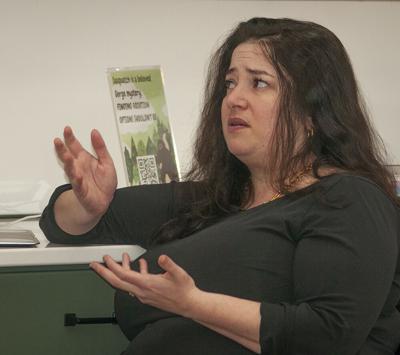
The nonprofit collective is a group of volunteers “helping connect Columbia River Gorge residents in Oregon and Washington with abortion options, emergency contraception, and advocating to bring abortion provision to our area” (www.gorgeaccess.org) since 2022. Organizer Kate Bertash started the April 29 workshop in The Dalles by saying abortion is “popular, bipartisan and common sense.” In all but seven states, most residents believe some legal access to abortion should exist, she noted.
According to the collective, the Gorge has no abortion providers. The closest are an hour away, in Portland, Vancouver, or Yakima. Patients here can either obtain pills through mail-order or telemedicine, or travel.
In many states, abortion clinics are “hundreds of miles” away, organizer Karen Enns said. She later added, “While we in the Gorge may not suffer as a significantly as other folks, it’s still a significant burden on those with limited resources — no car, no money for gas, no time off, no childcare, etc.”
Providence Hood River Memorial Hospital, part of a Catholic hospital and insurance provider chain operating in five states, does not provide abortion-related services, or cover abortions through their insurance program. A religious exemption enables their refusal, Bertash said.
Local county health departments are supportive, as is One Community Health, and can help confirm and date a pregnancy and provide unbiased information on the available options, she said. However, for most, seeking an abortion usually starts with the internet, Bertash noted, which can result in what she called “fake abortion clinics” at the top of their results.
Bertash warned these clinics can be found throughout the U.S. and take the form of mobile vans or brick and mortar locations. They provide free pregnancy tests, but no medical services, she said; thus, they aren’t bound by patient confidentiality laws, and because their services are free, she added that they aren’t bound by consumer protection laws, either.
Bertash explained how local access to abortion works in a region with no local providers. Most local organizations do not include the word “abortion” on their website or publicize such services. Locally, the collective helps abortion seekers with transportation, information and funding sources. Generally, someone needs transportation around once a month, and then a volunteer drives them, she said. There’s also an attorney helpline for those at legal risk.
Medicaid and private insurance are required to cover abortions in both Oregon and Washington, without parental notification or consent, Bertash noted.
According to the presentation, abortion providers can be doctors, nurse practitioners, midwives and others. Half of U.S. abortions are done by the ingestion of pills, a combination of misoprostol and mifepristone, which induce miscarriage, she said. The World Health Organization has come to recognize that combination of drugs as a safe abortion protocol and is now used for nearly two-thirds of all abortions in the U.S.
The federal 1873 Comstock Act prohibits the mailing of obscene material via U.S. Mail, and abortion advocates fear the courts could enforce the Comstock Act as a ban on mailing abortion medication in the U.S. “The Comstock Act can restrict access to abortion care, even in states that have protections for abortion, like the ones we live in,” Bertash said.
Otherwise, procedural abortions mean the pregnancy is ended in a clinical setting. Bertash said procedural abortion is a relatively safe operation. Many abortion procedures are also used to treat miscarriages.
In Oregon and Washington, abortion medication is prescribed up to 11 weeks. Oregon has no gestational limit for clinical abortions, and abortions in Washington can be conducted up to “viability.”
About 55% of abortion seekers have already given birth at least once. “I also like to note that abortion bans and restrictions especially fall hard on children who need abortions, and that [the term] pregnant people can also remind us that children [those under 18] are not quite yet women,” she added.
HIPAA protects the privacy of medical information — but, she said, medical providers can legally break that confidence to law enforcement if they believe a crime is being committed, with medical records potentially becoming criminal evidence.
“It is not possible for a doctor to distinguish between a medication induced versus spontaneous abortion ... So, a doctor will treat you based on your symptoms you describe.” Bertash said.
Only a few thousand of those later-term abortions are done in the U.S. each year — often, Bertash said, because the person was denied an abortion earlier in the pregnancy or learns something new about the pregnancy. She added that “a disproportionate number of such abortions” are for those under 18.
Oregon’s Medicaid program, Oregon Health Plan (OHP), has no residency requirement. That means anyone — say, a migrant farmworker or resident of another state — can get insurance coverage for an abortion, Enns said. Oregon also runs reproductive health programs that don’t ask questions about citizenship status, she added. Undocumented immigrants can get abortions through this service.
Washington’s Medicaid program, Apple Health, does have a residency requirement, according to their manual. However, for residents seeking pregnancy medical care, citizenship status is “not a factor.” This includes abortion.
For more information on the Gorge Abortion Access Collective, visit www.gorgeaccess.org.



Commented