The rumors of their demise have been floating around for years, and the U.S. Mint has tinkered with their size and composition several times in the 232 years it’s been in production. But in December 2025, the Mint pulled the plug for real, ceasing production of the U.S. one-cent coin.
Before we talk about the about the ramifications, we have a bit of numismatic nitpicking to do. That is, technically, the United States has never minted a penny. All of them are cents. The British make pennies, and at the time of the Revolution it took 240 of them to make a pound. The Founding Fathers simplified their new system at 100 cents to the dollar. But people were used to calling things pennies, and so the two terms have been used interchangeably.
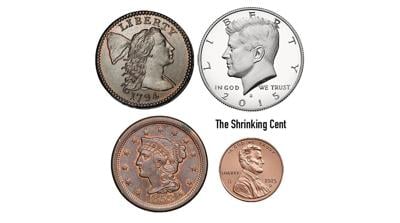
The original U.S. pennies were only slightly smaller than a modern half dollar. They were reduced slightly in the early 1800s and in 1857 shrank to the size we’re familiar with today. Obverse (heads) designs changed from a short-lived flying eagle to an Indian head until 1909, the 100th anniversary of President Lincoln’s birth.
There was tinkering with the composition as well. In 1943, the government needed copper for the war effort, and that year alone made pennies out of zinc-coated steel. And in the middle of 1982, with copper prices rising, the Mint changed the composition from 95% copper to 97.2% zinc with a thin copper coating.
The arguments for halting cent production fall into two main categories: minuscule buying power and escalating costs.
The loss of buying power is readily apparent. It is almost impossible to find any item that can be bought for a single penny.
And, yes, it’s a money-losing proposition, with costs rising from 3.07 cents per coin in 2023 to 3.69 cents in 2024. The move is estimated to save $56 million a year.
And the U.S. is not alone in eliminating its smallest coin. Some 86 countries, from Albania to Zambia, have done so with little or no problems. When Canada’s parliament held hearings on eliminating their cent in 2013, not one witness supporting the cent came forward.
Casting out the cent is a rare bipartisan issue. A recent poll showed 59% of Democrats, 57% of Republicans and 60% of independents favored its departure.
Merchants here are likely to adopt the customs of the other countries, rounding cash purchases up or down to the nearest 5 cents, but making no adjustments in prices for check, credit card or electronic purchases.
So, what should you do with that jar or box of pennies? There are still 300 billion of them out there, and they are still legal tender. Some folks separate out the pre-1982 copper coins, reasoning that they got each for a cent, and the copper in them is worth nearly 4 cents. If they could melt them down, they could quadruple their money. That can’t happen now, thanks to a 2005 law that prohibits melting down pennies and nickels. But now that there will be no more cents, hoarders are hoping that repeal of that legislation is next, and they can turn those buckets and barrels of cents into real money.
Finally, we appreciate the Mint’s touch of class in adding a privy mark for the last 232 cents produced at each mint. They chose the omega, last letter in the Greek alphabet, symbol of the end.



Commented