
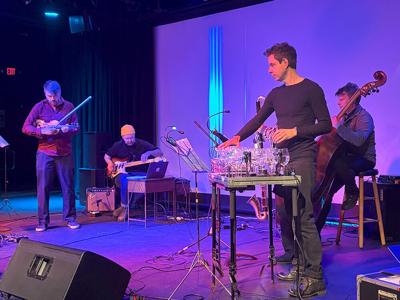

HOOD RIVER — An eruption of sound emerged from Columbia Center for the Arts on Jan. 29, as a quintet of award-winning musicians, The Volcano Listening Project (VLP), strummed, fiddled and blew along to the erratic beats of sonified volcanology.
Led by University of Oregon earth science professor and violinist Leif Karlstrom, nationally-recognized players Todd Sickafoose (bass), Idit Shner (clarinet-saxophone), Adam Roskiewicz (guitar), and Jonny Rodgers (tuned glass) guided listeners through millennia of seismic history, making stops at notable volcanic icons Hunga Tonga-Hunga Ha’apai, Mount Saint Helens, and Kilauea.
Between each medley, Karlstom presented scientific research, datasets, and other visuals to help familiarize the audience with volcanic eruptions and data sonification, which involves transforming complex data into sound.
The half-lecture-half-performance was a special Sense of Place event, tucked between presentations four and five of the program’s 16th season, hosted and curated by Sarah Fox.
The Volcano Listening Project
A number of years ago, Karlstrom developed an interest in representing data in non-traditional ways. Although researchers are often trained to analyze with their eyes, the human ear is equally adept at detecting patterns and can be a useful tool for understanding complex phenomena such as volcanology. And as it turns out, volcanic data has quite the musical structure.
With this in mind, Karlstrom formed the VLP to bridge his research with his creative side and experiment with esoteric musical ideas. “I am a scientist, but to me, it’s kind of impossible to do science without this chaotic, creative element,” he said.
Where eyes have excellent spatial and color resolution — we can see fine details, shapes, and hues very clearly — they have relatively poor temporal resolution, meaning they’re not proficient at tracking rapid changes.
Ears, on the other hand, excel with temporal resolution; it only takes a hundredth of a second to tell the difference between a string instrument, like a violin, and a voice. “Your ears are an amazing mechanical device that turns pressure fluctuation into electric impulses that your brain can interpret,” Karlstom explained. “It does so through the cochlea … an organ that separates frequencies through this transduction method, mapping a waveform called a spectrogram, which is frequency as a function of time.”
Seismic data, though, is not something that we can hear, out of the range of natural perception (20 to 20,000 Hertz). “What do we do if we want to listen to that? We take those waveforms, and we speed them up,” Karlstrom said. “We can do all kinds of creative things with that. It’s just another way to express patterns.”
Hunga Tonga-Hunga Ha’apai
After an opening piece and lecture, VLP performed a three-movement suite focused on the eruption of the South Pacific submarine volcano Hunga Tonga-Hunga Ha’apai in 2022. “It’s one of the last century’s most energetic submarine eruptions,” Karlstrom said. “And in terms of frequency content, it’s more significant than all other historic eruptions, nuclear tests, or asteroid impacts.”
The first movement paired instrumentation with sonified atmospheric reverberations, producing a loud, foreboding soundscape. Eerie whistling, deep clarinet-saxophone from Shner, and intense violin sculpted an atmosphere straight out of a horror film: the protagonist trapped in a sinking submarine with no escape, peering into a vast, blue expanse.
The second movement focused on the eruption itself — discharges of lightning generated by blast particles rubbing against each other in the plume. The plucky bass and exotic instrumentation elicited a peaceful, natural setting, paired nicely with the sonified data, reminiscent of water cascading through a forest before crescendoing into a simmering crackle.
The final movement translated a tiny tsunami triggered by atmospheric waves, which rang the earth like a bell. Chaotic, screechy, and distorted, it felt like walking through a clock shop while tripping on acid.
Mount Saint Helens
Next, VLP brought things closer to home with Mount Saint Helens, sonifying a prolonged period of eruptive activity that occurred from 2004-2008. Every now and then, lava spines poking out of the peak’s crater collapsed, generating large explosions and a distinct seismic pattern called drumbeat seismicity. “As scientists, we think these small earthquakes were related to the frictional slip of those spines, plugged with magma, being squeezed out of the crater like toothpaste,” Karlstrom said.
The sonified beat evoked the sound of rain pelting the roof, but instead of water droplets, rocks of various sizes. Its stressful atmosphere, jazzy and percussive, grew increasingly intense and eventually overwhelming. The final stretch felt like a sprint to the finish line with neurons firing at breakneck speeds — a chaos so hypnotic it could lull you into a trance.
Kilauea
Last stop: Hawaii’s Kilauea, the most active volcano on Earth. VLP performed a second three-movement suite, sonifying data from the last twenty years of activity.
The first movement translated open-vent activity between 2008 and 2018, when a lava lake sat at Kilauea’s summit, boiling along to the roaring hum of seismology. Karlstom fiddled on his violin, layered with a booming backdrop. Staccato plucks transformed into a gorgeous melody as the sonification intensified. It felt extraterrestrial, straight out of a science-fiction film.
The second movement focused on Kiluea’s 2018 month-long caldera collapse, a significant news event that caused property damage on the Big Island. Strangely, this was the evening’s most playful piece — a fun instrumentation layered with a crumbling beat.
The third and final movement transported listeners to the present day, where the volcano is currently erupting, exhibiting geyser-like behavior. In easily the most melodic and familiar piece of the night, VLP delivered a guitar-led, country-folk instrumental, evoking a spring day on the farm.
Final set
Last but not least, a final set, and their most ambitious yet: a sonified rendition of every eruption that has ever happened in the previous 2,000 years in rapid succession, paired with a fun visual demonstrating each incident’s location.
Erratic honks and large, thunderous strums echoed out as each explosion was rendered on the map, changing in volume to match the scale of each.
“Thanks for coming,” Karlstrom concluded. “The world is a dark place, and we need each other.”
From the opening set to the grand finale, “The Volcano Listening Project” captivated — equal parts informative and never-before-heard. For one hour, transitioning through several experimental, immersive soundscapes, the troupe conjured a musical atmosphere that sounded otherworldly, yet couldn’t be more earthly, plucked directly from one of the planet’s most mysterious natural phenomena and magicked into something beautiful.


Commented
Sorry, there are no recent results for popular commented articles.