
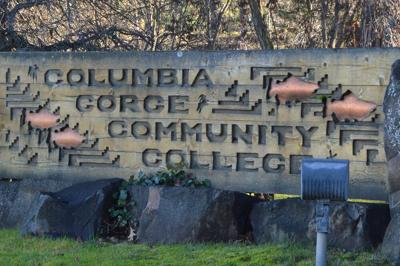
THE GORGE — Administration bargaining units gave another financial counter-offer to the union at Columbia Gorge Community College (CGCC) during a June 5 meeting.
President Kenneth Lawson and Vice-President Garett Gilbert presented, following up on several contentious back-and-forth meetings that argued how to calculate living wage, whether to offer wage increases to employees other than full-time faculty, and whether to split the pay chart.
“We do absolutely take full responsibility ... I’m just going to state frankly that the way our budget is done this year is not how it normally is done, nor should be done,” Lawson said. Normally, a budget should be ready for feedback in March or April; this time it’s still not completed, as the college catches up on audits and other projects.
CGCC has chosen five small rural colleges as “peer colleges,” to which they make all wage comparisons. “We don’t have the resources or the economies of scale of PCC,” or other urban colleges. “Our peers are deliberately rural colleges,” said Lawson.
While Lawson did not bring precise numbers, he’s also not expecting major changes in income, and expects enrollment and state allocations to stay about the same. He noted “substantial” increases to PERS expenses, inflation and prices.
He also specified that while the college does have $1.6 million in contingency funding salted away, and said, “I do suspect we will be dipping into that,” administration would rather not use it for the union’s requested wage increases. Lawson said using some of that money to “move off of Anthology and get a student information system that works.”
On the other hand, CGCC did pass a bond in the last election and thus retired $0.5 million in debt. And they got about $1.6 million from the Employee Retention Credit.
“We want to treat all employees fairly and equitably. And I mean that really across all employee categories, from our classified staff, to our faculty, academic professionals, and administration. I’m going to take a similar approach to everybody’s pay and compensation,” Lawson said.
According to Lawson’s prepared slides, CGCC “proudly pays all full-time employees a living wage of no less than $53,638/year in total compensation, consistent with the MIT living wage calculator.”
In previous meetings, union leaders and professors Rob Kovacich and tina ontiveros have compared wages between CGCC and other community colleges in Oregon, finding CGCC squarely at the bottom with many employees making below a living wage.
“Our wages will typically lag behind the private sector but our benefits tend to be pretty decent, compared to the private sector,” said Lawson.
The administration’s proposal: A 3.5% COLA for everyone in the first year of the contract, dropping to 3% after.
A one-step increase for full-time faculty, stretching the full pay chart to 20 steps, and adding a 3.5% longevity bonus. The college team also offered to complete a wage comparison study for academic professionals, newly added to the union, and open limited negotiations later to re-adjust their wages retro-actively if any academic professionals are making below average wages for their chosen set of peer colleges.
“At this point in time, as we expressed our primary interest is in the full-time space — or recruiting and retaining full-time instructors,” Gilbert said. They estimated their counter-offer would cost a total of $900,000.
Lawson said, “We still need to be, like, figuring out ways to make this work, but I think it’s fair ... For us, we feel like this offer keeps our commitment to paying a living wage, allows us to recruit and train a diverse, highly qualified faculty and staff.”
After Lawson’s departure, union and admin teams continued their formalized squabble over email use, compensation, and whether it’s appropriate for the contract to state that management and management employees must obey the provisions of state and local statutes, the collective bargaining agreement, and all college policies.
Union president Rob Kovacich countered that a member of CGCC’s bargaining unit had actually violated this board policy during negotiations. Also, he said, employees aren’t allowed to speak with board members. So if a supervisor disobeys this policy, the victim has no recourse. There’s no one to enforce this policy.
Kovacich said, “We need this in this agreement. When somebody in administration violates a college policy, law, that needs to be grievable. That is our decision.”
The college initially forbid union members from using their work email addresses for any union communications. The union responded by inserting an article in the contract stating, “college mail and email services shall be used in accordance with Oregon House Bill 2016...” the bill which protects a union’s right to organize without undue interference from employers.
The college then proposed to add: “... and will not contain any derogatory and/or inflammatory material, or any information that addresses partisan political materials. The parties agree that such communications on state equipment should not be considered confidential. The College may at any time, with notification to the Union, refuse to continue this practice due to substantial violation of ethical practices.”
ontiveros said: “We are probably going to need to figure out how to solve this impasse, because we are hearing from our members that emails are important. And this feels like an effort to control the union emails, so we’re all going to have to think of a way to resolve this.
“This is really uncommon language to have in a contract, and it’s very common for unions to send out emails to their members. And we don’t want anyone to be in a position where they could suffer some sort of occupational discipline for their service in the union; and sometimes things get a little inflammatory between union and management — that’s just the nature of things ... something’s going to have to shift.”
The college also refused to give full lecture pay for hours of lab instruction, after a comparison between their chosen peer institutions. “We feel that, with the exception of a couple of institutions, we’re consistent,” Gilbert said.
The union then opened articles on professional development compensation and asked the college to consider a payment method that would avoid putting charges on personal credit cards. “We do have a lot of employees who are struggling to get by; we do have a lot of employees who are not taking advantage of professional development because they are afraid of the embarrassment of putting something on their card, not getting paid back in time, not being able to make their visa payment, having to tell a professional peer about that,” ontiveros said.
However, much has been resolved since bargaining began. Gilbert even brought several tentative final agreements, but Google docs mysteriously ruined the printouts — and the union lacked enough members present to sign, anyway. “I apologize to these trees,” Gilbert sighed, waiving the ruined sheaf sadly.
Public bargaining meetings continue into summer.


Commented