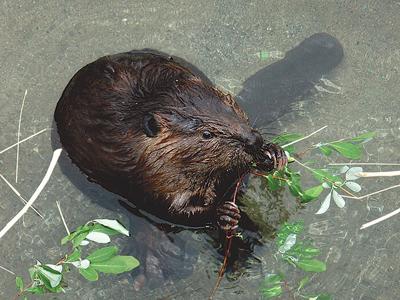
A team of individuals from a variety of agencies are working to retain, restore and rehome beavers, whose dams create wetland ecosystems which offer ideal conditions for vegetation and shrubs to grow.
A team of individuals from a variety of agencies are working to retain, restore and rehome beavers, whose dams create wetland ecosystems which offer ideal conditions for vegetation and shrubs to grow.
THE GORGE — Since 2018, a small group of individuals from different agencies and organizations have joined together to discuss one particular aquatic rodent: the beaver. Together, they’ve created Wishpush Working Group, an organization that focuses on retaining, restoring and rehoming beavers and the wetlands they create.
Their core steering committee includes Yakama Nation Fisheries, Mid-Columbia Fisheries Enhancement Group, Underwood Conservation District and Mount Adams Resource Stewards.
“[Wishpush Working Group] grew organically out of some conversations that were being had between these different parties,” said Jeanette Burkhardt, Southern Territories Habitat Project at the Yakama Nation Fisheries. “Beavers benefit from the resources that we are all working to conserve and enhance and protect.”
The geographic scope for Wishpush Working Group is defined as the southern territories of the Yakama Nation in Washington State — the North Bank Tributaries to the middle Columbia River.
Burkhardt noted that the name Wishpush is the English written approximation name for the beaver name in Yakama creation stories; this is to recognize the importance of beavers in the tribal culture of this region and that they are an integral piece of the landscape.
“There’s a growing recognition that they are a keystone species — many other wildlife, plants and species use or require the wetlands that beavers create,” Burkhardt said. “It’s a number upwards of 70% of the species in Washington state use beaver complexes or beaver-created wetlands.”
She explained that beaver dams create wetland ecosystems which offer ideal conditions for vegetation and shrubs to grow. This then attracts various types of wildlife to the area for breeding, protection, and foraging, creating a biologically diverse wetland ecosystem.
The additional benefits of beaver complexes include assisting with absorbing floodwater runoff and water filtration, though Burkhardt also cited Emily Fairfax’s research on how beaver wetlands help create drought and wildland fire resilience patches in a landscape.
“Unfortunately, we don’t have a lot of good examples of that in our area anymore after beavers were nearly trapped out of existence,” Burkhardt noted. “Our watersheds would look a lot different if beavers hadn’t been removed.”
Wishpush Working Group is working to mimic these beaver-created wetlands in a technique known as low-tech process-based restoration of riverscapes. The goal is to deepen the water and allow riparian plants to grow over time, which would be able to sustain and restore the beaver population. Areas for prioritization are chosen using the Beaver Restoration Assessment Tool, which helps identify locations that are likely to, and historically have, been able to support beaver populations.
Yakama Nation Fisheries has selected 11 locations in total for low-tech process based restoration projects, three of which were completed in 2023.
The Washington Department of Fish and Wildlife has a pilot beaver relocation program to train individuals how to trap and relocate beavers into portions of watersheds that are out of harm’s way from humans and man-made infrastructure.
“Beavers are not protected … There is no requirement at the moment to obtain a permit to lethally remove a beaver from your property,” Burkhardt said. She is hopeful about the relocation program and pointed to Wishpush Working Group’s licensed beaver relocator and beaver holding facility to help successfully rehome the species when needed.
An emphasis in 2024 for Wishpush Working Group is to continue education and outreach. Recently, the organization has been working with various educators to help teach students about the importance of beavers.
So far, they’ve worked with Goldendale Middle School students at a low-tech restoration site on Blockhouse Creek in Goldendale and have plans this year to bring Yakima Valley students to another project on a tributary at the base of Mount Adams to help assess and restore a former beaver complex burnt by the Cougar Creek Fire.
In another fire restoration project along the Little Klickitat River, Wishpush Working group is teaming up with Goldendale educators again.
“We’re having a watershed education field day, a little bit later this spring, to have the students kind of assess the habitat currently,” Burkhardt said. “In the fall, hopefully, we can get students back out to help do a little bit of implementation with a work crew out there.”
To reach out for more information regarding the Wishpush Working Group, reach out through email at fish@midcolumbiafisheries.org.



Commented