This story has been updated to reflect several transcription errors.
THE DALLES — Jeff Helfrich, who represents area in the Oregon House of Representatives has filed for the senate, leaving House District 52 open for contention.
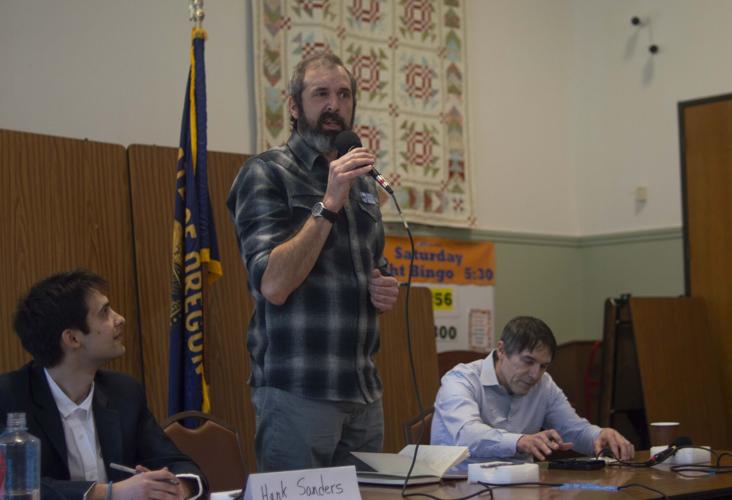
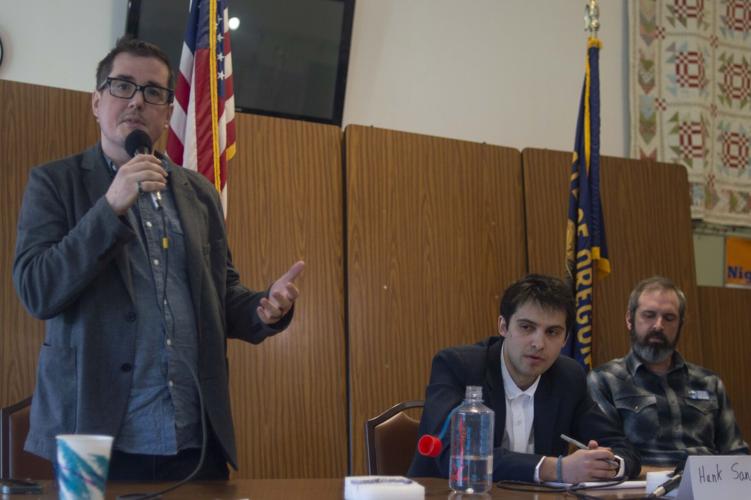
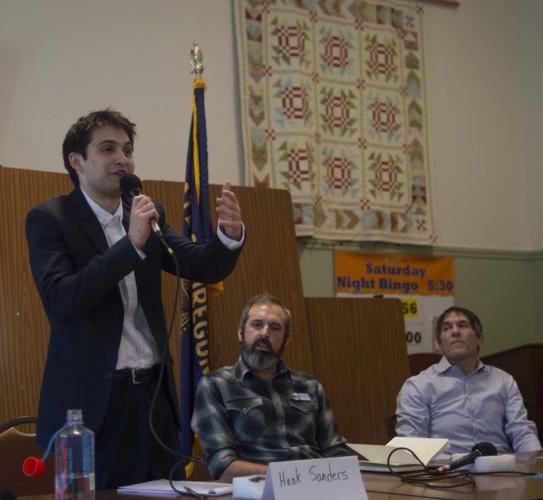
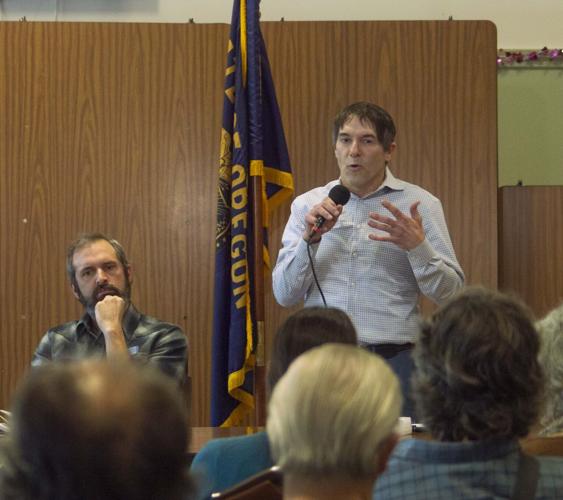
Four democrats have filed for the primary, and whoever wins on the May ballot will run for the empty seat: Bernard Seeger from Cascade Locks, David Osborn from Corbett, Hand Sanders from Hood River, and Nick Waldon Poublon from Sandy.
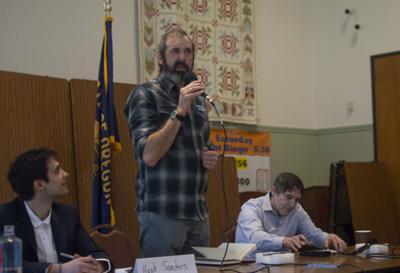
The four spoke at a forum on Feb. 1 hosted by the Wasco County Democrats at the Mid-Columbia Senior Center, and whoever wins will face Republicans Robert Flemming of Gresham or Darcy LaPier of Sandy in November.
Bernard Seeger
Martin Gibson photo
Bernard Seeger
Graduating from West Point in 1991, Seeger spent eight years in the army, then studied public administration at the University of Kansas. He’s spent 18 years working for local governments, six of those years in rural communities with conservative representatives, and also for Citizens' Climate Lobby. He’s now a city councilor in Cascade Locks.
Asked about transportation funding, he said he’d prioritize it, that electric vehicles should pay their fair share and heavy vehicle charges. He also favored learning from states like Utah and Colorado, which have a lower gas tax.
As for school funding, he supported decoupling Oregon’s taxes from the federal system, financial reform, and sales taxes on tourists. On housing, he wants more so that everyone can live near their work, and suggested building housing atop stores and other development.
Asked about energy policy, Seeger said he supports clean energy, the Power Act and raising franchise fees on power-hogging data center companies Google. He also likes geothermal energy (because it could plug into former natural gas plants along Oregon’s volcanic chain), and building transmission lines near wind or solar potential.
On how he’d differ from Helfrich, Seeger said Helfrich was his boss and friend when Seeger was city administrator in Cascade Locks. But Helfrich’s apparent support for ICE, Seeger said, is a dealbreaker; and as a veteran, Seeger wants stronger gun laws.
“I know what a responsible gun use and gun ownership looks like, and what is allowed for common citizens, in my mind, is way too generous.”
Seeger also said he loves working on Cascade Locks city council, and feels 11 years of wrestling in Texas schools prepared his “fighting spirit” for this race.
David Osborn
Osborn grew up in Douglas County and got a Ph.D. at Portland State University and the University of Oregon. He’s chaired boards and founded nonprofits such as the Sandy River Watershed Council, he said. His work includes grassroots networks that worked to stop proposed fossil fuel terminals throughout the Northwest.
Touching on the same points, he suggested equity between electric vehicles and hybrid cars, focusing on maintenance over new projects, and said he sees gas taxes as a “regressive” regressive solution to fixing the transportation deficit.
Osborn emphasized more cuts within school districts would be bad, but so would larger class sizes; he supported taxes for the wealthiest to fill the gap. “Our schools are on the brink,” he said.
Taxing the wealthy, kicking out hedge funds, and making building as easy as possible would help mitigate the housing crisis, he said, and he “completely” opposes nuclear energy as a renewable solution. He would work to ban it, and said construction of data centers should pause until issues of water use, pollution, and higher power rates for others get figured out.
He emphasized policies that support ordinary working people with housing, healthcare, education, and wildfire mitigation would distinguish himself from Helfrich.
Regarding wildfire, Osborn said he’d support home hardening and defensible space resources, and stewarding forests for “a healthier relationship to fire.”
“We are in a serious situation here, with the federal government, both withdrawing from and attacking our communities, and we have to look directly at this $5.7 billion deficit,” Obsborn said. "I’ve said it over and over and over and over again, because whichever one of us wins this race has to be the one that has an answer to that question, because otherwise it’s cuts ... We do not have to choose cuts.”
Hank Sanders
Martin Gibson photo
Hank Sanders
Sanders grew up in Gaston, Oregon, before attending public school in Portland. Sanders studied economics at the University of Chicago, and worked for the Chicago Tribune after college. There he wrote about a small-town mayor’s conflict of interest.
That earned him criminal citations for, he joked, “hampering and tampering with government work.” The charges were a First Amendment violation against him that was reported in the Associated Press and New York Times, who then hired Sanders to cover “the Trump administration’s corruption, and other news.” Sanders moved to Hood River and now works as legislative assistant to his mother, Lisa Reynolds, who’s a state senator.
Sanders said Oregon spends 6.5% of its budget on transportation, among the lowest nationwide. He objected to gas taxes and suggested carving out more money from, say, the Department of Human Services.
Asked about schools, which face significant loss of funding due to federal cuts, Sanders suggested detaching Oregon’s tax system from the federal government to save about $400 million per year; investing heavily in early childhood education; and larger class sizes, a solution he said is favored by union leaders and education experts.
On housing, he’s the only candidate who doesn’t own a home, he said. He advocated for incentives and fees to build on the half-million empty lots in local urban centers, noting that luxury housing is more profitable to build than affordable housing, even with tax breaks and benefits.
As for energy, he wanted honesty about how much energy and water Google is using, to stop tax breaks, and proposed raising power rates for data centers. “We have enough data centers,” he said.
He criticized Helrich for not being present in the community and having conversations with local officials. Additionally, Sanders said his policies on wildfire mitigation, tax credits for rural childcare workers, and Medicaid paperwork assistance set him apart.
Of note, Sanders has received endorsements from “several of the leading folks who have been on the forefront of fighting against ICE,” he said, including Hood River City Council President Gladys Rivera and Omar Perez, volunteer organizer of Latinos Unidos.
He supports banning masks for federal agents, which has to be approved by voters; financial support for families of the detained; and withholding tax dollars from the federal government if necessary to prevent Oregon dollars going to ICE. “That’s within our constitutional rights,” he noted.
“The Oregon that I love is slipping away,” he said, nodding to high prices and warming climates. “Our farm workers are all deported, and our farm owners are priced out of the already small margins they had to begin with.
“I’m the only renter. I’m the only candidate who does not have a 401k. And I’m also the only candidate with a succinct plan on how to lower costs — the Salem experience to get the job done.” he said. "And also somebody who’s been standing up to President Trump’s B.S. for years as a reporter for the New York Times and Chicago Tribune."
Nick Walden Poublon
Martin Gibson photo
Nick Walden Poublon
The largest city Poublon has ever lived in is little Sandy. He attended grad school at Portland State, where he was diagnosed with a brain tumor the university’s health insurance would not cover. In response, he jumped through all the hoops — advisory board, other students coming forward, open forums, talking to administrators — to get the university’s health insurance company switched. Then, he served as the legislative aide for District 52, the last time a democrat held the office.
He proposed a reasonable fee for electric vehicles, and a good hard look at where Oregon’s Department of Transportation is spending money. While he objected to a gas tax, Poublon didn’t want to take money from other agencies either, and he noted rural residents should not be taxed for the inescapable need to drive long distances for basic services.
A substitute teacher, he reufted that enlarging class size would solve the school funding crisis and suggested that education should be funded by something other than property taxes.
Asked what legislation he’d propose for affordable housing, he called it “one of the hugest issues. Cutting red tape to spur development and stopping hedge funds from purchasing homes within three months on the market were among his main solutions.
On energy, he said that data centers need to be transparent, that the money they make goes local, and was firmly against any additional tax breaks.
Asked how he’s different from Helrich, Poublon — who narrowly lost the District 52 race in 2024 — remembered how Helfrich admitted that he didn’t believe in “women’s right to choose” during a Willamette Weekly conversation. Other forums in that race were canceled when Helfrich failed to show up, he said. Poublon is pro-choice.
Regarding the $900 million shortfall in Oregon’s budget caused by HR 1 (“One Big Beautiful Bill”), Poublon said he’s endorsed by “seven or eight” legislators for his experience with budgets. He proposed “clawing back” its tax breaks for the rich.
Poublon is running because someone told him they were tired of candidates who tried once, then disappeared: “We have a chance to give the Dallas some blue representation so that you aren’t known for Cliff Bentz alone.”



Commented