
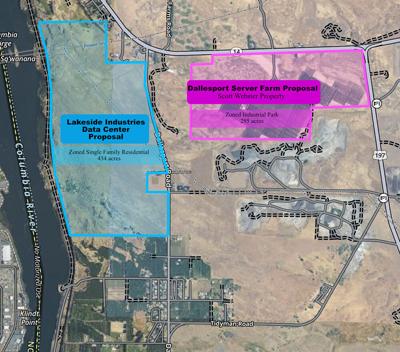
At least three data centers are currently being planned across Klickitat County, largely along the Columbia
DALLESPORT — Klickitat Public Utility District (KPUD) confirmed that a second data center in Dallesport is being proposed on a 434-acre parcel owned by Lakeside Industries.
Lakeside Industries, a Seattle-based asphalt paving company, did not respond to multiple requests regarding the facility. The land is zoned single-family residential, so any development would require a conditional use permit from the Klickitat County Planning Department. The process allows for a public review hearing.
In March, KPUD submitted a 1,260-megawatt (MW) line-load connection on behalf of Lakeside Industries from the Bonneville Power Administration (BPA). The agency declined to share additional information about the request — an unnamed representative stated that “studies are only shared with requestors and impacted parties.”
This is the second known data center being planned in the unincorporated community, alongside the “Dallesport Server Farm,” located on an orchard zoned as an industrial park and owned by Scott Webster.
Over the past few months, concerns among residents about power rates and water use from data centers have grown. Dallesport and Murdock share a city council, board members and a weekly newsletter. No mayor exists; their total population is about 1,500.
“The data center will literally be across the street from me,” said resident Tracy Zumwalt, who’s lived in town for well over a decade, referring to Webster’s property. She explained how they are careful with water usage, especially in winters with low snowpack. “A well is enough to run orchards but not enough to run a data center.”
Even a small volunteer-run Facebook Page — STOP Klickitat County Data Centers — has appeared, with one resident Sheryl Lane, intending to “put together a list of actions that everyday folks in High Prairie could do to express their thoughts against data centers.”
The worry led Klickitat Public Utility District (KPUD) Commissioner Doug Miller to guest speak at a Dallesport-Murdock Community Council meeting on Aug. 13.
“The biggest thing that’s in the news today is data centers,” Miller said. “The [KPUD] board is agnostic about data and AI centers, and this includes any new large load that might show up.”
It’s not guaranteed every project will have access to water.
He added that water for data centers could be leased from a 14,900 acre-feet a year water right from the Columbia River, acquired after the old aluminum plant outside of Goldendale closed. That same water was confirmed to be used for the Goldendale Energy Project, a controversial pumped hydro storage project and a nearby 1,118 MW data center being planned by Blue Owl Infrastructure, as previously reported by Columbia Gorge News.
In comparison, Google’s data centers across the river in The Dalles reportedly used 1,687 acre-feet of water in 2025.
But water is just a fraction of the puzzle — power is another.
If both the Dallesport Server Farm and Lakeside Industries data centers go through, that’s potentially an additional 2,260 MW of electricity flowing through the town.
Miller stated that data center power would be separate from residents’ and would not affect current prices, adding that the data center fees would be used to offset rate increases.
A KPUD policy from 2012, approved well before data centers were proposed in Klickitat County, stated that large load users would have to financially provide their own power and substations, then turn it over to KPUD for operations and maintenance services, which the developers would also provide funding for.
“Large developments, such as data centers, would typically be served under an Industrial Service rate, which is established through a negotiated contract specific to that customer,” said a KPUD spokesperson. “This contract is structured to ensure that the customer bears the full cost associated with the electric service they require, including any incremental demand placed on the system.”
As of now, if Lakeside Industries or the Dallesport Server Farm moves forward, both would have to secure power outside of BPA and KPUD. Due to Washington’s Clean Energy Transformation Act, developers must look at carbon-neutral power generation sources such as solar, wind, nuclear, or hydropower.
•••
Bernard Yoo, a documenter with Uplift Local, contributed reporting to this story.


Commented