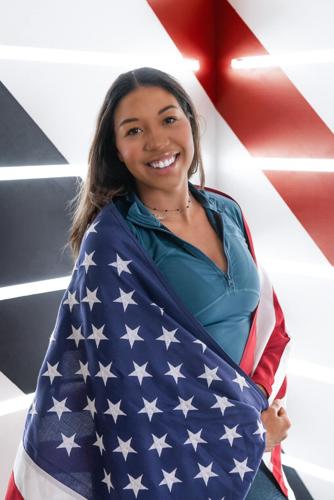
Hood River Valley High School grad Jestena Mattson trains with Team USA Bobsled for the upcoming World Cup competitions. The circuit is scheduled to be held in the U.S., Canada, Switzerland and other countries around Europe.
Hood River Valley High School grad Jestena Mattson trains with Team USA Bobsled for the upcoming World Cup competitions. The circuit is scheduled to be held in the U.S., Canada, Switzerland and other countries around Europe.
Contributed photos
Mattson dons Team USA gear as she and teammates prepare to travel North America and Europe for the upcoming World Cup circuit.
Former Hood River Valley High School track and field standout Jestena Mattson was selected to represent the 2022-2023 USA Bobsled National Team at the upcoming World Cup competitions. Mattson ran for the Division 1 Fresno State Bulldogs, where she earned multiple Mountain West conference championships in the heptathlon and pentathlon competitions. Her senior year she was also named to the All-American second team for her performance at the NCAA Outdoor Championships.
Despite COVID-19 derailing much of the 2020 and 2021 track and field seasons, Mattson continued to train and compete when and where she could. While training on her own, she received a call from Team USA bobsled representatives asking if she would be interested in attending a rookie camp in Park City, Utah.
“So, I was like, ‘Heck yeah I want to do that. I’m gonna go out there, just see what it’s about’,” said Mattson.
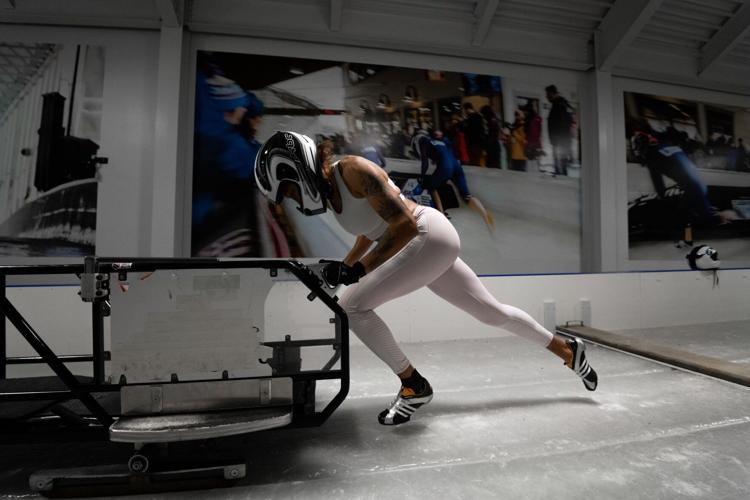
Going from a rubber track to an ice track, Mattson said rookie camp was a lot for her to take in. She was tested for her maxes in several weightlifting exercises — which was nothing she hadn’t done before, being a pentathlete. Her impressive marks placed her second behind another Mountain West All-Conference sprinter, Kaysha Love. At the 2022 Beijing Olympic games, Love served as a brakewoman for Team USA. For Mattson, finally stepping on the track opened her eyes to how taxing the sport can be.
“You just jump in the back of a sled, and we’re going about 85 miles an hour with your head between your knees just getting rocked back and forth and all you got on is a helmet,” said Mattson. “I quit the sport about three times.”
As training camp continued, she reflected on how far she has come and began to enjoy the process.
“No one can really prepare you for what it’s like to go down in bobsled,” she said.
As Mattson continued to carve out a role, it was clear she would be best as a brakewoman. The responsibilities of a brakewoman are few and far between. She administers one final push and hops in the back of the sled, where she is told not to move on the way down. Mattson said the sled can often hit G-forces of up to 5 Gs — which is more than an astronaut feels when taking off in a space shuttle.
“As a brakeman, you put your life and your pilot’s life in your hands,” said Mattson. “I have no control over what happens, until the end when I have to pull the brake at the right moment.”
A few months away from the sport, Mattson finally returned this year and competed at the Junior World Championships in Lake Placid, N.Y., where she joined forces with former teammate Kaysha Love. The two did well enough to get noticed, and Mattson received a call from Team USA asking her to be on the squad for the World Cup.
Mattson and the team are currently in Whistler preparing for the upcoming World Cup Circuit. The pilots usually gather everyone around 10 a.m. and head up to the one-mile-long track to see how it has changed since their last run. Pilots must study every inch very closely and decide how to approach each turn with delicate precision. Each course has 15 to 18 curves — depending on the track — and each one is different than the one before.
“I need to know why I’m out on the tracks. I have to learn the track, and I have to count the curves,” said Mattson. “We’re like, hey, we bumped out of turn 11. That’s not great. We might crash on 13. Those types of things.”
In preparation for the World Cup, typically they will do two or three runs a day, before heading back to the garage around 5:30 p.m. to loosen the nuts and bolts. The runners will dry everything and make any changes to the sled that might need to be adjusted. After dinner, the squad heads to get one last lift in before they call it a night. Recovery is important for all athletes, but those who bobsled do what is called contrast water therapy — which is similar to an ordinary ice bath. But contrast water therapy can speed an athlete’s recovery even faster by flushing lactic acid from sore muscles.
While training for the national team, Mattson is also making time to train for her track and field career.
“I wake up every day at 6 a.m. I do 40 minutes of yoga. And then I do some type of workout. Sometimes it’s my track workout. Sometimes it’s just an active recovery work,” she said.
World Cup races begin next weekend, Nov. 22-27 in Whistler before Team USA heads back to Park City for the next installment. Two weeks later Mattson will travel to Lake Placid in mid-December, before everyone gets 10 days off to return home and celebrate Christmas. Then it is go, go, go for Team USA. In Winterberg and Altenberg, Germany, they will return to the tracks. They will have five weekends from January to the final day on March 19, 2023, where champions for the 2023 International Bobsleigh & Skeleton Federation will be named.
Team USA is covering Mattson’s lodging and food expenses while training, but athletes do not get a stipend, forcing many of them to pay out of pocket for travel and other expenses. If you are interested in helping Mattson, she is looking for sponsors and is accepting donations. To donate her Venmo is @jestena-mattson, or you can reach out to her email JestenaMattson@gmail.com.



Commented
Sorry, there are no recent results for popular commented articles.