

HOOD RIVER — For generations, family farms in the Hood River Valley (HRV) have helped shape a unified sense of place, growing crops that define the region as an agricultural hub — world-renowned pears, apples, and cherries — while strengthening a tight-knit rural community.
Now facing modern barriers, including economic, climate and social pressures, owners of Out On A Limb Farm in Dukes Valley, just southwest of Odell, Lisa Perry and Ricardo “Bubsy” Galvez are keeping that commitment alive.
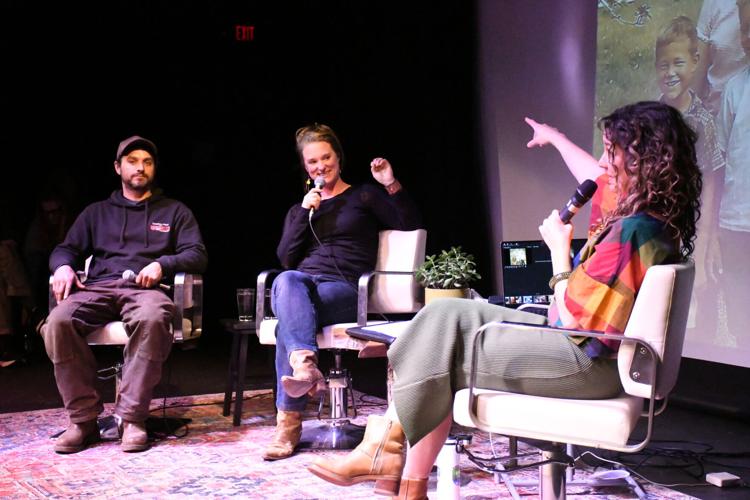
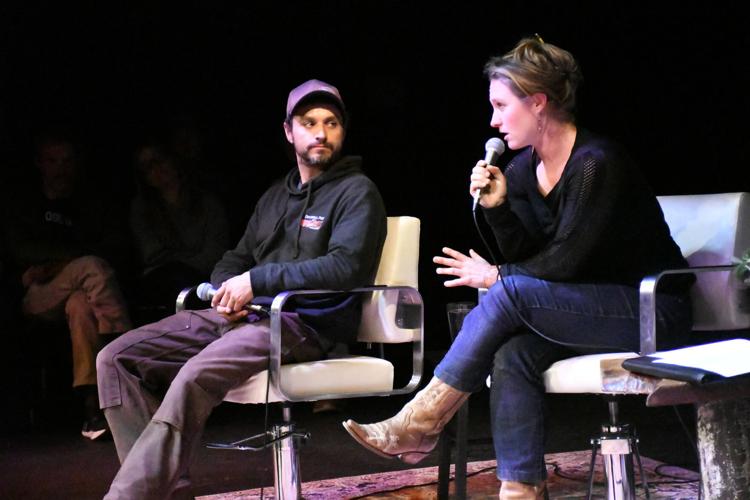
The locally-grown couple brought their agricultural expertise to Columbia Center for the Arts on Feb. 18, reflecting on the trials and tribulations of family farming in 2026 and the deep connection to place that keeps them devoted to the Gorge. Curated and moderated by Sarah Fox, the interview-style lecture was the fifth presentation in Mt. Adams Institute’s Sense of Place Season 16.
Both descendants of farmers in the region whose families have harmoniously intertwined over the years, Perry and Galvez are a match made in heaven. Perry, a fourth-generation HRV farmer, is a social butterfly, considered the face of the farm and its popular fruit stand business, The Farmer in Odell. You can catch her on social media, frequently posting photos and reels that offer a raw window into farm life while sporting fruit-themed earrings.
The soft-spoken, second-generation farmer Galvez, on the other hand, prefers to stay out of the limelight, perfectly content spending his day alone on the farm, absorbed in handiwork. Together, the two grow pears, apples, plums, peaches, and nectarines for a local packing house, while raising their 3-year-old son, Jackson.
Perry got her start in agriculture as a young girl on her great-grandfather’s Pine Grove property, where she’d cruise around in a Ford F-150 with her father, checking on nearby orchard blocks or hitting up the local gas station — vivid memories she can feel and smell to this day.
But her father, struggling with alcoholism and mental health, eventually lost the farm to an out-of-town buyer, paving a long and unpredictable road back to her roots, to continuing her family’s legacy.
Galvez’s farming ties also trace back four generations, though fragmented across both sides of his family. His father, also named Ricardo, immigrated to America from Mexico when he was 14. He started working in orchards, gradually building a future that would allow him to buy his own farm property.
On his mother’s side, it began with his great-grandfather, Jack, who came to the HRV from Arkansas to join the logging industry. His son, Galvez’s grandfather, Calvin, later acquired 14 acres of farm land from Jack that would eventually become Out On A Limb.
Ironically, people tend to associate Grandpa Calvin with Perry before Galvez, she explained. In fact, she met him before she ever met her husband.
“We look similar, we both walk fast, we have the same get-it-done attitude,” Perry said.
At age 10, Perry and her siblings moved in with her stepdad, Glen Cody, where the ideals of farm life became permanently ingrained in her being — the reason she is still farming today, she said.
On the Cody farm, the kids enjoyed a balanced combination of hard work and play, following a structured regimen that involved moving water, feeding livestock, and seasonal orchard work every morning from 8 a.m. to noon. “I just loved it,” Perry said. “I loved being outside and growing up.”
She has fond memories of daily, sit-down lunches with the family, before being let loose in the afternoon for sports and giggly nights with friends. All was fair so long as they returned to work the next morning.
“We were working so hard, but as a family,” Perry said. “It was stressful, but I look back on that as the best time in my life. I can’t believe what we accomplished then.”
During this time, Perry’s mom started a fruit stand, transforming a 100-year-old packing shed into a beloved, magical space. Working the stand helped Perry build confidence and taught her how to talk with customers, many of whom knew little about what happens on a farm. The experience later shaped her own Farmer in Odell identity — her current fruit stand business.
Many years later, Perry’s stepdad shared thoughts on retirement and asked her if she wanted to continue the lease on the fruit stand property. Now married to Galvez, she elected to purchase Grandpa Calvin’s farm instead. “I feel like I let go of such a special piece of our history with that barn and that fruit stand,” Perry said. “But my husband pointed out to me, if we had the opportunity to purchase his grandpa’s farm and have it be ours, that just made more sense.”
After two years of leasing, the couple bought the farm from Grandpa Calvin, keeping it in the family. The lease period was effectively a test — proof that they could manage the work and care for the land.
Even after the sale in 2017 — the birth of Out On A Limb — Grandpa Calvin and Galvez’s father continued to contribute to the farm. But over the last two years, Grandpa Calvin retired to Arizona, and Galvez’s father passed away — a loss of familiar faces and institutional knowledge that has increased workload and decreased morale.
“We lost two of our greatest contributors to bounce ideas off of and have reassurance that we’re doing the right thing,” Galvez said. “Those guys, you could look at them, and you would know that you’re okay.”
Today, Galvez works his tail off fixing things and improving the property. “That’s a rule on the farm: 10 things have to be broken,” Perry added.
He recently revived and upgraded the on-farm cooler, which had previously sat unused for decades, modernizing it for current operations. With support from an Oregon Department of Agriculture grant, he installed a new compressor unit and fans, redid the interior walls, and rebuilt the roofline so a forklift could fit through the doors. Before that, since the 1970s, every box of fruit had been hand-trucked in and out. “The fruit stand looks all fun and golden, and it’s a lot of work, but Bubsy is why it can happen, and I know that he does not get all the praise and credit,” Perry said.
Alongside her efforts with the Farmer in Odell, Perry tends to seasonal orchard work and off-the-farm business. “If there’s anything that has to do with talking to people, meeting with people, or networking with people, I would much prefer it’s Lisa’s job,” Galvez said.
Perry’s social media pursuits aren’t solely a marketing tactic, though. One of the largest issues modern farmers face is mistrust or misunderstanding of farming practices, often perpetuated by stereotypes — notions that farmers are “dumb hicks” or “evil.”
“The fruit stand provided me with enough evidence that people did not know what was going on — like the fruit just showed up,” Perry said. “Social media has been a very useful tool to help start discussions and provide food for thought.”
“I wouldn’t say that I’m affected by outside noise,” Galvez added. “Really, farmers are chemists, farmers are very smart … I see farmers doing their best to be very knowledgeable about the way we’re doing things because we’re kind of under scrutiny.”
Another major deterrent farmers face, particularly in the HRV, is weather extremes during critical moments. Rain, cold, wind, or heat during the short pollination window can ruin fruit set. Snow can knock blossoms onto the ground, while frost can kill blossoms or cosmetically damage fruit so badly that it’s not marketable. Farmers spend thousands per night on frost fans and fuel, with no guarantee of success.
Additionally, this winter, low mountain snowpack has threatened irrigation supplies that the entire valley relies on.
But perhaps the biggest challenge for family farms in the Gorge is evolving economic and market pressures; large buyers can suddenly decide they don’t want a variety, leaving farmers with unsellable, but perfectly good fruit. Perry shared a video of a beautiful cherry crop she couldn’t pick because the prices offered didn’t cover labor costs.
“I understand that’s part of the game, but this is really criminal,” she said. “How much effort has gone into this crop, and it’s not worth anything.”
To add insult to injury, HRV farmland is among the most expensive per acre in the state, making it very hard for smaller or mid-size family farms to launch or expand.
“I think family farms are in real trouble right now; vertically integrated operations are going to be the future,” Perry said. “We love this lifestyle, and I will fight hard for family farms, but I don’t think it’s going to be a very comfortable next five to 10 years. I think we’ll see a lot of consolidation.”
Before concluding the lecture, Perry and Galvez urged the audience to acknowledge family farmers and to continue buying local.
“Be a good neighbor and go introduce yourself and have a conversation,” Perry said. “I want to see more people eating fruits and vegetables, because that is what’s going to save farms.”


Commented
Sorry, there are no recent results for popular commented articles.