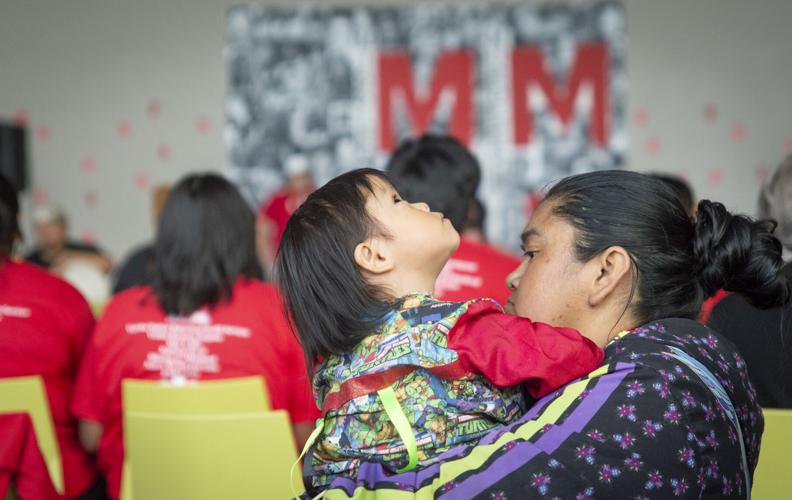
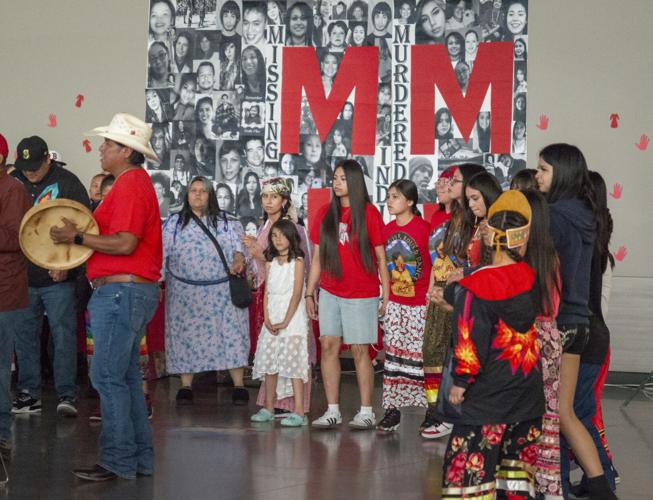
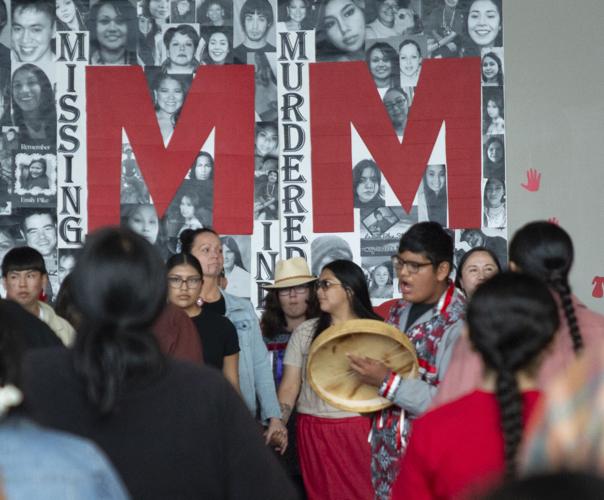
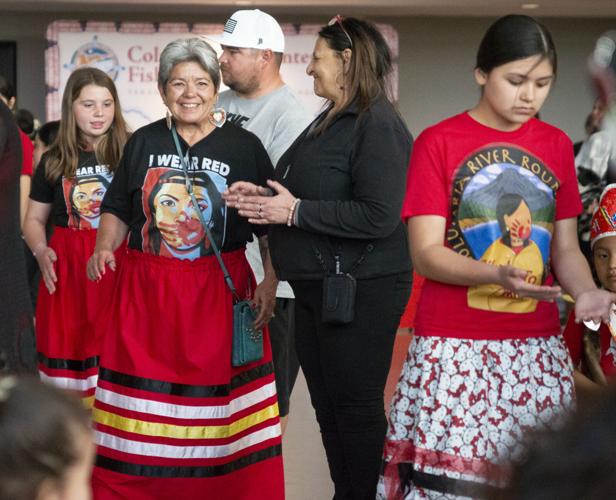
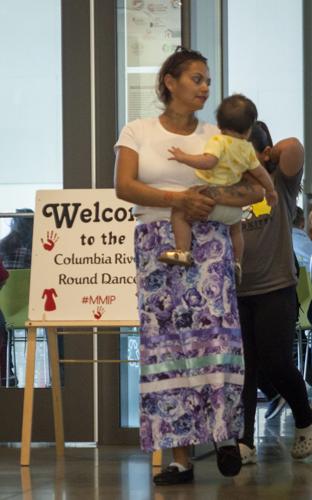
In a crowd of red shirts, worn in support of Missing and Murdered Indigenous People (MMIP), Laura and little Mason McConville watch the Columbia River Round Dance at Fort Dalles Readiness Center May 2. Behind them, a wall of photos shows the faces of relatives of the missing and murdered. An estimated several hundred attended.
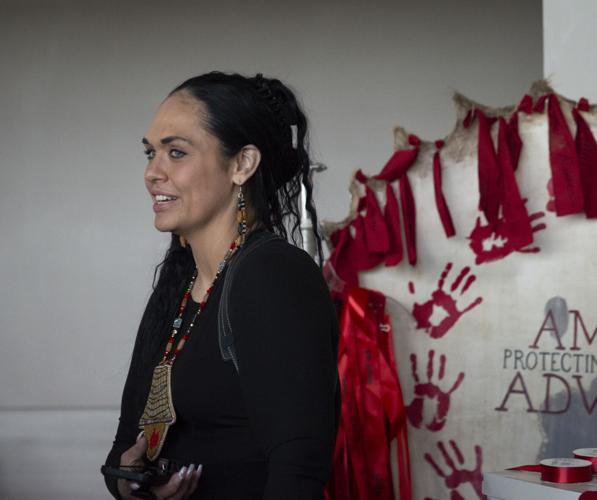
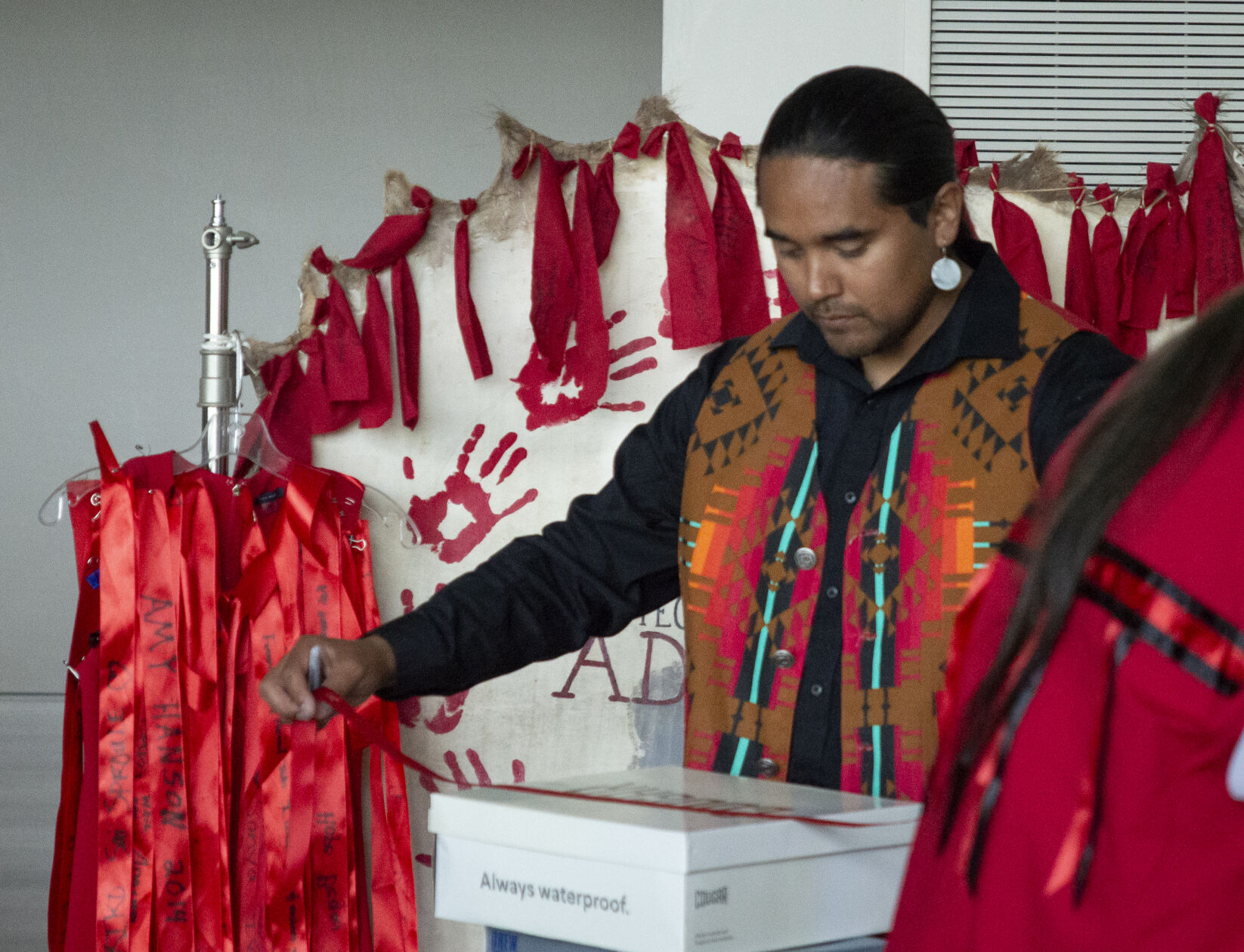
Amanda Freeman stands near a memorial. Created by Freedman, the memorial is covered in the names of missing and murdered Indigenous people written on scarlet ribbons.
In a crowd of red shirts, worn in support of Missing and Murdered Indigenous People (MMIP), Laura and little Mason McConville watch the Columbia River Round Dance at Fort Dalles Readiness Center May 2. Behind them, a wall of photos shows the faces of relatives of the missing and murdered. An estimated several hundred attended.
Flora Martin Gibson photo
Dancers circle the huge room.
Flora Martin Gibson photo
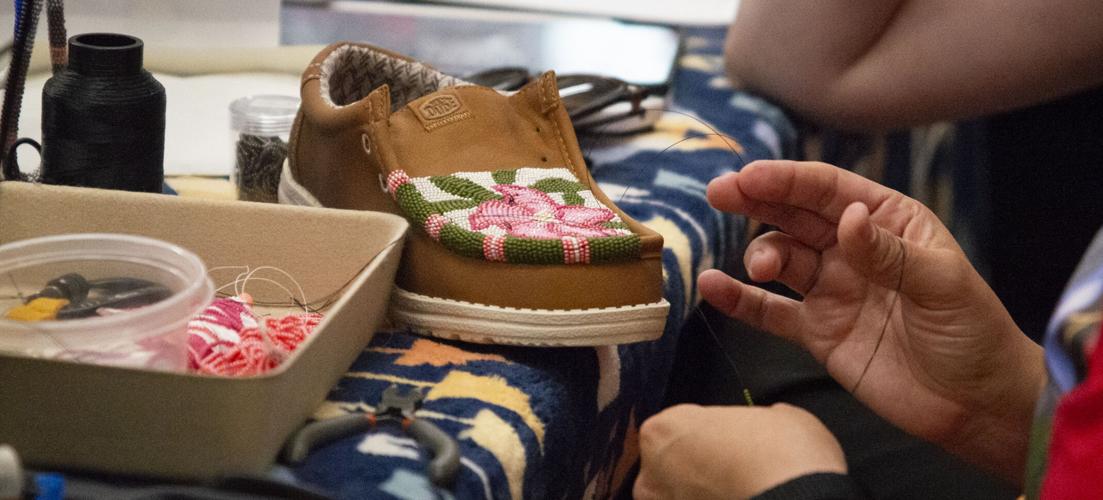
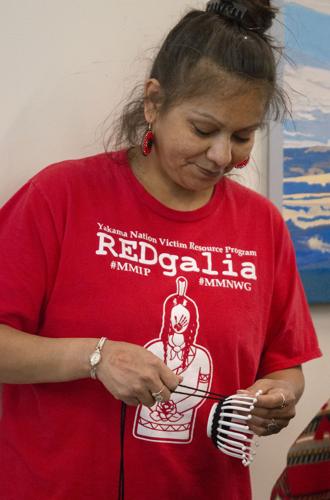
A vendor works on beaded footwear just before the dance commences.
Flora Martin Gibson photo
Amanda Freeman stands near a memorial. Created by Freedman, the memorial is covered in the names of missing and murdered Indigenous people written on scarlet ribbons.
F. Martin Gibson photo
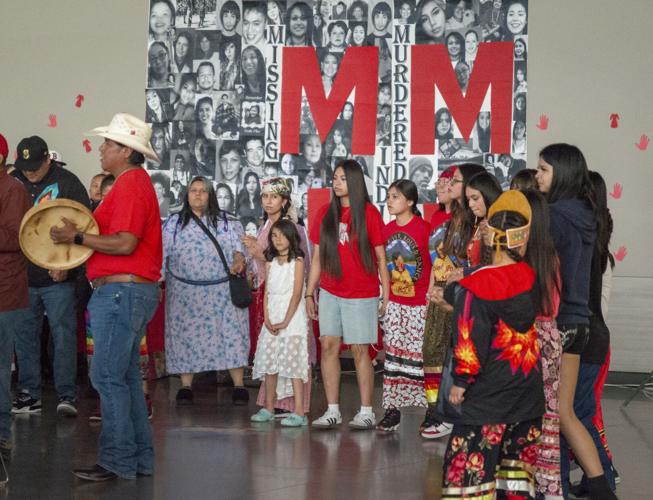
Dancers circle around drummers.
F. Martin Gibson photo
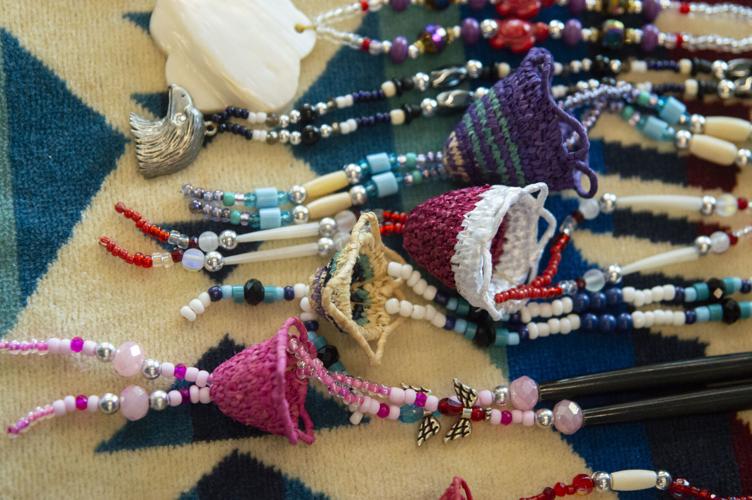
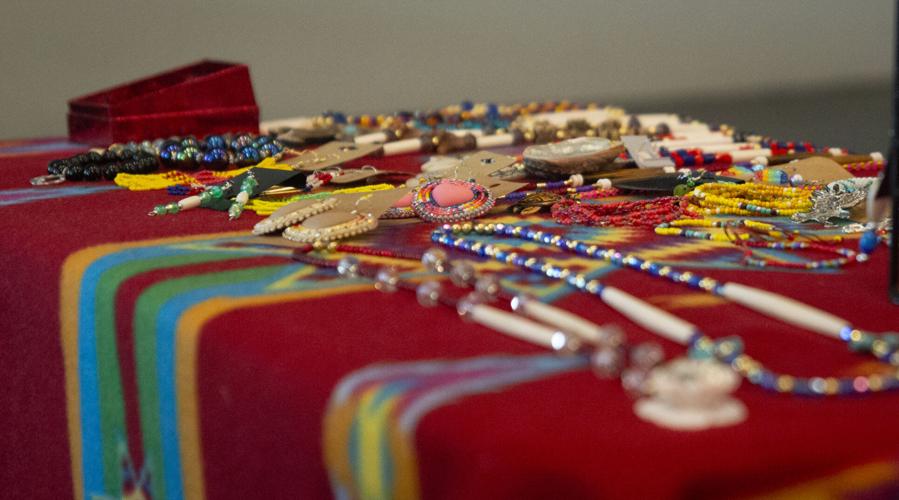
Miniature versions of gathering baskets adorn jewelry in a vendor's stall.
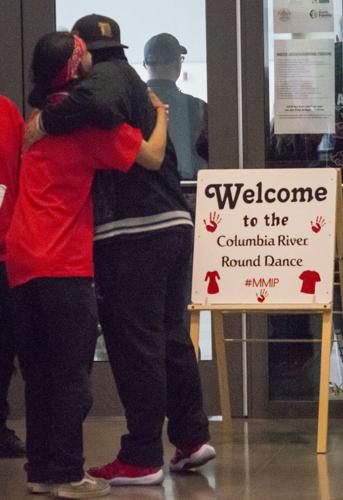
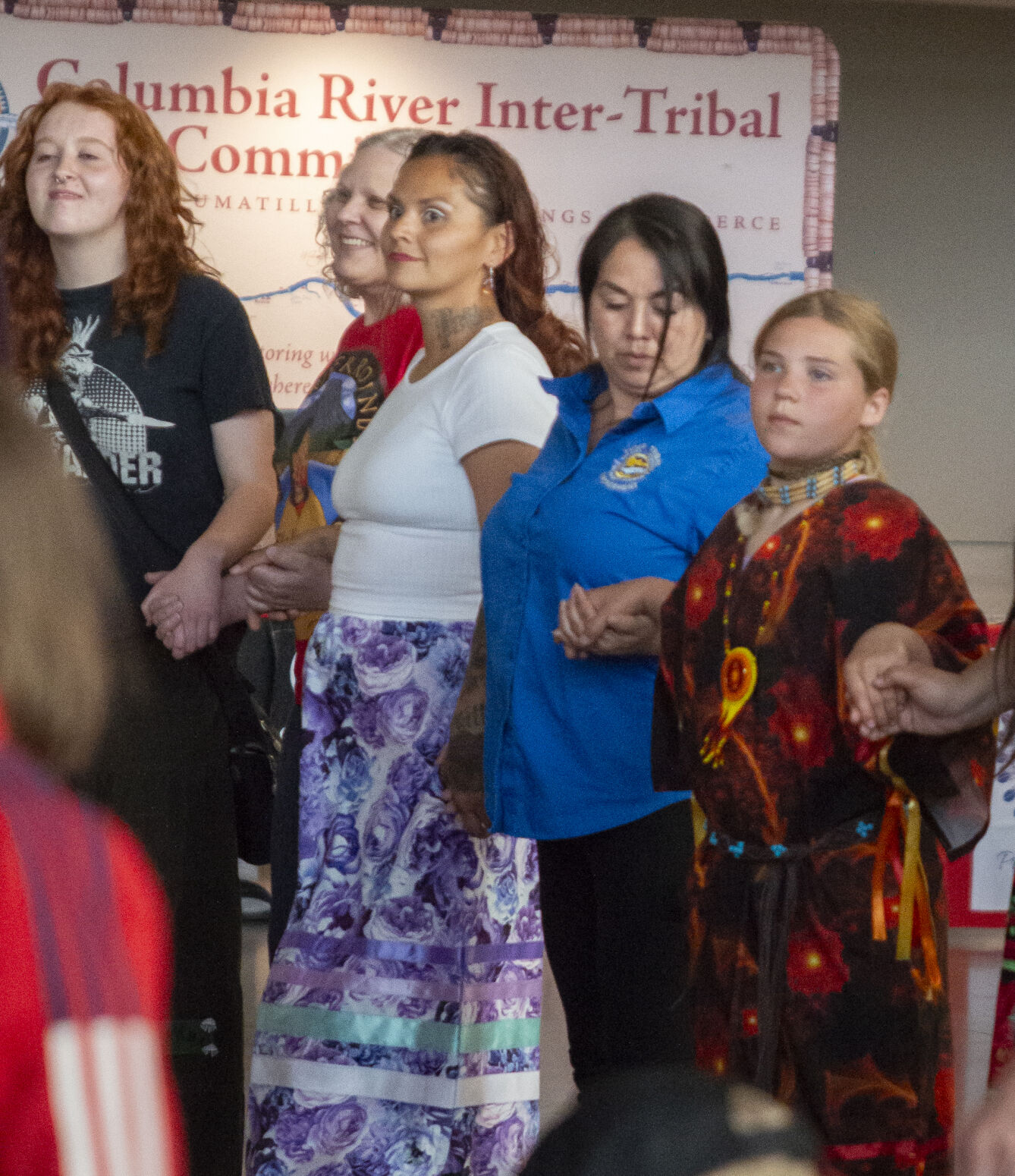
Visitors were welcomed into the dance, and by many artists and vendors.
F. Martin Gibson photo
The crowd breaks up into conversations between each dance.
F. Martin Gibson photo
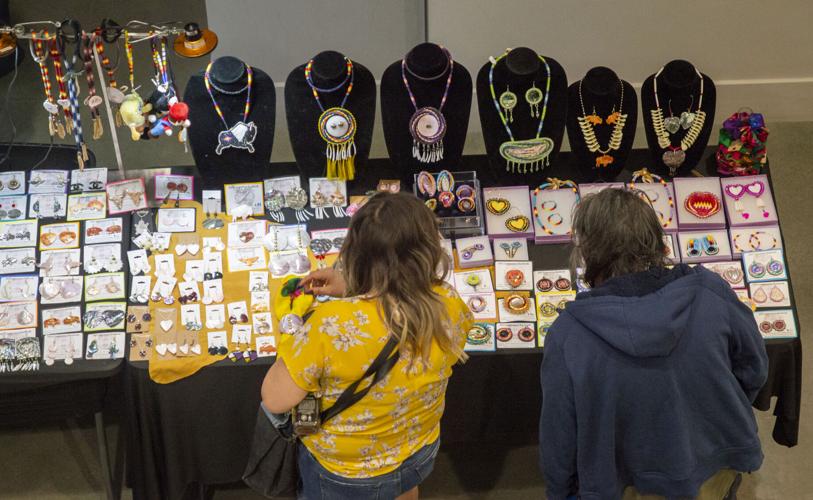
Indigenous vendors filled the hallway with art.
F. Martin Gibson photo
Dancers pass the plaque for an event sponsor, Columbia River Inter-Tribal Fish Commission.
THE DALLES — Around 700 people gathered to celebrate the lives of missing and murdered Indigenous relatives, friends and community on May 2, to create healing and community and raise awareness for a crisis that is far from new.
The third Columbia River Round Dance in honor of Missing and Murdered Indigenous People (MMIP), held in The Dalles on May 2, was the largest yet.
Dancers and drummers in front of a wall of photos showing the relatives of Missing and Murdered Indigenous People.
Flora Martin Gibson photo
“Even though the reason we’re gathering is very emotional and heavy, it’s also a time for us to celebrate and heal with our community. We celebrate the lives of those we’ve lost and pray for the return of those that are still missing. Movement is medicine and when we round dance, we’re calling our loved one’s spirits so that they could be with us to help us heal and move forward from the pain that we’ve been carrying,” Charlieann Herkshan, Victim Assistance Supervisor at Columbia River Inter-Tribal Fish Commission, told Columbia Gorge News. Herkshan is on the round dance organization committee. “The MMIP crisis isn’t something new or recent, but now our people are coming together to speak up and part of the movement is bringing awareness and educating our non-Native relatives so that they can join us in this fight for justice.”
Tommy Thompson adds another ribbon to the memorial, already covered in the names of missing and murdered.
F. Martin Gibson photo
With a community supper provided by tribal member Sarah Dave from Omak, Wash., and special guest speakers from around the U.S., the event built community and raised awareness for the crisis of missing and murdered Indigenous people, and their relatives.
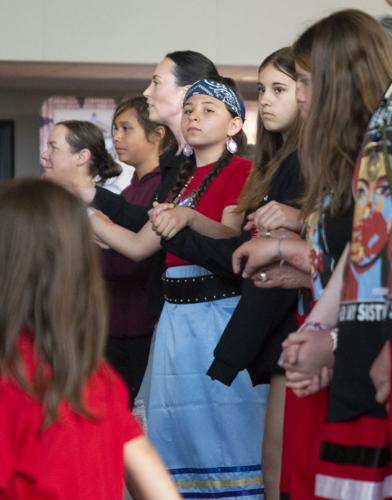
The non-Native community was invited to join a ceremonial round dance, which continued until midnight. Despite the losses many attendees recounted, the mood was one of joy and community for much of the evening.
Many attendees at the dance wore red and black in support of MMIWP.
Flora Martin Gibson photo
Honored were five separate youth councils, 18 lead singers, two backup singers, many vendors, and Ampkwa Advocacy. One Community Health’s Wy-kan-ush-pum van visited to hand out self-care kits with a Behavioral Health Consultant available.
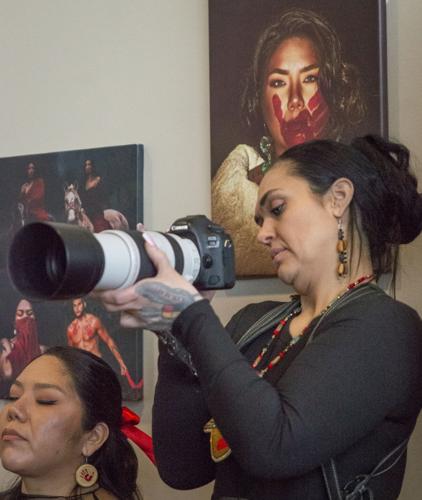
Photographer Star Tennison provided free photography services to the families of missing and murdered Indigenous people — both to create missing persons flyers, and to artistically tell their loved one’s story. Ampkwa Advocacy’s founder, Amanda Freeman, does the same.
Amanda Freeman of Ampkwa Advocacy photographs the speakers at the May 2 Round Dance in honor of Missing and Murdered Indigenous Women and People.
Flora Martin Gibson photo
Ampkwa Advocacy also provides personal safety consulting to Native communities, which many are now asking for, an organizer said.
They have reason: Native women face a murder rate 10 times higher than the national average. Four out of five will experience violence in her lifetime. The suspects in those crimes are 96% white, and many go unprosecuted or univestigated due to jurisdictional challenges and systemic neglect, according to Ampkwa Advocacy’s statistics. Murder is the third leading cause of death for Indigenous youth.
Drummers and dancers circle past a wall of photos showing the relatives of the missing and murdered.
F. Martin Gibson photo
Ampkwa Advocacy brought a memorial, in the form of a hide with dozens of red tags dangling around the edges, each bearing the names of missing and murdered loved ones from all over the Northwest. Attendees were invited to add their own lost or missing loved one’s names to the memorial on more ribbons.
“Whatever side of this Northwest that we’re coming from, please remember to honor your loved ones in a good way. Celebrate the life that they’ve lived here. Please don’t let the story of what took them ever overshadow the life that they lived here,” said Dawn LeMieux, a tribal member from the Midwest (HoChunk and Sokaogon Chippewa), who has been on the round dance committee since its beginning. She attended as a community member and also heads the Native Support Team at Next Door, Inc.
LeMieux shared the story of a relative who disappeared here in 1999, whose case has only recently been moved from “missing” to “murdered.”
“I was young when he disappeared, but I remember him as a lovely individual,” she remembered, telling his life story.
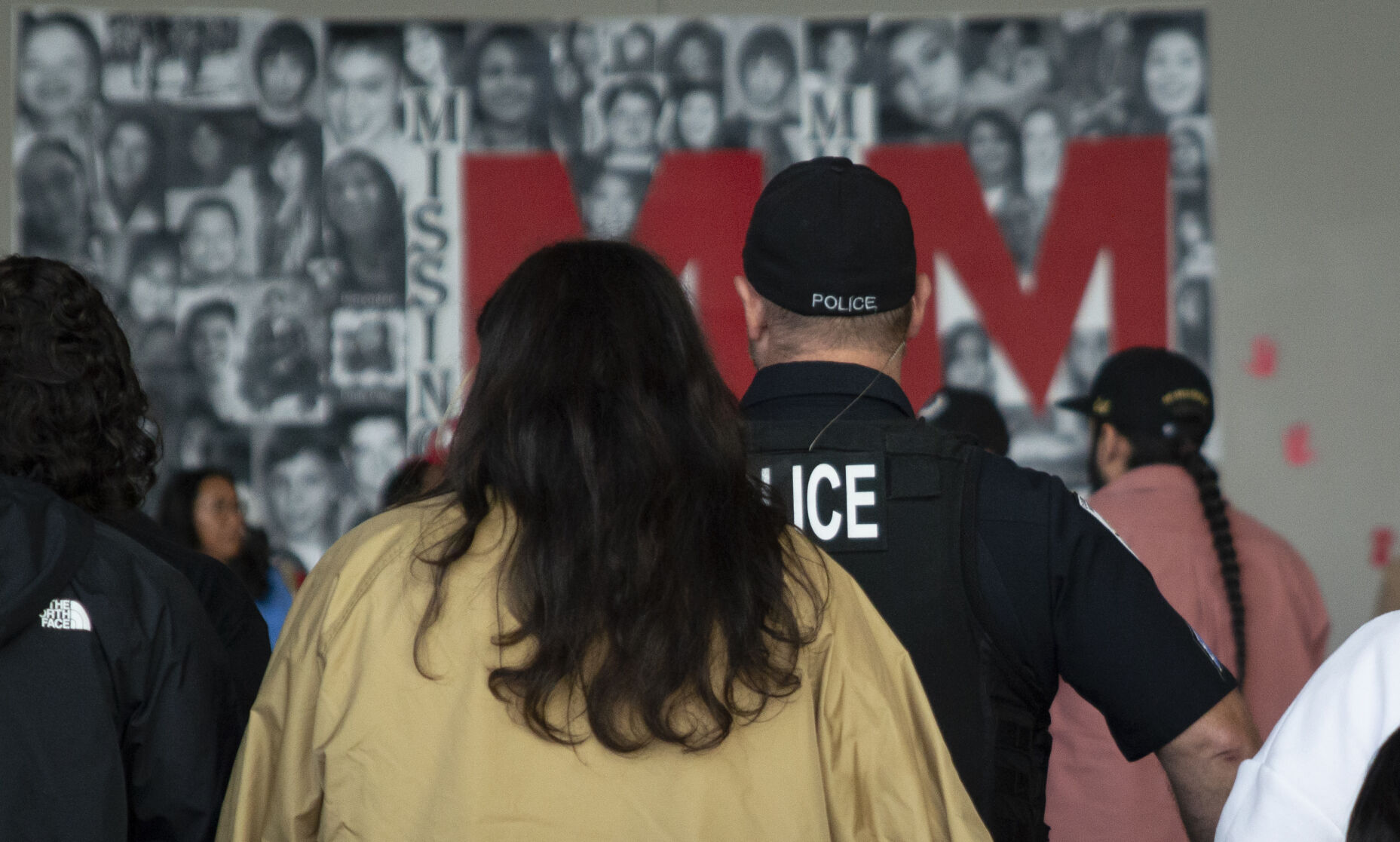
Police provided security, and also joined the round dance.
F. Martin Gibson photo
“I’m going to ask all of you to help all of these families. And it’s really easy to do. If you see flyers, please share them. If you know a family member that’s missing someone, or someone who’s murdered reach out and let them know that you care about them and you’re thinking about them and you wish them well,” said Darlene Gomez, a tribal member from New Mexico and the only U.S. Attorney who takes pro-bono cases for MMIP, at the event.
“If any of you are leaders — tribal leaders, state leaders, stand up and fight for your people. Hold the FBI accountable, because they are responsible for major crimes in Indian country.
“...Can you imagine what that would feel like, that your baby or your child is ripped away and nobody looks for her? You trust your tribe to take care of your children. You trust state agencies to have oversight,” Gomez asked the crowd. Often such trust is unfulfilled.
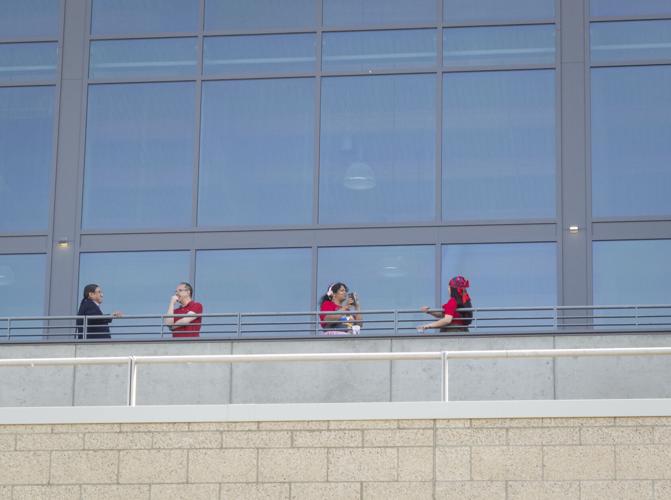
Dancers gather on the balcony in view of the mountain and river.
Flora Martin Gibson photo
A problematic patchwork of jurisdiction on tribal lands means lots of cases involving missing and murdered Indigenous people go unreported, un-investigated, or un-prosecuted.
Tribal, state, or federal law enforcement may have jurisdiction depending on where a crime was committed, and whether the victim or suspect is a tribal citizen. A Supreme Court case in 1973 set the precedent that Native courts cannot prosecute non-Native people for crimes committed on tribal land.
Even in cities, many such cases are not investigated because of similar challenges and plain neglect, according to Ampkwa Advocacy.
On reservations, major crimes go to the FBI. But The U.S. Attorney’s Office declines about 67% of cases involving sexual abuse or violent crimes occurring on tribal lands.
“Advocates for Indigenous people say that poor data collection due in part to racial misclassification has made it impossible to determine the true number of missing and murdered Native American individuals. Although there have been stated efforts to improve data collection at the federal level, there’s been little improvement on the ground,” according to InvestigateWest’s report by Melanie Henshaw.
Jasmine McCormack and child enter the dance.
Speakers encouraged the crowd to support a new bill introduced this session by Representative Tawna Sanchez (D-Portland) which would establish victim outreach, education and violence prevention services for the families of missing and murdered Indigenous people.
If House Bill 3198 passes, Oregon Health Authority will be required to make a dataset of missing and murdered Indigenous people, and partner with tribal governments, Native-led organizations, communities and state, local, tribal and federal law enforcement to help them and their families.
Six years ago, another law was passed that required a report on the subject of missing and murdered Indigenous people. InvestigateWest found that report’s recommendations resulted in very limited progress, and didn’t help Indigenous families with missing or murdered members.
Estimated cost of House Bill 3198 would be $500,000. It’s supported by tribal organizations and by Multnomah County, and Portland’s Office of Government Relations.
And Gomez had some words for the Native communities around her: Be very careful of your children. Keep a list of all your passwords, from bank accounts to social media. Find someone you trust, and give them the list and power of attorney — so if you go missing, in the first few vital hours, that person can take the power of attorney to police, who can start looking through records to find you.
And if you go missing that trusted person must demand a police report, get updates, and keep records of every conversation with law enforcement, witnesses, etc. “You have to be your own investigator,” Gomez said.
A basket takes shape in a lull between conversations.
F. Martin Gibson photo
In 2024, more than 550 people attended second Columbia River Round Dance in honor of MMIP, and it continues to grow.
There will be another dance next year. Community members are welcome to attend and, after listening to the practices and protocols, join the dancing.
“We’re done participating in the ‘moment of silence’ during candlelight vigils and instead will fill that silence with the sound of the drums and the singing of our men and women who share their medicine with our community,” said Herkshan.






Commented