
For more than 100 years, Sherman County had a newspaper.
And the Sherman County Historical Museum is making sure people don’t forget it.
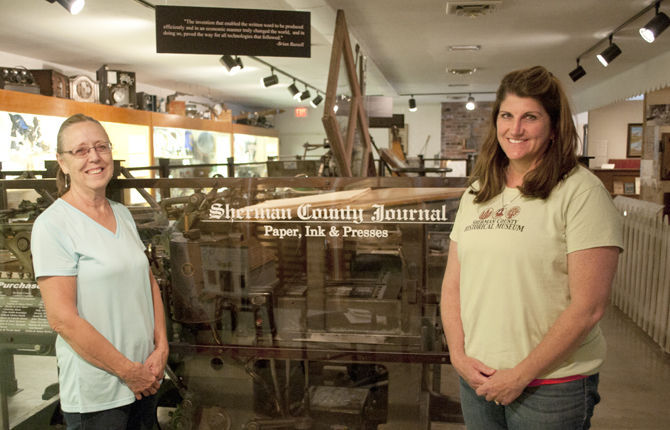
Inside the museum is a Sherman County Journal: Paper, Ink and Presses exhibit with as many items from the old paper, which printed its last issue on Sept. 14, 1989, that will fit in a 32 x 11-foot display.
One of the largest items is a linotype machine, which once revolutionized typesetting and was the industry standard for newspapers until the 1970s when it was replaced by newer technology.
The machine, which Thomas Edison called the “Eighth Wonder of the World,” prints an entire line of type at once and features a 90-character keyboard. With the linotype, newspapers like the Sherman County Journal were able to print many more pages in each edition.
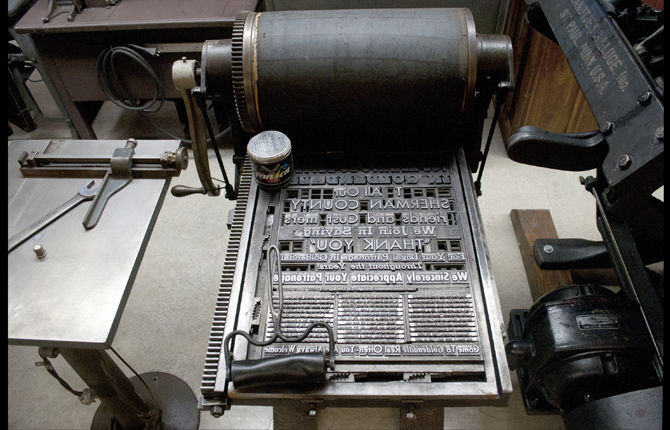
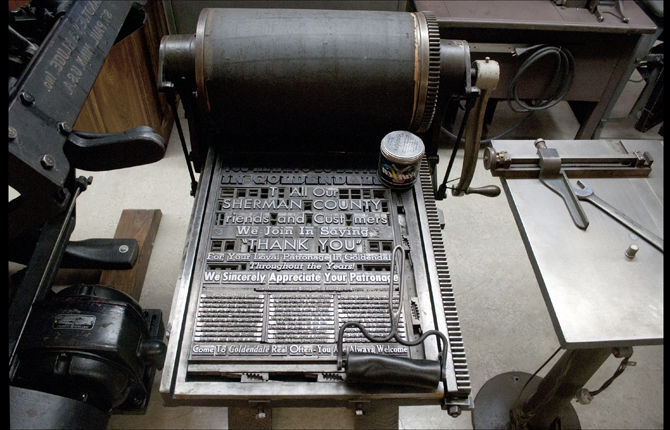
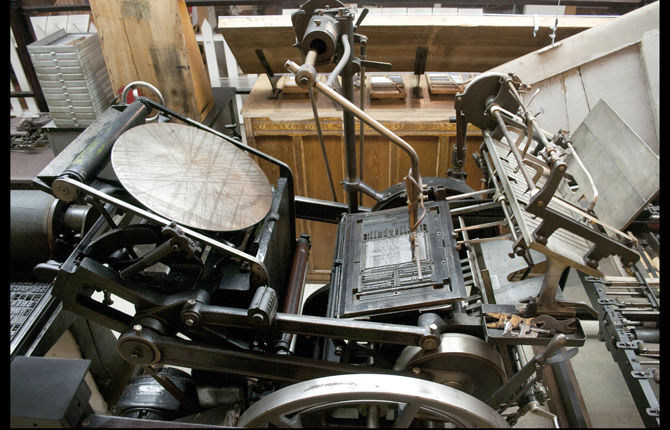
Another large item in the exhibit is the Miehle Flatbed Letterpress, which uses a series of rollers to ink type. According to information in the exhibit, the Miehle Flatbed fell victim to photo offset printing methods and the computer.
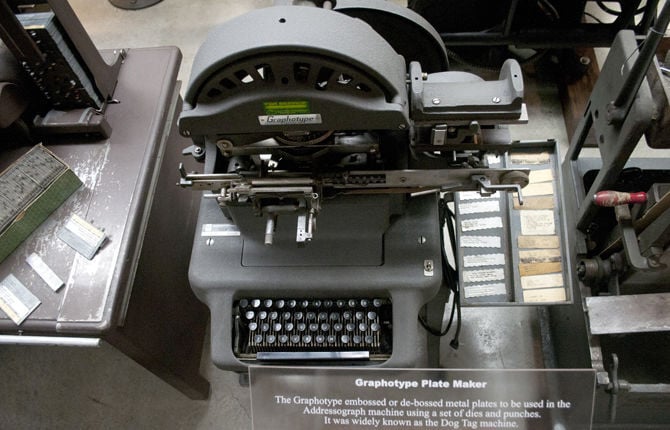
Many other machines the Journal used to put out the paper each week are also included, like a Kluge job press, Brown paper folding machine and addressograph.
While the core of everything the museum purchased from the heirs of the last owner of the Sherman County Journal, Daniel Bartlett, Jr., is on display, even a front door and printer’s visor, a few items like the office desks as well as the belts and motors that run the machines are still in storage containers.
“I wish we had more space for it,” Sherman County Historical Museum director Patti Fields said of the Journal exhibit. “Having its own space would be so ideal. It would be quite spectacular if you could spread it out more.
“We don’t have enough property for an entire building but that is something we will look into. That’s quite an expense and it would be another building to maintain.
“There’s a lot of responsibility that goes along with adding a larger foot print to the museum. It’s a big step but it would definitely put it in all its glory.”
Fields would also like to find space for the beloved exhibits the Journal replaced, like past sheriffs of Sherman County. That and three other exhibits are now in storage.
The historical society didn’t purchase the actual Journal building and lot below the Moro post office, facing First Street, because it didn’t have the capacity or the volunteers to operate, maintain and sustain two sites. However, the Journal was torn down board by board so if the museum can get the property and maintain another building, it would be able to replicate the old newspaper structure.
Fields grew up in Sherman County and has fond memories of the Journal.
“They were really good at covering local events and it was always very exciting to see your name in the paper in local things that you participated it,” Fields said.
Now, Fields enjoys seeing people come to the museum and share their own memories of the Journal.
“I love to hear the different community people that have grown up in Sherman County, come to the museum, see this and talk about looking through the doors and watching them make the paper week in and week out,” Fields said. “Everyone knew where the paper was. A lot of people have a story that they had either worked there for a short time or had some kind of experience watching them make the paper. The Sherman County Journal was a staple for our community.”
The paper was so important that in 2008 the museum decided to purchase the Journal for $55,000. The equipment, machinery and furnishings were paid off over the next three years and in August of 2011, volunteers began measuring each artifact to figure out what would fit in the space as well as researching and cleaning each item.
Patti Fields’ mother-in-law Nancy Fields was one of those volunteers.
“It was oily and greasy just like any old machine would be and had ink on it,” Nancy said. “We called people in Portland that have presses to get their advice on what to use to clean it with and they suggested kroil, which is like a WD-40 but it doesn’t have as many chemicals. We had to be very careful with what we used, a lot of air and the kroil and very fine cloths because we couldn’t scratch anything. It was a tedious process.”
More than 15 donors and around 40 volunteers made the Journal exhibit possible. Mac Stinchfield, owner, editor and publisher of the Times-Journal in Condon, helped select artifacts.
Graphic designer Cameron Kaseberg, carpenters Mike Doolin and Jack Thompson and C.C. Stern Type Foundry staff also lent their expertise.
“There were volunteers in the museum who wanted to see this be successful and put in a lot of hours,” Patti said.
The history of Sherman County newspapers goes back to 1888 with the Observer in Wasco. The Grass Valley Journal was launched in 1897 and sold to Giles L. French for $100 in 1929. French then purchased the Observer, which had since moved to Moro, in 1931 and the Wasco News in 1932.
Due to the Great Depression, he combined all three papers to form the Sherman County Journal.
“It’s covered Sherman County for a lot of years, from weddings to funerals to school events to news, I think it’s been a big part of Sherman County so having it here has been wonderful,” Patti said.
The Sherman County Historical Museum, which has 16,000 square feet and over 15,000 artifacts used in Native American families, Oregon Trail migration, wheat farming and military units, is open daily from 10 a.m. to 5 p.m. through October. Admission is $5 for adults and $1 for students.


Commented